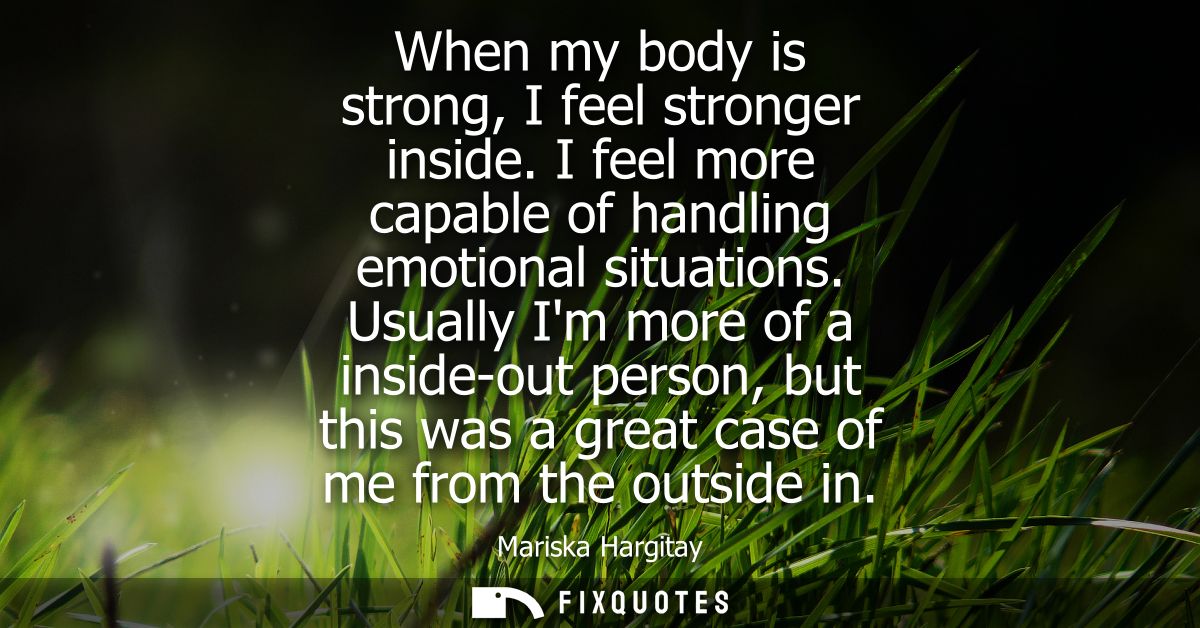
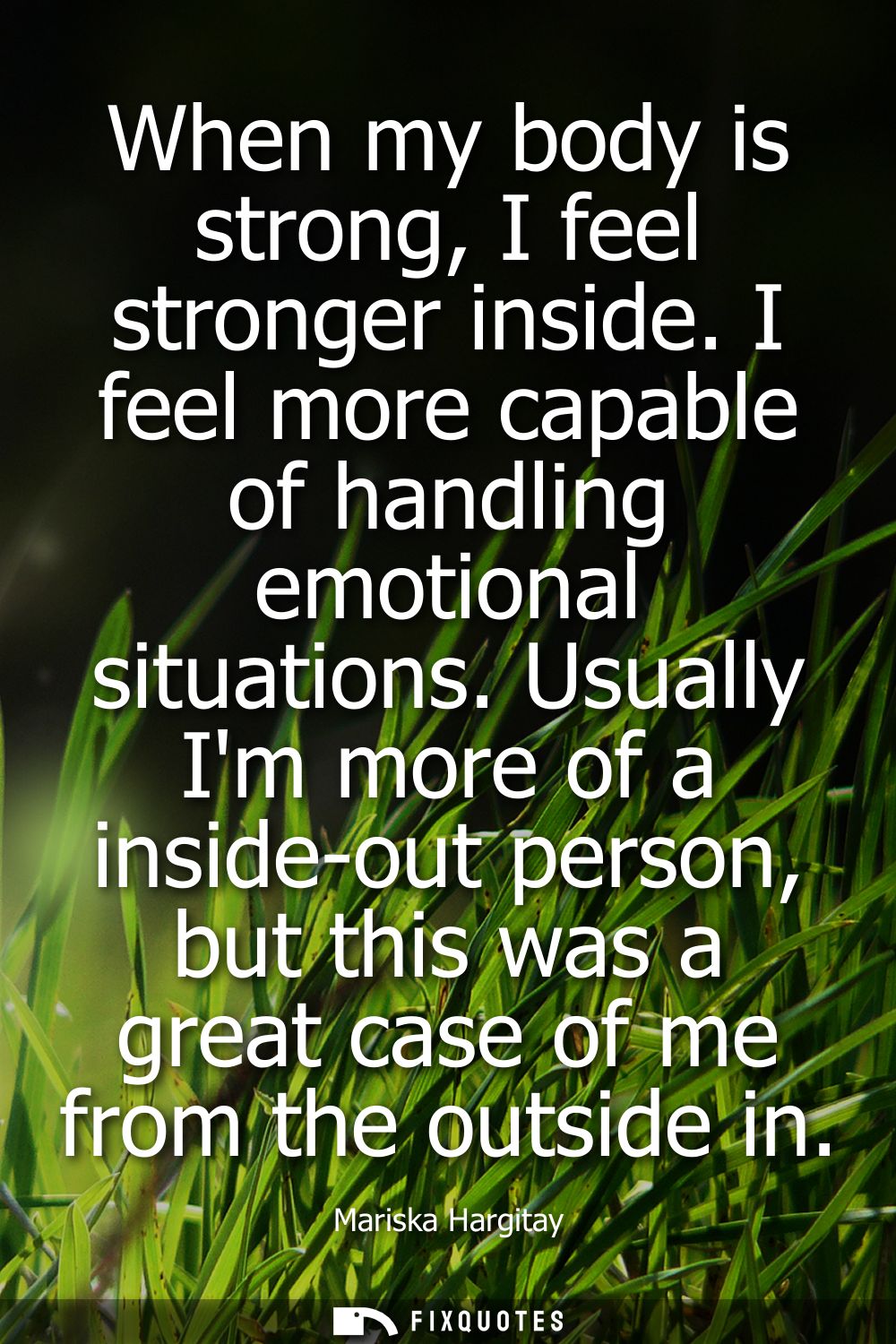
"When my body is strong, I feel stronger inside. I feel more capable of handling emotional situations. Usually I'm more of a inside-out person, but this was a great case of me from the outside in"
About this Quote
The line that matters is the pivot: “Usually I’m more of a inside-out person.” That’s a declaration of values. She’s aligning herself with the contemporary preference for authenticity, therapy-language, and inner work, then admits the limits of that framework. Sometimes you don’t think your way into steadiness; you move, lift, sleep, eat, train your nervous system, and the mind follows. “Outside in” becomes a permission slip for pragmatism.
There’s also a subtle gendered subtext. Women are routinely told their bodies are projects for other people’s viewing, while their emotional labor is treated as infinite. Hargitay flips that script: building physical power is portrayed as self-protection, not self-display. The body isn’t an ornament; it’s infrastructure.
Culturally, this lands in a moment when “wellness” is both a billion-dollar industry and a backlash target. Her phrasing threads the needle: not biohacking bravado, not moralizing self-care, just a plainspoken observation that agency can start anywhere, even in the muscles.
Quote Details
| Topic | Fitness |
|---|---|
| Source | Help us find the source |
| Cite |
Citation Formats
APA Style (7th ed.)
Hargitay, Mariska. (2026, January 15). When my body is strong, I feel stronger inside. I feel more capable of handling emotional situations. Usually I'm more of a inside-out person, but this was a great case of me from the outside in. FixQuotes. https://fixquotes.com/quotes/when-my-body-is-strong-i-feel-stronger-inside-i-165429/
Chicago Style
Hargitay, Mariska. "When my body is strong, I feel stronger inside. I feel more capable of handling emotional situations. Usually I'm more of a inside-out person, but this was a great case of me from the outside in." FixQuotes. January 15, 2026. https://fixquotes.com/quotes/when-my-body-is-strong-i-feel-stronger-inside-i-165429/.
MLA Style (9th ed.)
"When my body is strong, I feel stronger inside. I feel more capable of handling emotional situations. Usually I'm more of a inside-out person, but this was a great case of me from the outside in." FixQuotes, 15 Jan. 2026, https://fixquotes.com/quotes/when-my-body-is-strong-i-feel-stronger-inside-i-165429/. Accessed 30 Mar. 2026.