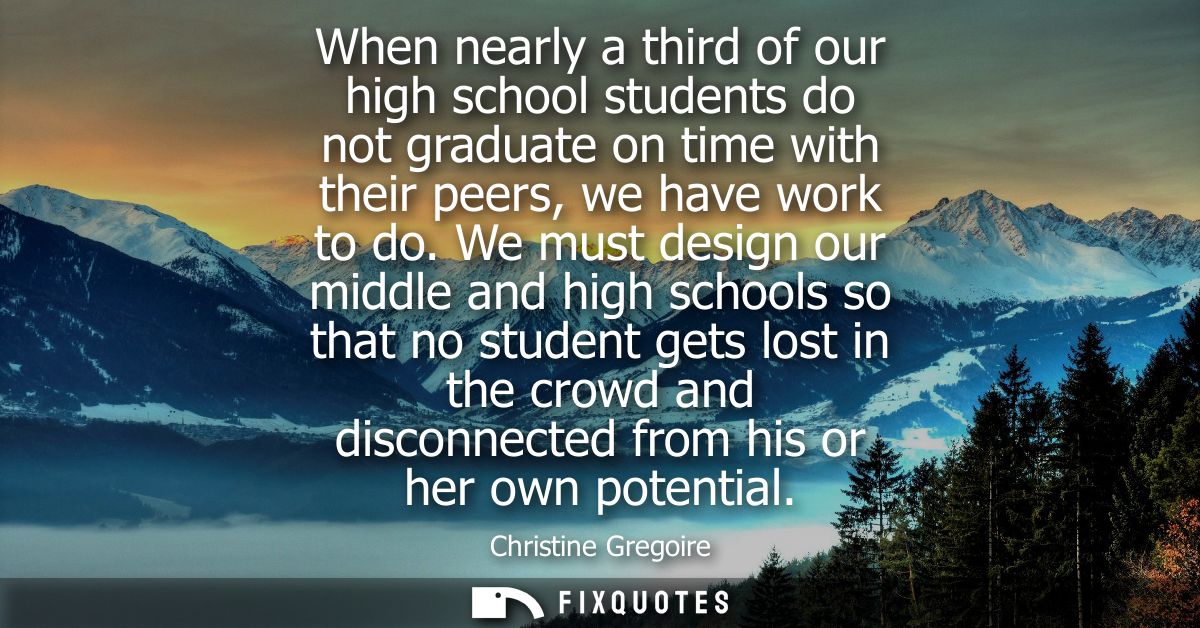
"When nearly a third of our high school students do not graduate on time with their peers, we have work to do. We must design our middle and high schools so that no student gets lost in the crowd and disconnected from his or her own potential"
About this Quote
The line opens with a sober statistic, then pivots fast into a moral diagnosis: a system where a third of students fall off schedule is not a series of individual failures, it is institutional negligence. Gregoire’s phrasing keeps the blame abstract enough to be politically usable - "we have work to do" is an invitation and an indictment - while still landing as a clear referendum on the status quo.
The subtext is about design, not discipline. By insisting schools must be built so "no student gets lost in the crowd", she smuggles in a critique of large, impersonal campuses, tracking systems, and bureaucratic routines that treat teenagers as throughput. "Disconnected from his or her own potential" is classic political uplift, but it functions strategically: it reframes dropout risk as alienation. The enemy isn’t laziness; it’s invisibility. That’s a powerful move in education debates, because it positions reform as belonging and mentorship rather than punishment and test prep.
Context matters: as a governor in an era of accountability metrics and graduation-rate scrutiny, Gregoire is speaking the language of outcomes ("on time") while reaching for something more human than a spreadsheet. "On time with their peers" highlights the social cost of falling behind - stigma, isolation, the quiet message that you’re not part of the main story. The quote’s intent is to build consensus for structural interventions (smaller learning communities, better counseling, early warning systems) without sounding technocratic. It’s policy talk that tries to feel like care.
The subtext is about design, not discipline. By insisting schools must be built so "no student gets lost in the crowd", she smuggles in a critique of large, impersonal campuses, tracking systems, and bureaucratic routines that treat teenagers as throughput. "Disconnected from his or her own potential" is classic political uplift, but it functions strategically: it reframes dropout risk as alienation. The enemy isn’t laziness; it’s invisibility. That’s a powerful move in education debates, because it positions reform as belonging and mentorship rather than punishment and test prep.
Context matters: as a governor in an era of accountability metrics and graduation-rate scrutiny, Gregoire is speaking the language of outcomes ("on time") while reaching for something more human than a spreadsheet. "On time with their peers" highlights the social cost of falling behind - stigma, isolation, the quiet message that you’re not part of the main story. The quote’s intent is to build consensus for structural interventions (smaller learning communities, better counseling, early warning systems) without sounding technocratic. It’s policy talk that tries to feel like care.
Quote Details
| Topic | Student |
|---|
More Quotes by Christine
Add to List