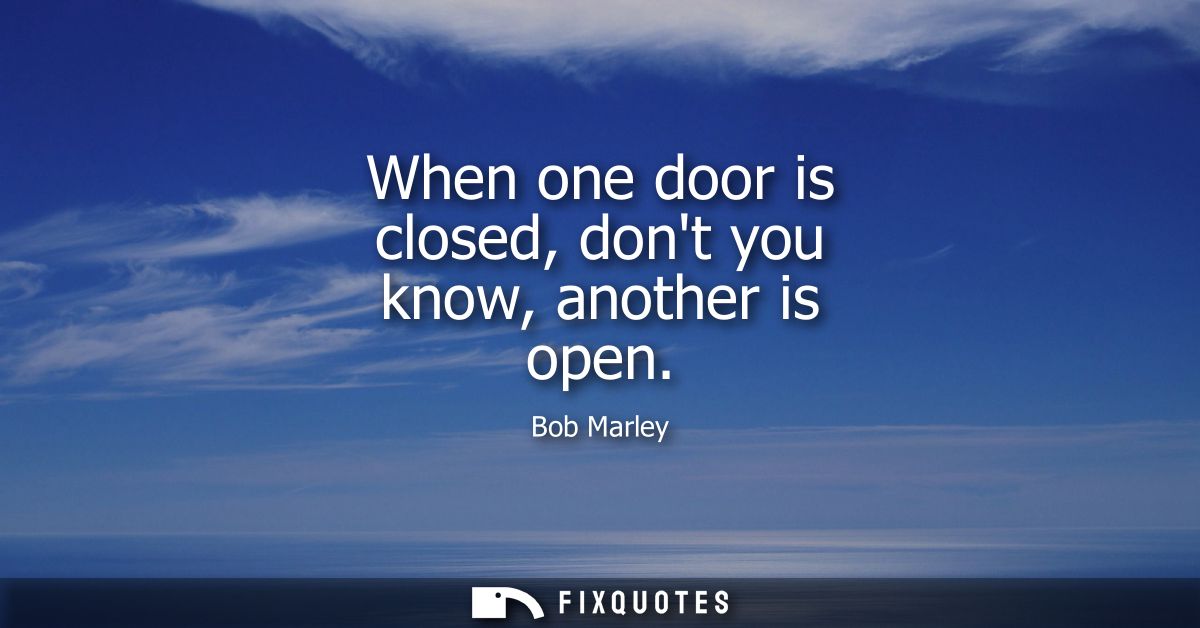
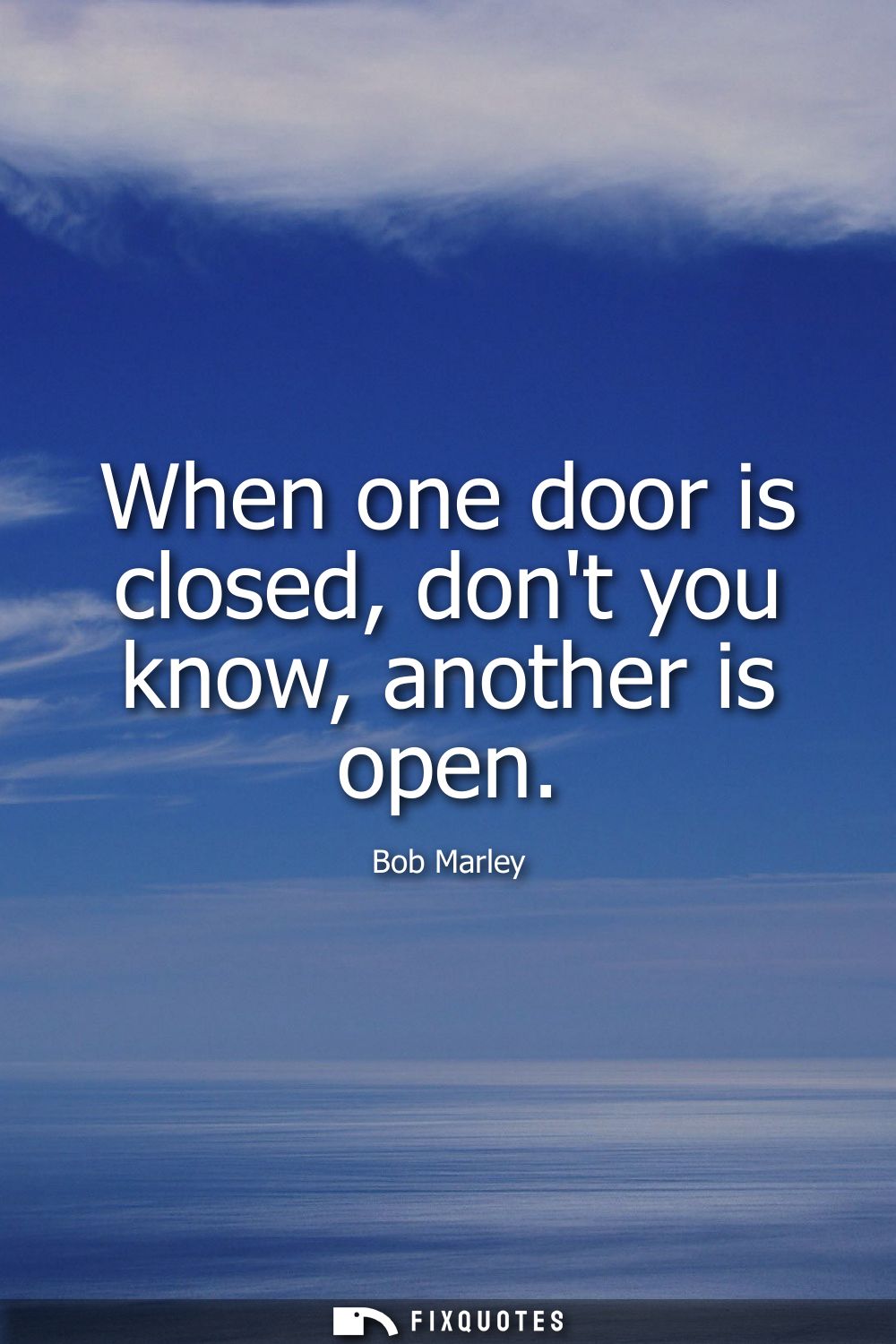
"When one door is closed, don't you know, another is open"
About this Quote
Optimism, in Bob Marley’s hands, isn’t a scented candle slogan; it’s survival strategy. “When one door is closed, don’t you know, another is open” lands like everyday talk, almost teasing in its phrasing, because Marley isn’t preaching from on high. The tag “don’t you know” turns the line into a gentle shove: you already understand this, you’ve lived it, so act like it. That small rhetorical move matters. It shifts hope from a wish into a kind of street-level knowledge shared among people who’ve had to improvise their way through disappointment.
The intent is restorative, but not naive. Doors don’t close in Marley’s world because the universe is doing spring cleaning; they close because systems, poverty, and politics slam them shut. Reggae, especially in Marley’s era, is full of that dual charge: naming the pressure without letting it define the future. The “another is open” isn’t magic, it’s agency - the possibility of a new path if you keep moving, keep looking, keep believing you’re entitled to one.
Context sharpens the subtext. Marley came up in postcolonial Jamaica amid economic strain and political violence, then became a global voice for the dispossessed. Read there, the line becomes communal counsel: resilience as a shared practice, not a private mood. It works because it compresses hardship and forward motion into one breath, making hope sound less like escapism and more like a beat you can actually live to.
The intent is restorative, but not naive. Doors don’t close in Marley’s world because the universe is doing spring cleaning; they close because systems, poverty, and politics slam them shut. Reggae, especially in Marley’s era, is full of that dual charge: naming the pressure without letting it define the future. The “another is open” isn’t magic, it’s agency - the possibility of a new path if you keep moving, keep looking, keep believing you’re entitled to one.
Context sharpens the subtext. Marley came up in postcolonial Jamaica amid economic strain and political violence, then became a global voice for the dispossessed. Read there, the line becomes communal counsel: resilience as a shared practice, not a private mood. It works because it compresses hardship and forward motion into one breath, making hope sound less like escapism and more like a beat you can actually live to.
Quote Details
| Topic | New Beginnings |
|---|---|
| Source | Verified source: Uprising (Bob Marley, 1980)
Evidence: When one door is closed don't you know another is open. This line is from the song “Coming in from the Cold” performed by Bob Marley & The Wailers on the album Uprising (released 1980). The quote is commonly circulated as a standalone Bob Marley saying, but its primary-source origin is as song lyrics. I could not, within available online scans, reliably confirm the exact *first* publication instance (e.g., first pressing lyric inner-sleeve, sheet music, or a dated printed lyric book) with a page number; however, multiple lyric-archiving sources explicitly associate the line with “Coming in from the Cold” on Uprising, and a 1981 magazine article (“Rip It Up”, June 1, 1981) quotes the same lyric lines in print, indicating early contemporaneous publication after the album release. For strict “first published” verification, the best primary artifact would be the 1980 Island Records Uprising LP packaging (inner sleeve/liner with lyrics) from the earliest pressing in your target market. Other candidates (2) BOB MARLEY’S 282 LINES OF TRANCE (Akṣapāda) compilation95.0% ... When one door is closed , don't you know , another is open ? " " To love is to risk , not being loved in return .... Echoing Dream (The Ries Brothers, 2017) primary60.0% Song: "Echoing Dream" by The Ries Brothers |
| Cite |
Citation Formats
APA Style (7th ed.)
Marley, Bob. (2026, March 2). When one door is closed, don't you know, another is open. FixQuotes. https://fixquotes.com/quotes/when-one-door-is-closed-dont-you-know-another-is-5139/
Chicago Style
Marley, Bob. "When one door is closed, don't you know, another is open." FixQuotes. March 2, 2026. https://fixquotes.com/quotes/when-one-door-is-closed-dont-you-know-another-is-5139/.
MLA Style (9th ed.)
"When one door is closed, don't you know, another is open." FixQuotes, 2 Mar. 2026, https://fixquotes.com/quotes/when-one-door-is-closed-dont-you-know-another-is-5139/. Accessed 27 Mar. 2026.
More Quotes by Bob
Add to List