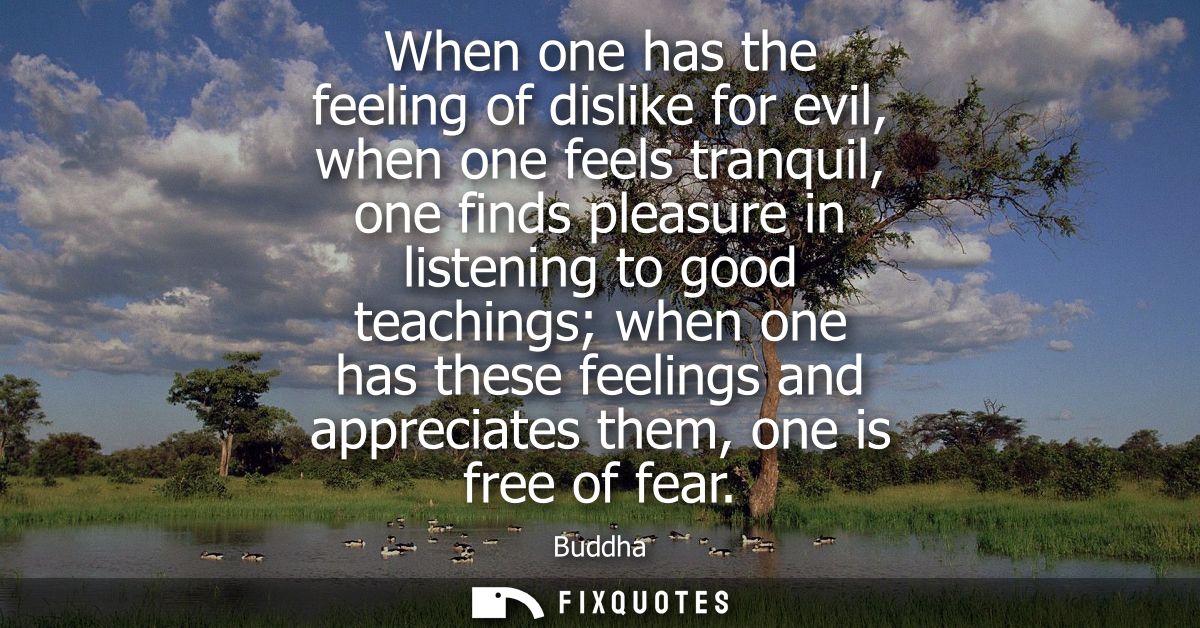
"When one has the feeling of dislike for evil, when one feels tranquil, one finds pleasure in listening to good teachings; when one has these feelings and appreciates them, one is free of fear"
About this Quote
The subtext is quietly political in the broad sense: fear is what keeps people governable by impulse, superstition, and status anxiety. The Buddha’s alternative isn’t a new authority figure; it’s a new kind of self-governance. “Dislike for evil” isn’t moral grandstanding, either. In Buddhist context, “evil” is less about sin and more about actions rooted in greed, hatred, and delusion - the habits that reliably produce suffering. Disliking them is pragmatic: you’re tired of paying the bill.
“Tranquil” functions as both symptom and proof. A tranquil mind has fewer moving parts, fewer excuses, less need to rationalize. That’s why pleasure in “good teachings” shows up next: the Dhamma is framed as something you can actually enjoy once you’re not using your intelligence as a shield.
The payoff - “free of fear” - is not bravado. It’s the consequence of alignment: when your actions don’t secretly incriminate you, and your mind isn’t at war with itself, fear loses its leverage.
Quote Details
| Topic | Wisdom |
|---|---|
| Source | Help us find the source |
| Cite |
Citation Formats
APA Style (7th ed.)
Buddha. (2026, January 17). When one has the feeling of dislike for evil, when one feels tranquil, one finds pleasure in listening to good teachings; when one has these feelings and appreciates them, one is free of fear. FixQuotes. https://fixquotes.com/quotes/when-one-has-the-feeling-of-dislike-for-evil-when-25716/
Chicago Style
Buddha. "When one has the feeling of dislike for evil, when one feels tranquil, one finds pleasure in listening to good teachings; when one has these feelings and appreciates them, one is free of fear." FixQuotes. January 17, 2026. https://fixquotes.com/quotes/when-one-has-the-feeling-of-dislike-for-evil-when-25716/.
MLA Style (9th ed.)
"When one has the feeling of dislike for evil, when one feels tranquil, one finds pleasure in listening to good teachings; when one has these feelings and appreciates them, one is free of fear." FixQuotes, 17 Jan. 2026, https://fixquotes.com/quotes/when-one-has-the-feeling-of-dislike-for-evil-when-25716/. Accessed 31 Mar. 2026.