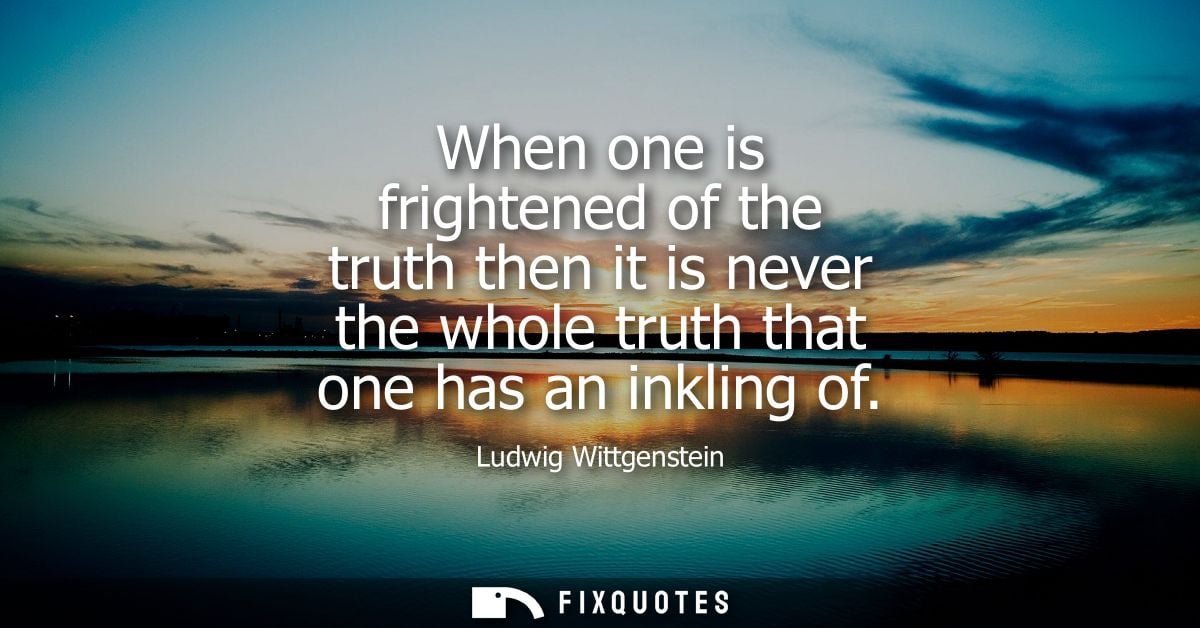
"When one is frightened of the truth, then it is never the whole truth that one has an inkling of"
About this Quote
That’s classic Wittgenstein: not truth as a distant metaphysical object, but truth as something bound up with how we can speak, acknowledge, and live. The phrasing is almost clinical. “Never the whole truth” implies a structural limit: fear isn’t a mood you can bracket off; it shapes what counts as sayable and therefore what can be known. You don’t merely avoid a fact. You avoid the grammar that would let the fact take its full form.
The subtext is moral without sounding like it. He’s describing a failure of honesty that begins earlier than confession - at perception. It also hints at why arguments so often go nowhere: people aren’t disagreeing over the same “truth” because one party is only touching the safe edges of it. In the early 20th-century backdrop of war, ideology, and personal reckoning (Wittgenstein’s own included), this reads like a warning: the most dangerous lies are the ones fear tells before language even arrives to check them.
Quote Details
| Topic | Truth |
|---|---|
| Source | Help us find the source |
| Cite |
Citation Formats
APA Style (7th ed.)
Wittgenstein, Ludwig. (2026, February 19). When one is frightened of the truth, then it is never the whole truth that one has an inkling of. FixQuotes. https://fixquotes.com/quotes/when-one-is-frightened-of-the-truth-then-it-is-41624/
Chicago Style
Wittgenstein, Ludwig. "When one is frightened of the truth, then it is never the whole truth that one has an inkling of." FixQuotes. February 19, 2026. https://fixquotes.com/quotes/when-one-is-frightened-of-the-truth-then-it-is-41624/.
MLA Style (9th ed.)
"When one is frightened of the truth, then it is never the whole truth that one has an inkling of." FixQuotes, 19 Feb. 2026, https://fixquotes.com/quotes/when-one-is-frightened-of-the-truth-then-it-is-41624/. Accessed 7 Apr. 2026.