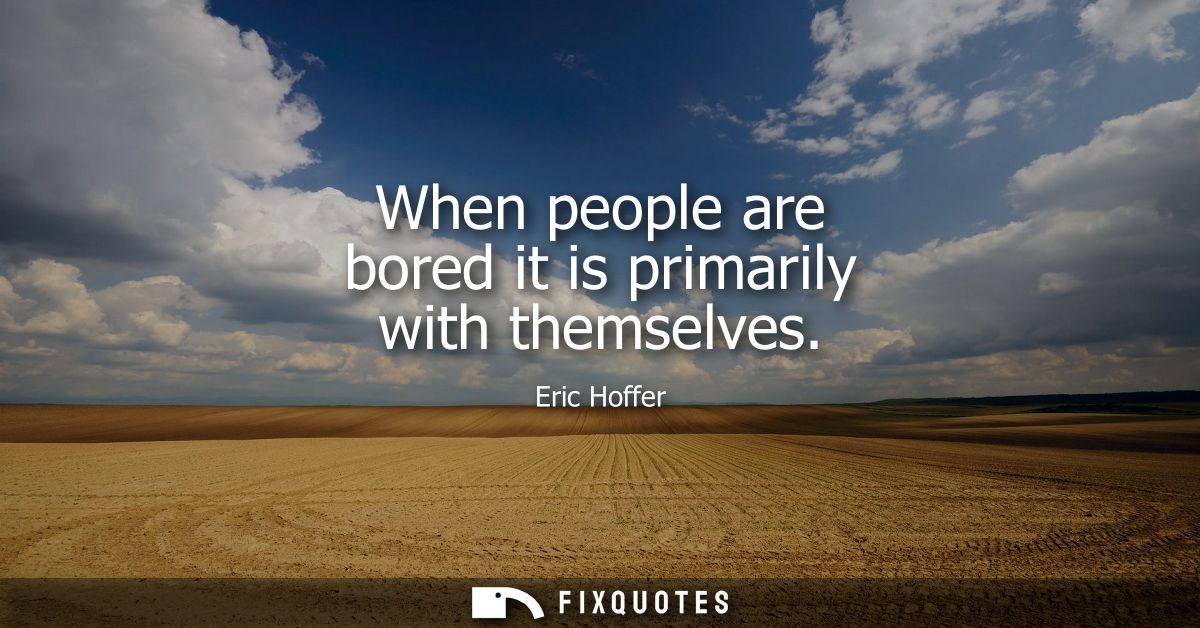
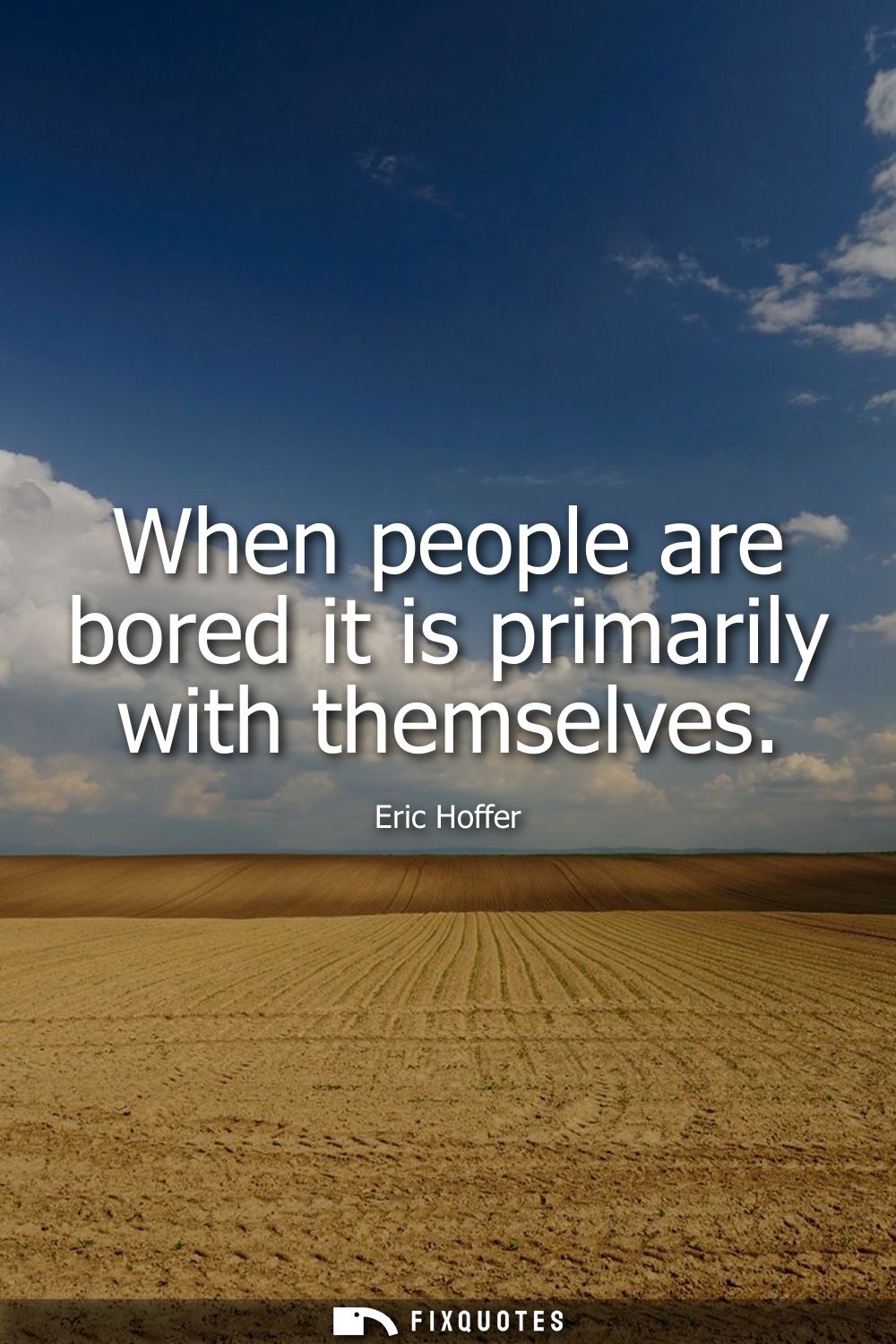
"When people are bored, it is primarily with themselves"
About this Quote
Boredom gets treated like bad weather: an external condition that descends on innocent victims. Hoffer flips the blame inward. If you are bored, he suggests, you are confronting a shortage not of stimuli but of self - thin appetites, untrained attention, an inner life that can’t generate friction without constant novelty. It’s a harsh diagnosis, and that’s why it lands: it punctures the modern habit of outsourcing dissatisfaction to the room, the job, the phone, the era.
Hoffer’s intent is partly moral, partly democratic. As a self-taught longshoreman-philosopher suspicious of mass movements and easy consolations, he’s interested in how emptiness invites manipulation. The bored person becomes hungry for ready-made meaning: ideology, spectacle, grievance, any prefab identity that relieves them of the work of becoming someone. Read that way, boredom isn’t a minor mood; it’s a vulnerability.
The subtext is also an argument for disciplined interiority. A rich self can metabolize silence and repetition; it can turn waiting into observation, routine into craft, solitude into thought. A poor self experiences the same conditions as insult. The line has the clean, corrective snap of an aphorism because it refuses empathy-by-default. It implies agency: if boredom is with yourself, then the remedy isn’t better entertainment but better inhabiting your own mind.
In a culture that monetizes distraction, Hoffer’s sentence feels almost impolite - which is exactly its point. It won’t let you blame the world for failing to amuse you. It asks what you’ve built inside that needs constant noise to feel real.
Hoffer’s intent is partly moral, partly democratic. As a self-taught longshoreman-philosopher suspicious of mass movements and easy consolations, he’s interested in how emptiness invites manipulation. The bored person becomes hungry for ready-made meaning: ideology, spectacle, grievance, any prefab identity that relieves them of the work of becoming someone. Read that way, boredom isn’t a minor mood; it’s a vulnerability.
The subtext is also an argument for disciplined interiority. A rich self can metabolize silence and repetition; it can turn waiting into observation, routine into craft, solitude into thought. A poor self experiences the same conditions as insult. The line has the clean, corrective snap of an aphorism because it refuses empathy-by-default. It implies agency: if boredom is with yourself, then the remedy isn’t better entertainment but better inhabiting your own mind.
In a culture that monetizes distraction, Hoffer’s sentence feels almost impolite - which is exactly its point. It won’t let you blame the world for failing to amuse you. It asks what you’ve built inside that needs constant noise to feel real.
Quote Details
| Topic | Wisdom |
|---|---|
| Source | Help us find the source |
| Cite |
Citation Formats
APA Style (7th ed.)
Hoffer, Eric. (2026, February 20). When people are bored, it is primarily with themselves. FixQuotes. https://fixquotes.com/quotes/when-people-are-bored-it-is-primarily-with-23524/
Chicago Style
Hoffer, Eric. "When people are bored, it is primarily with themselves." FixQuotes. February 20, 2026. https://fixquotes.com/quotes/when-people-are-bored-it-is-primarily-with-23524/.
MLA Style (9th ed.)
"When people are bored, it is primarily with themselves." FixQuotes, 20 Feb. 2026, https://fixquotes.com/quotes/when-people-are-bored-it-is-primarily-with-23524/. Accessed 3 Apr. 2026.
More Quotes by Eric
Add to List