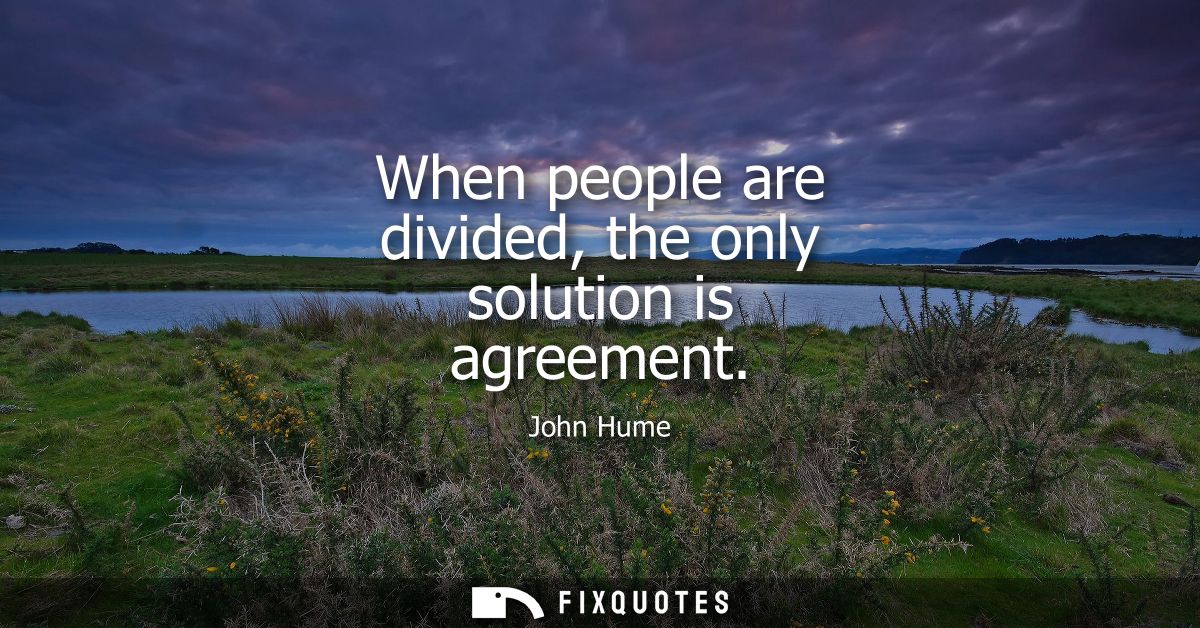
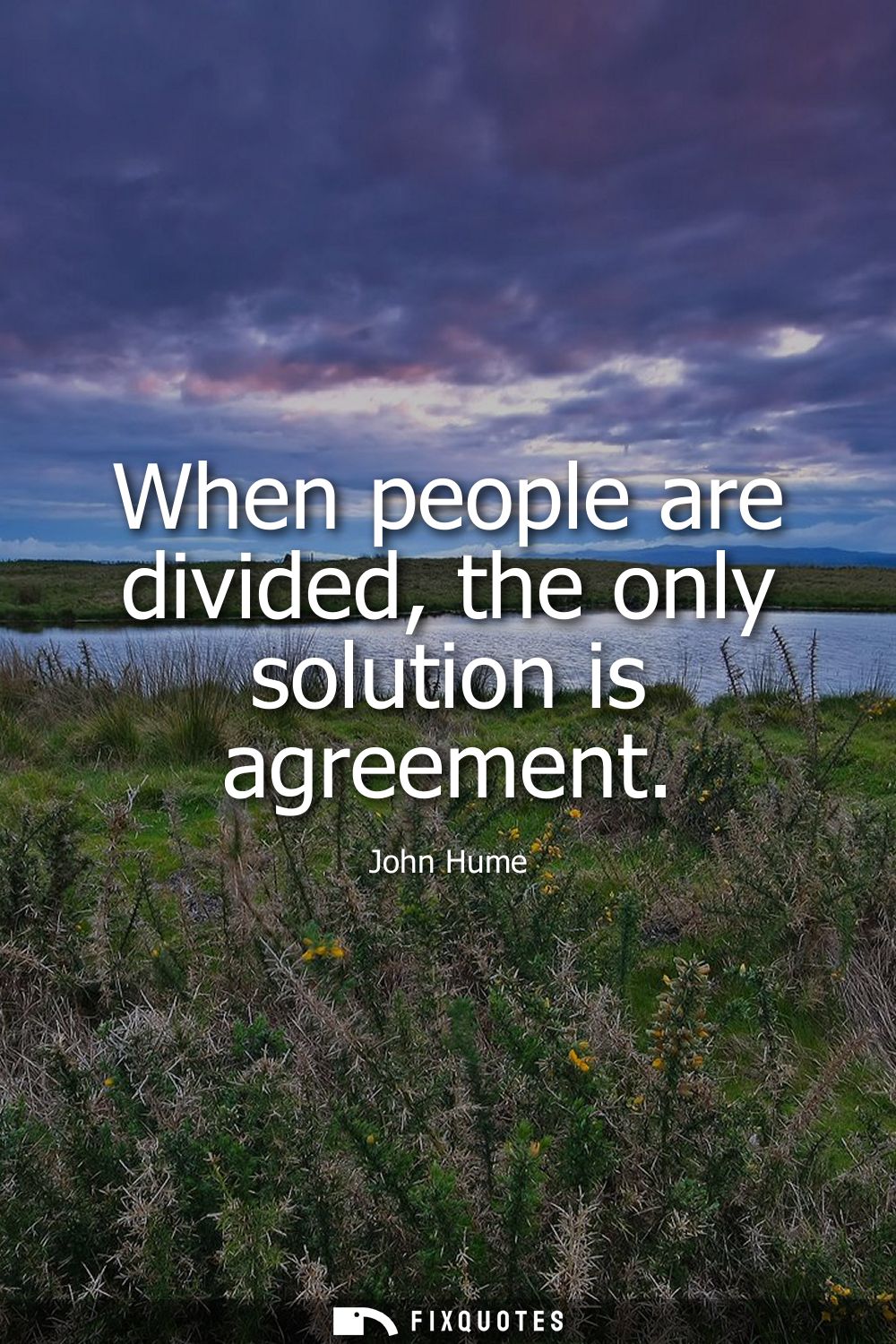
"When people are divided, the only solution is agreement"
About this Quote
In a line that sounds almost childishly obvious, John Hume smuggles a hard-earned political theory: conflict doesn’t end by winning, it ends by consenting to share a future. “When people are divided” doesn’t just describe disagreement; it evokes partitioned streets, segregated schools, and the everyday choreography of fear that defined Northern Ireland. Hume’s genius is to treat that division not as a moral failing to be punished, but as a condition to be managed.
“The only solution is agreement” is doing heavy rhetorical work. “Only” shuts the door on the romance of total victory, on the intoxicating idea that one side can finally silence the other. It also quietly rebukes both the gun and the grandstanding speech: force can dominate, but it can’t settle. Agreement, by contrast, is less a kumbaya plea than a recognition of arithmetic. In a shared territory, everyone is permanent; politics is the technology for living with people you cannot remove.
The subtext is both pragmatic and demanding. Agreement requires each camp to accept that its story is not the whole story. It asks for institutional humility: power-sharing, safeguards, and the boring machinery of compromise. Coming from Hume, a central architect of the peace process, the quote reads as a moral constraint disguised as a practical tip. He’s saying: if you want an end that lasts, you have to negotiate with the people you most dislike, and you have to build a system that assumes distrust will persist. That’s not idealism. It’s survival with paperwork.
“The only solution is agreement” is doing heavy rhetorical work. “Only” shuts the door on the romance of total victory, on the intoxicating idea that one side can finally silence the other. It also quietly rebukes both the gun and the grandstanding speech: force can dominate, but it can’t settle. Agreement, by contrast, is less a kumbaya plea than a recognition of arithmetic. In a shared territory, everyone is permanent; politics is the technology for living with people you cannot remove.
The subtext is both pragmatic and demanding. Agreement requires each camp to accept that its story is not the whole story. It asks for institutional humility: power-sharing, safeguards, and the boring machinery of compromise. Coming from Hume, a central architect of the peace process, the quote reads as a moral constraint disguised as a practical tip. He’s saying: if you want an end that lasts, you have to negotiate with the people you most dislike, and you have to build a system that assumes distrust will persist. That’s not idealism. It’s survival with paperwork.
Quote Details
| Topic | Peace |
|---|---|
| Source | Help us find the source |
| Cite |
Citation Formats
APA Style (7th ed.)
Hume, John. (2026, January 17). When people are divided, the only solution is agreement. FixQuotes. https://fixquotes.com/quotes/when-people-are-divided-the-only-solution-is-78050/
Chicago Style
Hume, John. "When people are divided, the only solution is agreement." FixQuotes. January 17, 2026. https://fixquotes.com/quotes/when-people-are-divided-the-only-solution-is-78050/.
MLA Style (9th ed.)
"When people are divided, the only solution is agreement." FixQuotes, 17 Jan. 2026, https://fixquotes.com/quotes/when-people-are-divided-the-only-solution-is-78050/. Accessed 25 Mar. 2026.
More Quotes by John
Add to List