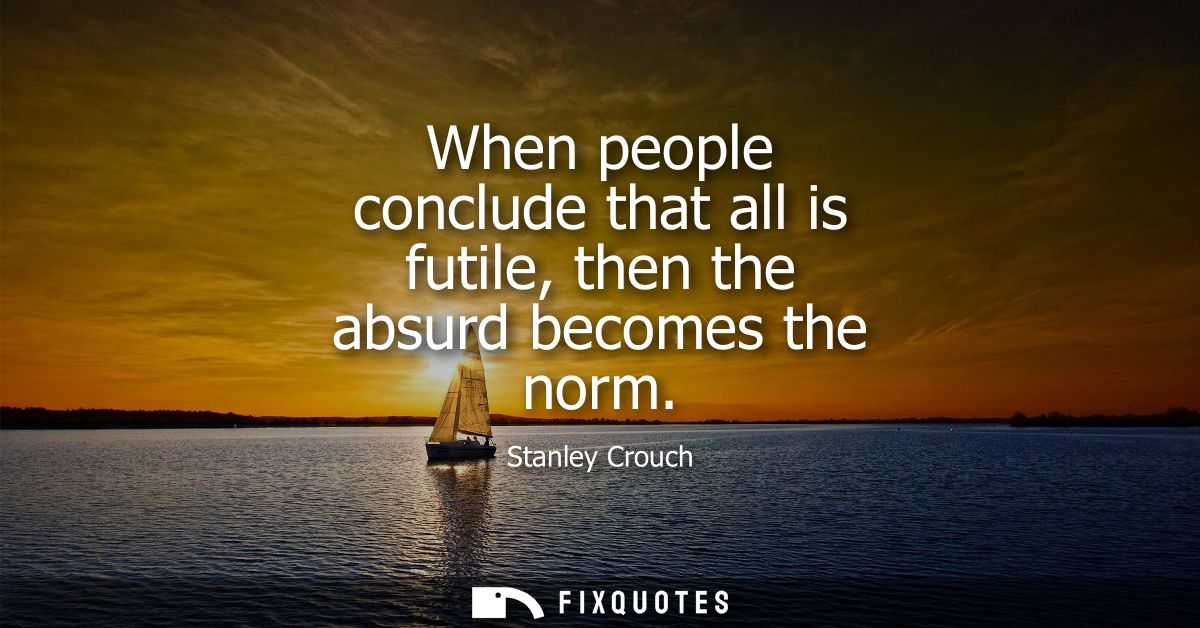
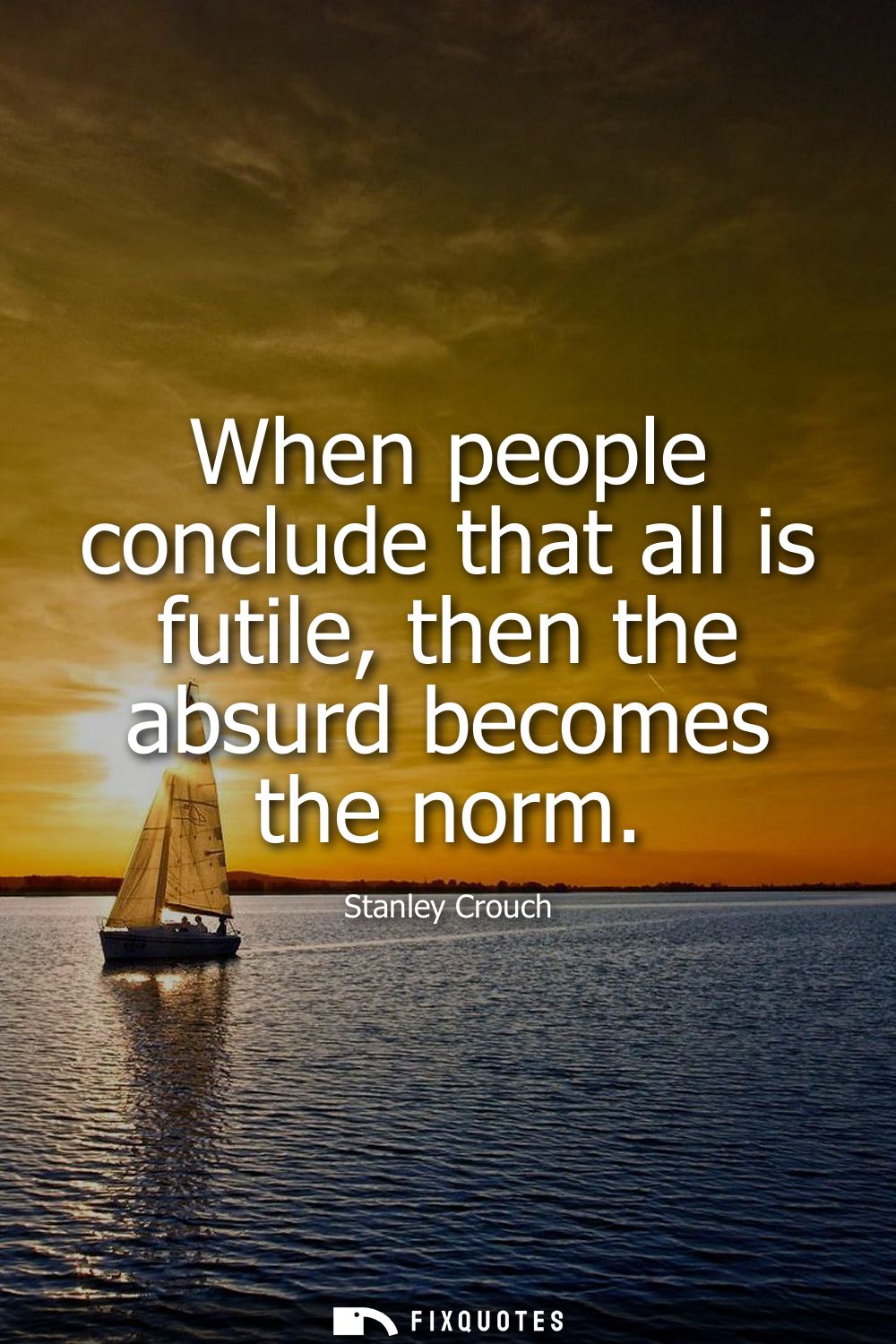
"When people conclude that all is futile, then the absurd becomes the norm"
About this Quote
As a critic, Crouch spent a career fighting the drift toward irony-as-a-lifestyle, especially in American arts and politics where posturing can replace argument and spectacle can replace achievement. The subtext is moral as much as aesthetic: cynicism is not neutral sophistication, it’s an alibi. If everything is futile, then any demand for rigor sounds naive, any appeal to tradition sounds oppressive, any insistence on excellence can be dismissed as elitism. Absurdity becomes protective camouflage: it lets institutions fail without admitting failure, lets public figures contradict themselves without paying a price, lets audiences consume without judging.
The context here is late-20th-century culture war terrain: mass media’s amplification of nonsense, the flattening of taste into brand identity, the temptation to confuse transgression with depth. Crouch’s point lands because it names the real danger: not that the world becomes absurd, but that we adapt to it.
Quote Details
| Topic | Deep |
|---|---|
| Source | Help us find the source |
| Cite |
Citation Formats
APA Style (7th ed.)
Crouch, Stanley. (2026, January 16). When people conclude that all is futile, then the absurd becomes the norm. FixQuotes. https://fixquotes.com/quotes/when-people-conclude-that-all-is-futile-then-the-86259/
Chicago Style
Crouch, Stanley. "When people conclude that all is futile, then the absurd becomes the norm." FixQuotes. January 16, 2026. https://fixquotes.com/quotes/when-people-conclude-that-all-is-futile-then-the-86259/.
MLA Style (9th ed.)
"When people conclude that all is futile, then the absurd becomes the norm." FixQuotes, 16 Jan. 2026, https://fixquotes.com/quotes/when-people-conclude-that-all-is-futile-then-the-86259/. Accessed 3 Apr. 2026.