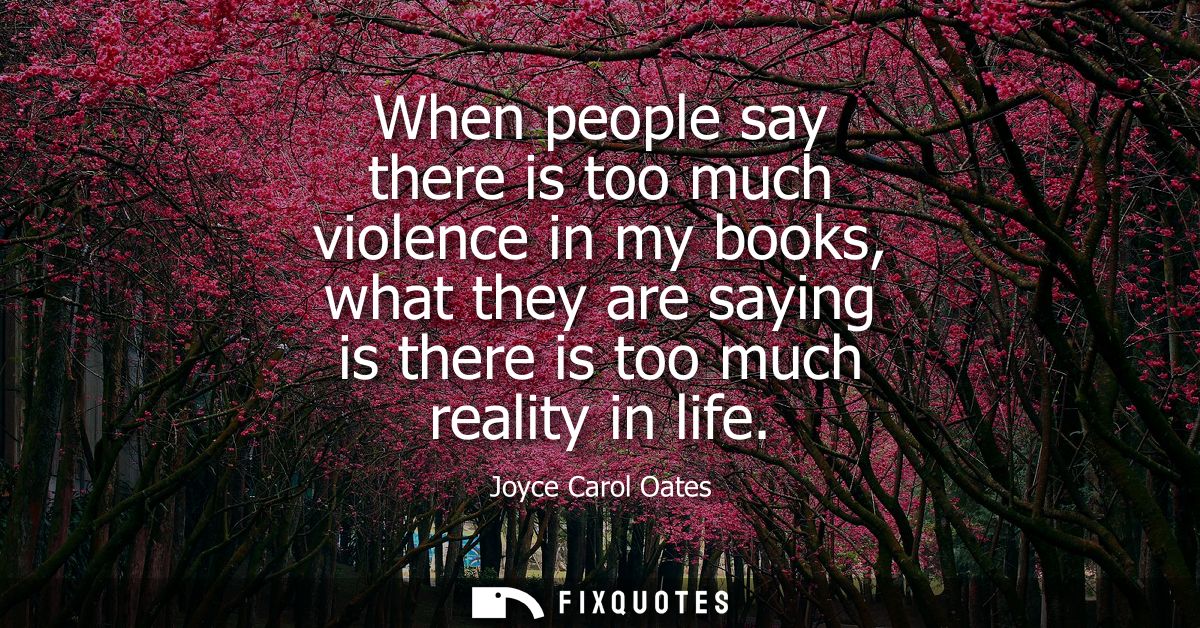
"When people say there is too much violence in my books, what they are saying is there is too much reality in life"
About this Quote
The subtext is a defense of realism that doesn’t romanticize its own harshness. Oates isn’t arguing that brutality is noble or enlightening on its own; she’s pointing to the cultural bargain behind the critique. Readers want the thrill of confronting darkness, but not the discomfort of admitting it’s ordinary, domestic, structural. Calling it “too much” is a way to keep violence safely fictional - a genre element rather than a social fact.
Context matters because Oates has spent decades writing about American appetites and American harm: the quiet menace in families, the public spectacle of crime, the gendered vulnerability that turns “violence” into a daily weather system. Her line lands because it reframes censorship-as-preference into a question of complicity. If reality is excessive, the problem isn’t the novelist’s inventory; it’s the society supplying the scenes.
Quote Details
| Topic | Writing |
|---|---|
| Source | Help us find the source |
| Cite |
Citation Formats
APA Style (7th ed.)
Oates, Joyce Carol. (2026, January 16). When people say there is too much violence in my books, what they are saying is there is too much reality in life. FixQuotes. https://fixquotes.com/quotes/when-people-say-there-is-too-much-violence-in-my-119662/
Chicago Style
Oates, Joyce Carol. "When people say there is too much violence in my books, what they are saying is there is too much reality in life." FixQuotes. January 16, 2026. https://fixquotes.com/quotes/when-people-say-there-is-too-much-violence-in-my-119662/.
MLA Style (9th ed.)
"When people say there is too much violence in my books, what they are saying is there is too much reality in life." FixQuotes, 16 Jan. 2026, https://fixquotes.com/quotes/when-people-say-there-is-too-much-violence-in-my-119662/. Accessed 5 Apr. 2026.