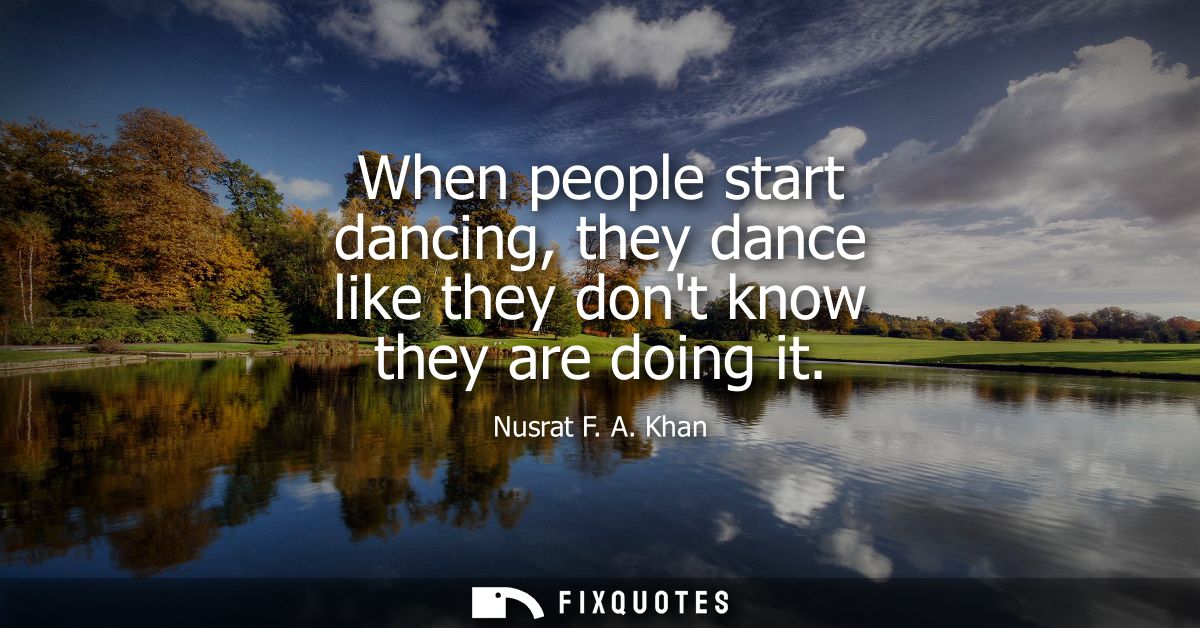
"When people start dancing, they dance like they don't know they are doing it"
About this Quote
Dancing, in Nusrat F. A. Khan's framing, is less a choice than a small possession. The line lands with the plainspoken clarity of someone who’s watched a room change: a body loosens, the face forgets itself, and suddenly the person who was managing their image a second ago is gone. That "like they don't know they are doing it" is the tell. It points to the moment self-consciousness short-circuits, when rhythm outruns the mind's commentary.
Khan came out of qawwali, a tradition built to push listeners past everyday restraint into something closer to surrender. In that context, the quote reads like a quiet manifesto: the best dance is unselfed. Not performative, not strategic, not designed for approval. It's the opposite of the modern camera-ready groove, where movement is pre-edited for an audience. Here, dancing is involuntary honesty. The body confesses what the mouth won't.
The subtext is also a gentle rebuke to the idea that control is the highest human state. Khan suggests that joy, devotion, release - whatever you want to call the pulse that makes people move - doesn't arrive by planning. It arrives by being overtaken. That's why the sentence is structured the way it is: not "they decide to dance", but "people start dancing", as if a current has grabbed them. In one compact observation, he turns dance into evidence: under the right music, even the most guarded person reveals a self they didn't know they were carrying.
Khan came out of qawwali, a tradition built to push listeners past everyday restraint into something closer to surrender. In that context, the quote reads like a quiet manifesto: the best dance is unselfed. Not performative, not strategic, not designed for approval. It's the opposite of the modern camera-ready groove, where movement is pre-edited for an audience. Here, dancing is involuntary honesty. The body confesses what the mouth won't.
The subtext is also a gentle rebuke to the idea that control is the highest human state. Khan suggests that joy, devotion, release - whatever you want to call the pulse that makes people move - doesn't arrive by planning. It arrives by being overtaken. That's why the sentence is structured the way it is: not "they decide to dance", but "people start dancing", as if a current has grabbed them. In one compact observation, he turns dance into evidence: under the right music, even the most guarded person reveals a self they didn't know they were carrying.
Quote Details
| Topic | Live in the Moment |
|---|
More Quotes by Nusrat
Add to List