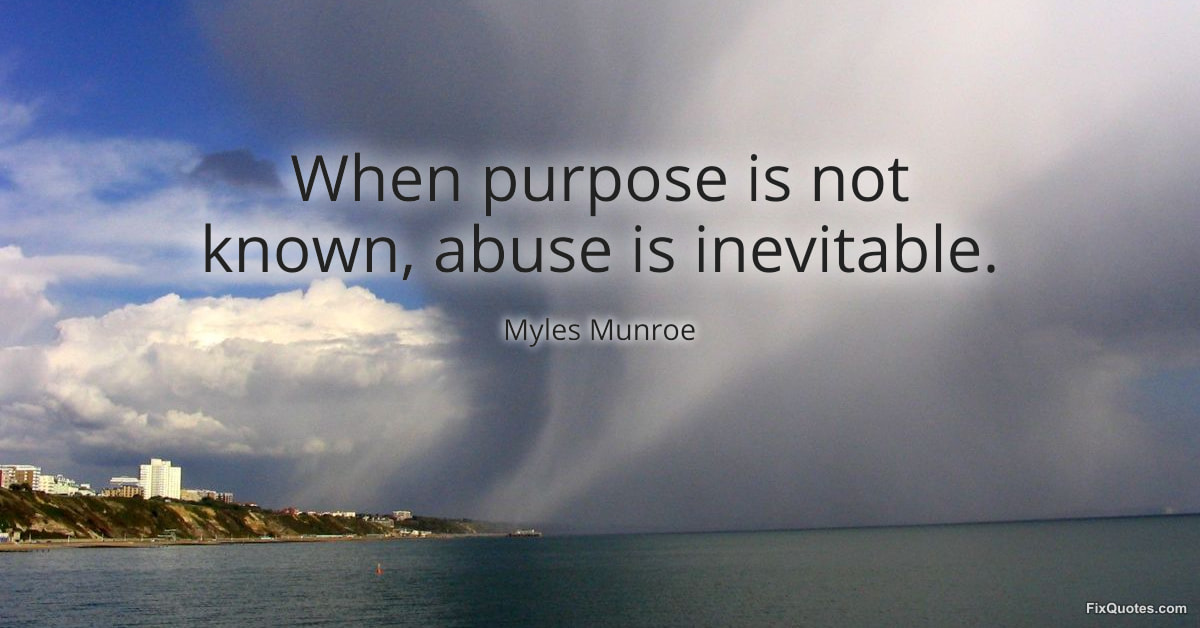
"When purpose is not known, abuse is inevitable"
About this Quote
A warning disguised as a proverb: if you do not know what something is for, you will almost certainly use it in a way that damages it. Munroe, a prosperity-tinged Pentecostal teacher with a gift for managerial clarity, frames “abuse” not first as moral depravity but as misalignment. The word choice matters. Abuse here is less scandal than entropy: a predictable outcome when design and behavior drift apart.
“Purpose” does heavy lifting. It implies origin, authorship, and a built-in telos, which in Munroe’s theology means God’s intention. That subtext quietly relocates authority away from personal preference (“I’ll decide what this is for”) and toward an external blueprint (“it already has a function”). The line is persuasive because it flatters our desire for order while scolding our improvisation. It also turns confusion into culpability: not knowing becomes the first step toward harm.
In pastoral context, the quote works as a multi-use tool. It can counsel individual lives (you feel stuck because you haven’t discerned your calling), relationships (misunderstanding what partnership is for breeds manipulation), and institutions (church, state, family) that start serving ego instead of mission. It’s also a culturally savvy critique of modern consumer freedom: when everything is customizable, meaning gets treated like a setting rather than a commitment.
The brilliance is its inevitability clause. “Inevitable” shuts down excuses. If you want to prevent damage, you don’t just police behavior; you clarify purpose.
“Purpose” does heavy lifting. It implies origin, authorship, and a built-in telos, which in Munroe’s theology means God’s intention. That subtext quietly relocates authority away from personal preference (“I’ll decide what this is for”) and toward an external blueprint (“it already has a function”). The line is persuasive because it flatters our desire for order while scolding our improvisation. It also turns confusion into culpability: not knowing becomes the first step toward harm.
In pastoral context, the quote works as a multi-use tool. It can counsel individual lives (you feel stuck because you haven’t discerned your calling), relationships (misunderstanding what partnership is for breeds manipulation), and institutions (church, state, family) that start serving ego instead of mission. It’s also a culturally savvy critique of modern consumer freedom: when everything is customizable, meaning gets treated like a setting rather than a commitment.
The brilliance is its inevitability clause. “Inevitable” shuts down excuses. If you want to prevent damage, you don’t just police behavior; you clarify purpose.
Quote Details
| Topic | Meaning of Life |
|---|---|
| Source | Understanding The Purpose And Power Of Woman (book, 2001) |
| Cite |
Citation Formats
APA Style (7th ed.)
Munroe, Myles. (2026, February 16). When purpose is not known, abuse is inevitable. FixQuotes. https://fixquotes.com/quotes/when-purpose-is-not-known-abuse-is-inevitable-185567/
Chicago Style
Munroe, Myles. "When purpose is not known, abuse is inevitable." FixQuotes. February 16, 2026. https://fixquotes.com/quotes/when-purpose-is-not-known-abuse-is-inevitable-185567/.
MLA Style (9th ed.)
"When purpose is not known, abuse is inevitable." FixQuotes, 16 Feb. 2026, https://fixquotes.com/quotes/when-purpose-is-not-known-abuse-is-inevitable-185567/. Accessed 30 Mar. 2026.
More Quotes by Myles
Add to List