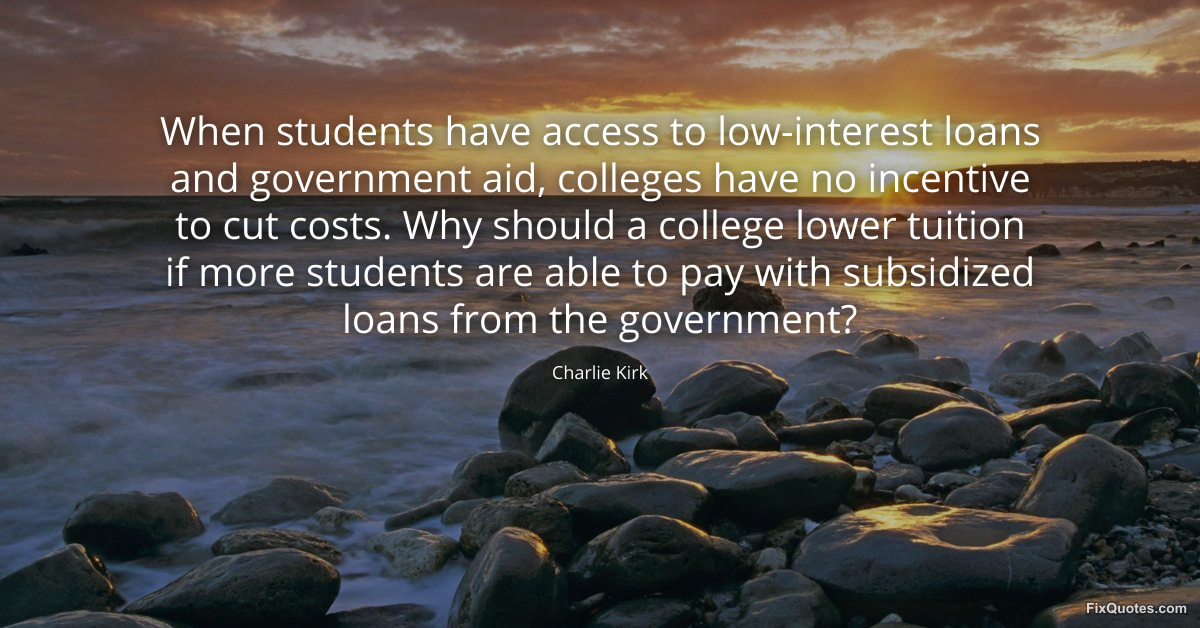
"When students have access to low-interest loans and government aid, colleges have no incentive to cut costs. Why should a college lower tuition if more students are able to pay with subsidized loans from the government?"
About this Quote
Kirk’s framing is a classic populist squeeze: take an experience people already resent (tuition that climbs faster than wages) and pin it on a clean villain (government “subsidy”) rather than a messy system of administrators, rankings arms races, state disinvestment, and credential inflation. The intent is less to litigate the economics than to reposition higher education as a rigged market where public help doesn’t democratize access - it props up a cartel.
The subtext is moral as much as financial. “Low-interest loans and government aid” are cast not as a social good but as a narcotic that dulls price sensitivity. Students become consumers who can be overcharged because Washington is picking up the tab, and colleges become lazy spenders who won’t reform unless the money dries up. It’s a line designed to feel like common sense: if you remove the cushion, institutions will finally behave.
Context matters because this argument rides on a real phenomenon often called the “Bennett hypothesis,” the idea that aid can enable price hikes. But Kirk’s simplicity is the point: it sidesteps the political choices that helped create today’s tuition dependence, especially declining state support for public universities and the way prestige incentives reward spending on amenities, marketing, and layers of management. It also quietly shifts the burden of discipline onto students: if colleges won’t cut costs, the solution implied is to make paying harder, even if that reduces access.
Rhetorically, the question isn’t seeking an answer; it’s a trapdoor. Once you accept the premise that aid is the accelerant, any defense of loans starts to sound like complicity in the scam.
The subtext is moral as much as financial. “Low-interest loans and government aid” are cast not as a social good but as a narcotic that dulls price sensitivity. Students become consumers who can be overcharged because Washington is picking up the tab, and colleges become lazy spenders who won’t reform unless the money dries up. It’s a line designed to feel like common sense: if you remove the cushion, institutions will finally behave.
Context matters because this argument rides on a real phenomenon often called the “Bennett hypothesis,” the idea that aid can enable price hikes. But Kirk’s simplicity is the point: it sidesteps the political choices that helped create today’s tuition dependence, especially declining state support for public universities and the way prestige incentives reward spending on amenities, marketing, and layers of management. It also quietly shifts the burden of discipline onto students: if colleges won’t cut costs, the solution implied is to make paying harder, even if that reduces access.
Rhetorically, the question isn’t seeking an answer; it’s a trapdoor. Once you accept the premise that aid is the accelerant, any defense of loans starts to sound like complicity in the scam.
Quote Details
| Topic | Student |
|---|
More Quotes by Charlie
Add to List