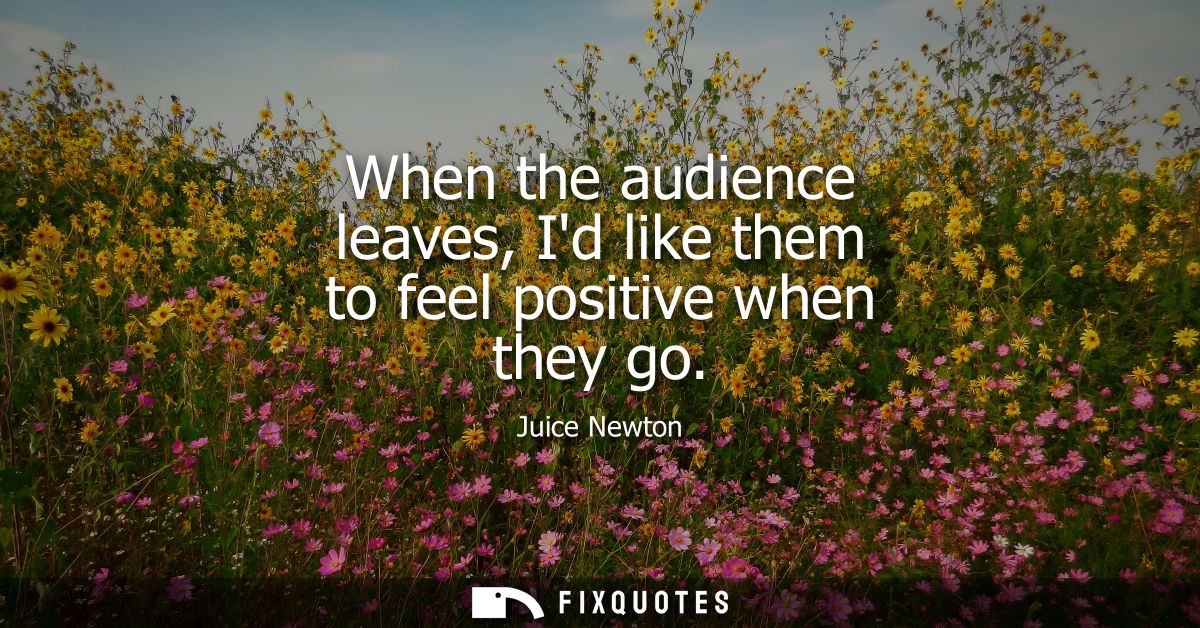
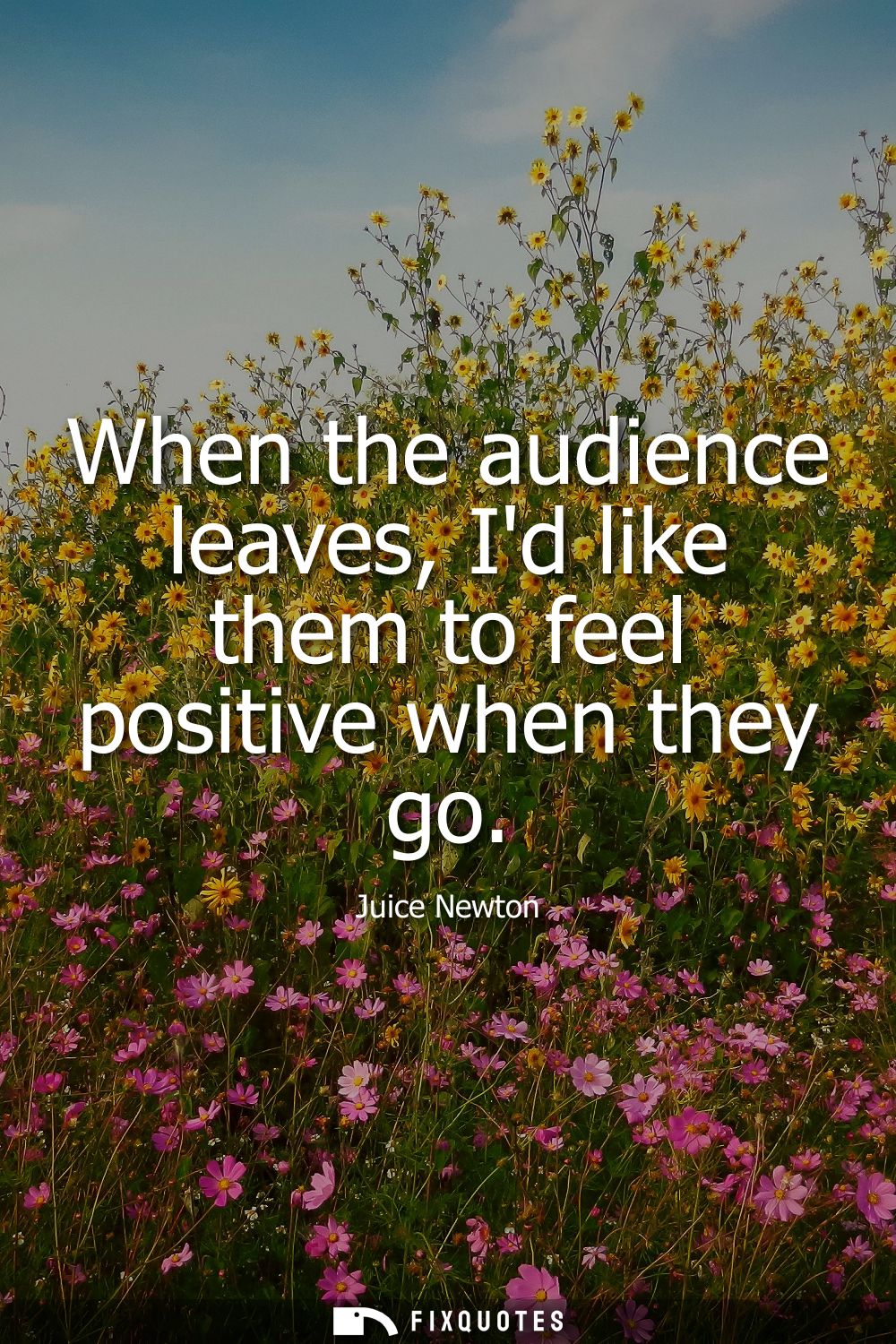
"When the audience leaves, I'd like them to feel positive when they go"
About this Quote
There’s something almost radical about how modest this ambition is. In an industry that rewards provocation, reinvention, and the occasional public breakdown, Juice Newton frames success as a simple emotional aftertaste: people should walk out feeling better than when they arrived. It’s not a manifesto, it’s a service ethic - closer to hospitality than stardom. And that’s the point.
Newton came up in a pop-country ecosystem where the “product” wasn’t just songs, but reassurance: melody you can hum on the drive home, heartbreak that doesn’t ask you to drown in it, a voice that treats vulnerability as communal rather than confessional. “Feel positive” isn’t naïveté so much as craft. It implies control over tone, pacing, and narrative - the setlist as emotional architecture. You can hear the subtext: I’m not here to punish you with my pain, or demand you validate my genius. I’m here to give you something you can carry.
The line also quietly rejects the modern posture that art must be abrasive to be serious. Newton’s era prized accessibility; her crossover success depended on being legible across radio formats, age groups, and moods. That context makes the quote read like a mission statement for the working musician: the crowd doesn’t owe you transcendence; you owe them an experience. It’s a reminder that “positive” can be a deliberate, disciplined choice - and that leaving lighter is its own kind of impact.
Newton came up in a pop-country ecosystem where the “product” wasn’t just songs, but reassurance: melody you can hum on the drive home, heartbreak that doesn’t ask you to drown in it, a voice that treats vulnerability as communal rather than confessional. “Feel positive” isn’t naïveté so much as craft. It implies control over tone, pacing, and narrative - the setlist as emotional architecture. You can hear the subtext: I’m not here to punish you with my pain, or demand you validate my genius. I’m here to give you something you can carry.
The line also quietly rejects the modern posture that art must be abrasive to be serious. Newton’s era prized accessibility; her crossover success depended on being legible across radio formats, age groups, and moods. That context makes the quote read like a mission statement for the working musician: the crowd doesn’t owe you transcendence; you owe them an experience. It’s a reminder that “positive” can be a deliberate, disciplined choice - and that leaving lighter is its own kind of impact.
Quote Details
| Topic | Happiness |
|---|---|
| Source | Help us find the source |
| Cite |
Citation Formats
APA Style (7th ed.)
Newton, Juice. (2026, January 16). When the audience leaves, I'd like them to feel positive when they go. FixQuotes. https://fixquotes.com/quotes/when-the-audience-leaves-id-like-them-to-feel-94587/
Chicago Style
Newton, Juice. "When the audience leaves, I'd like them to feel positive when they go." FixQuotes. January 16, 2026. https://fixquotes.com/quotes/when-the-audience-leaves-id-like-them-to-feel-94587/.
MLA Style (9th ed.)
"When the audience leaves, I'd like them to feel positive when they go." FixQuotes, 16 Jan. 2026, https://fixquotes.com/quotes/when-the-audience-leaves-id-like-them-to-feel-94587/. Accessed 13 Feb. 2026.
More Quotes by Juice
Add to List