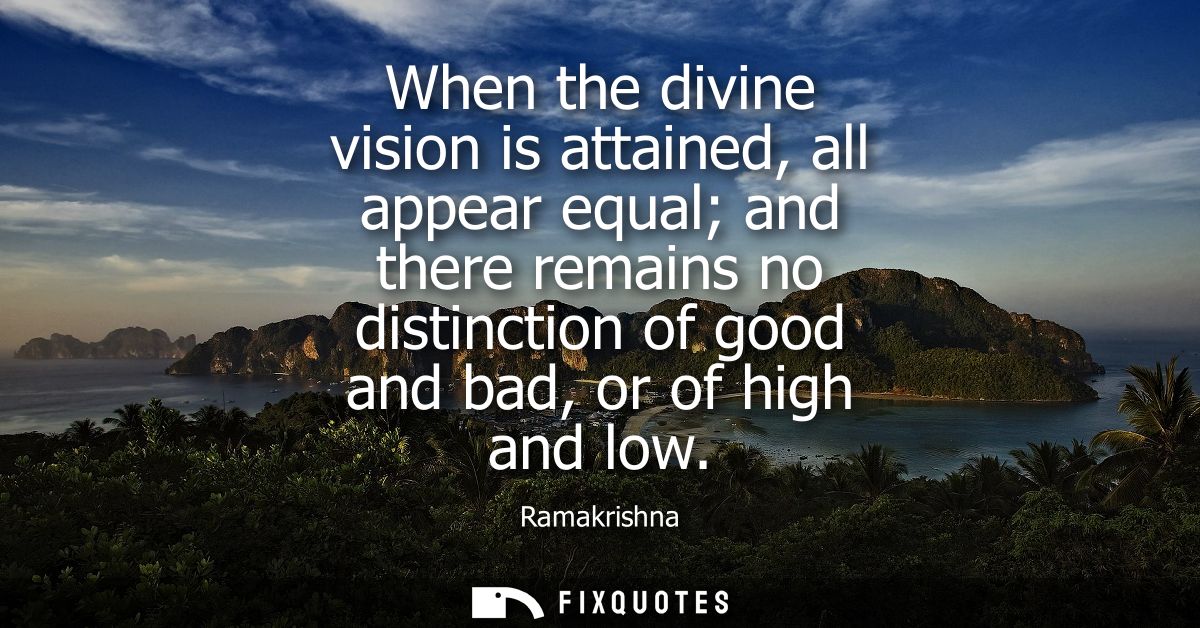
"When the divine vision is attained, all appear equal; and there remains no distinction of good and bad, or of high and low"
About this Quote
The phrasing matters. “All appear equal” signals appearance, not policy. This isn’t a manifesto for leveling institutions so much as a report from a consciousness where hierarchy can’t get traction. “There remains no distinction” pushes further: moral binaries are not merely softened but rendered irrelevant, like trying to rank waves in the ocean. That’s both liberating and provocative. If good and bad dissolve, what happens to accountability, to reform, to the everyday need to choose?
Context sharpens the edge. Ramakrishna taught in 19th-century Bengal, a society stratified by caste, colonial power, and religious boundary policing. His devotional ecstasies and insistence on the validity of multiple paths (Hindu, Muslim, Christian) were not abstract pluralism; they were a lived affront to social sorting. The subtext is quietly insurgent: if the highest truth erases high and low, then the authority of “high” people, “high” religions, and “high” birth is revealed as temporary theater.
Still, the quote’s tension is its power. It describes a summit-state that can inspire compassion, yet it also dares you to ask whether society can borrow that vision without escaping responsibility to the world it would otherwise transcend.
Quote Details
| Topic | Faith |
|---|---|
| Source | Help us find the source |
| Cite |
Citation Formats
APA Style (7th ed.)
Ramakrishna. (2026, January 17). When the divine vision is attained, all appear equal; and there remains no distinction of good and bad, or of high and low. FixQuotes. https://fixquotes.com/quotes/when-the-divine-vision-is-attained-all-appear-28581/
Chicago Style
Ramakrishna. "When the divine vision is attained, all appear equal; and there remains no distinction of good and bad, or of high and low." FixQuotes. January 17, 2026. https://fixquotes.com/quotes/when-the-divine-vision-is-attained-all-appear-28581/.
MLA Style (9th ed.)
"When the divine vision is attained, all appear equal; and there remains no distinction of good and bad, or of high and low." FixQuotes, 17 Jan. 2026, https://fixquotes.com/quotes/when-the-divine-vision-is-attained-all-appear-28581/. Accessed 27 Mar. 2026.