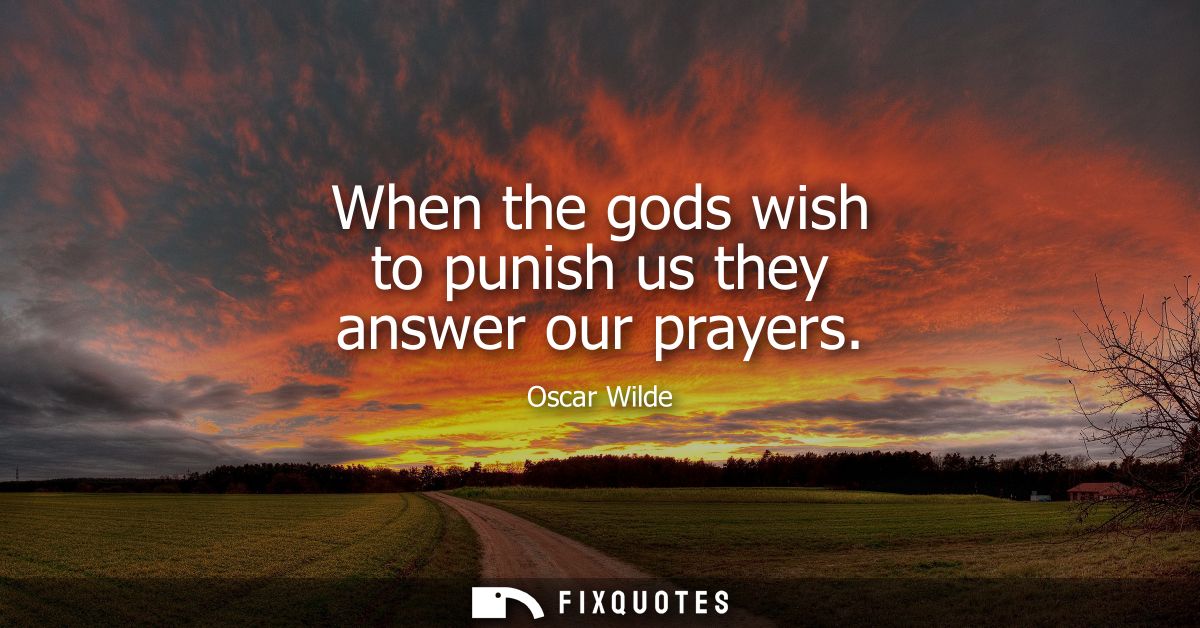
"When the gods wish to punish us they answer our prayers"
About this Quote
Be careful what you ask for is the watered-down version; Wilde’s is colder, funnier, and more damning. “When the gods wish to punish us they answer our prayers” flips the moral logic of religious consolation: the danger isn’t denial, it’s indulgence. The line works because it treats desire itself as the trap. We imagine our prayers as pure, noble, clarified by suffering. Wilde assumes the opposite: what we want is often petty, vain, shortsighted, and heavily conditioned by the tastes of our class and moment. The gods don’t need thunderbolts. They just give you exactly what you thought would fix you and let the consequences do the humiliating.
The plural “gods” matters. This isn’t a pious warning from inside one creed; it’s a sly, pagan-sounding shrug that makes divine power feel like a capricious salon audience. Punishment becomes a kind of aesthetic lesson: a perfectly tailored irony in which achievement, romance, status, or recognition reveals itself as corrosive the moment it’s finally attained. Wilde’s comedies thrive on that mechanism - the social wish fulfilled, then instantly exposed as absurd.
Context sharpens the bite. Wilde wrote in a culture that prized respectability and moral certainty while privately gorging on appetite and spectacle. His own life would become a public case study in answered prayers: fame, desire, and notoriety arriving with the precision of a curse. The subtext is not anti-prayer so much as anti-self-deception: the real terror is getting what you want and discovering it was never what you needed.
The plural “gods” matters. This isn’t a pious warning from inside one creed; it’s a sly, pagan-sounding shrug that makes divine power feel like a capricious salon audience. Punishment becomes a kind of aesthetic lesson: a perfectly tailored irony in which achievement, romance, status, or recognition reveals itself as corrosive the moment it’s finally attained. Wilde’s comedies thrive on that mechanism - the social wish fulfilled, then instantly exposed as absurd.
Context sharpens the bite. Wilde wrote in a culture that prized respectability and moral certainty while privately gorging on appetite and spectacle. His own life would become a public case study in answered prayers: fame, desire, and notoriety arriving with the precision of a curse. The subtext is not anti-prayer so much as anti-self-deception: the real terror is getting what you want and discovering it was never what you needed.
Quote Details
| Topic | Free Will & Fate |
|---|---|
| Source | Verified source: An Ideal Husband (Oscar Wilde, 1899)
Evidence: I remember having read somewhere, in some strange book, that when the gods wish to punish us they answer our prayers. (Act II (scene between Sir Robert Chiltern and Lord Goring); exact page varies by edition). Primary-source verification: the line appears in Oscar Wilde’s play An Ideal Husband, spoken by Sir Robert Chiltern in Act II. The play was first performed on January 3, 1895 (Theatre Royal, Haymarket, London), but it was not published in book form until 1899; that 1899 book publication is the earliest clear ‘first published’ form for the text of the play. The Project Gutenberg transcription shows the line in Act II (see around the passage where Sir Robert discusses his financial/political success and Baron Arnheim). Other candidates (1) The Book of Positive Quotations (Steve Deger, Leslie Ann Gibson, 2024) compilation95.0% ... When the gods wish to punish us , they answer our prayers . -Oscar Wilde God alone fully understands what each on... |
| Cite |
Citation Formats
APA Style (7th ed.)
Wilde, Oscar. (2026, February 8). When the gods wish to punish us they answer our prayers. FixQuotes. https://fixquotes.com/quotes/when-the-gods-wish-to-punish-us-they-answer-our-26978/
Chicago Style
Wilde, Oscar. "When the gods wish to punish us they answer our prayers." FixQuotes. February 8, 2026. https://fixquotes.com/quotes/when-the-gods-wish-to-punish-us-they-answer-our-26978/.
MLA Style (9th ed.)
"When the gods wish to punish us they answer our prayers." FixQuotes, 8 Feb. 2026, https://fixquotes.com/quotes/when-the-gods-wish-to-punish-us-they-answer-our-26978/. Accessed 21 Mar. 2026.
More Quotes by Oscar
Add to List