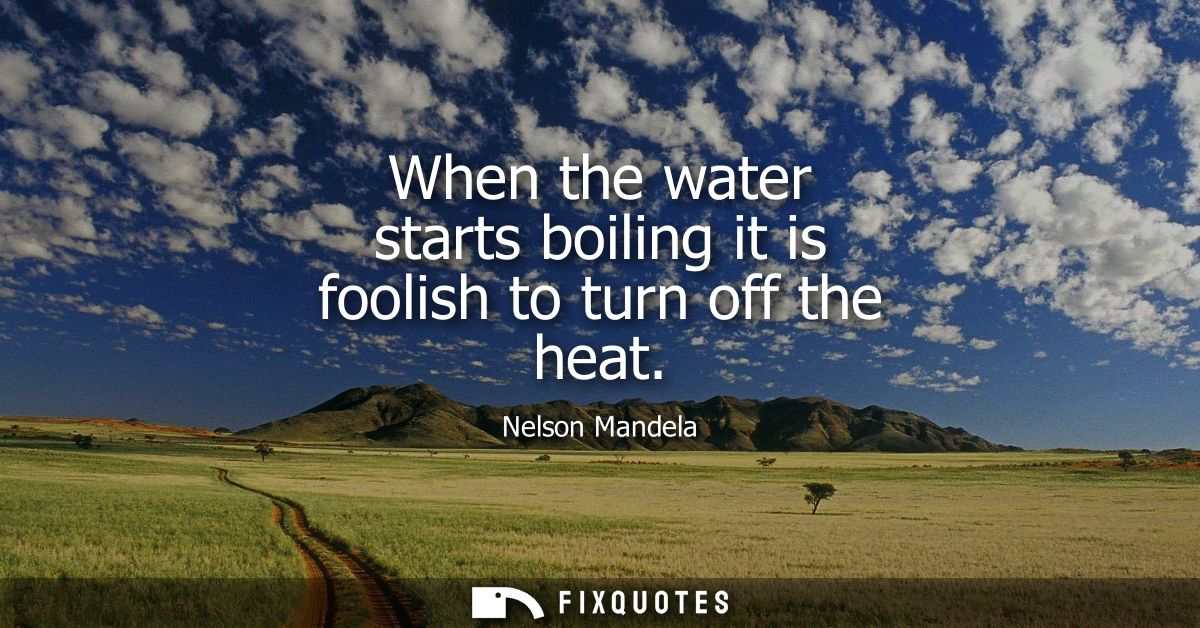
"When the water starts boiling, it is foolish to turn off the heat"
About this Quote
It reads like kitchen logic, but it lands as insurgent strategy: once pressure has finally built, you don’t soothe it back into stillness. “When the water starts boiling” conjures a long, controlled buildup - the years of organizing, endurance, and incremental sacrifice that precede any real political rupture. The point isn’t impatience; it’s respect for momentum. Boiling is hard-won. Turning off the heat at that moment is less “prudence” than sabotage.
Mandela’s subtext is aimed at moderates, gatekeepers, and nervous allies who suddenly discover a taste for calm precisely when change becomes possible. The metaphor flatters them with practicality (“foolish” is a household word, not an ideological slur) while indicting the reflex to de-escalate once conflict becomes visible. In liberation struggles, the dangerous temptation is to treat unrest as the problem rather than the symptom - to negotiate away urgency, to accept symbolic concessions, to confuse temporary quiet with justice.
Context matters because Mandela is not romanticizing chaos from a safe distance. He’s speaking as someone who watched apartheid persist through polite appeals, and who understood that the system depended on exhausting resistance, stretching time until opponents lose nerve. “Heat” here is collective insistence: strikes, mass action, international pressure, disciplined defiance. The line’s rhetorical power is its reversal of the usual moral lesson. We’re trained to lower the flame when things get intense. Mandela suggests intensity is the proof the work is finally working.
Mandela’s subtext is aimed at moderates, gatekeepers, and nervous allies who suddenly discover a taste for calm precisely when change becomes possible. The metaphor flatters them with practicality (“foolish” is a household word, not an ideological slur) while indicting the reflex to de-escalate once conflict becomes visible. In liberation struggles, the dangerous temptation is to treat unrest as the problem rather than the symptom - to negotiate away urgency, to accept symbolic concessions, to confuse temporary quiet with justice.
Context matters because Mandela is not romanticizing chaos from a safe distance. He’s speaking as someone who watched apartheid persist through polite appeals, and who understood that the system depended on exhausting resistance, stretching time until opponents lose nerve. “Heat” here is collective insistence: strikes, mass action, international pressure, disciplined defiance. The line’s rhetorical power is its reversal of the usual moral lesson. We’re trained to lower the flame when things get intense. Mandela suggests intensity is the proof the work is finally working.
Quote Details
| Topic | Motivational |
|---|---|
| Source | Help us find the source |
| Cite |
Citation Formats
APA Style (7th ed.)
Mandela, Nelson. (2026, February 20). When the water starts boiling, it is foolish to turn off the heat. FixQuotes. https://fixquotes.com/quotes/when-the-water-starts-boiling-it-is-foolish-to-9243/
Chicago Style
Mandela, Nelson. "When the water starts boiling, it is foolish to turn off the heat." FixQuotes. February 20, 2026. https://fixquotes.com/quotes/when-the-water-starts-boiling-it-is-foolish-to-9243/.
MLA Style (9th ed.)
"When the water starts boiling, it is foolish to turn off the heat." FixQuotes, 20 Feb. 2026, https://fixquotes.com/quotes/when-the-water-starts-boiling-it-is-foolish-to-9243/. Accessed 3 Apr. 2026.
More Quotes by Nelson
Add to List