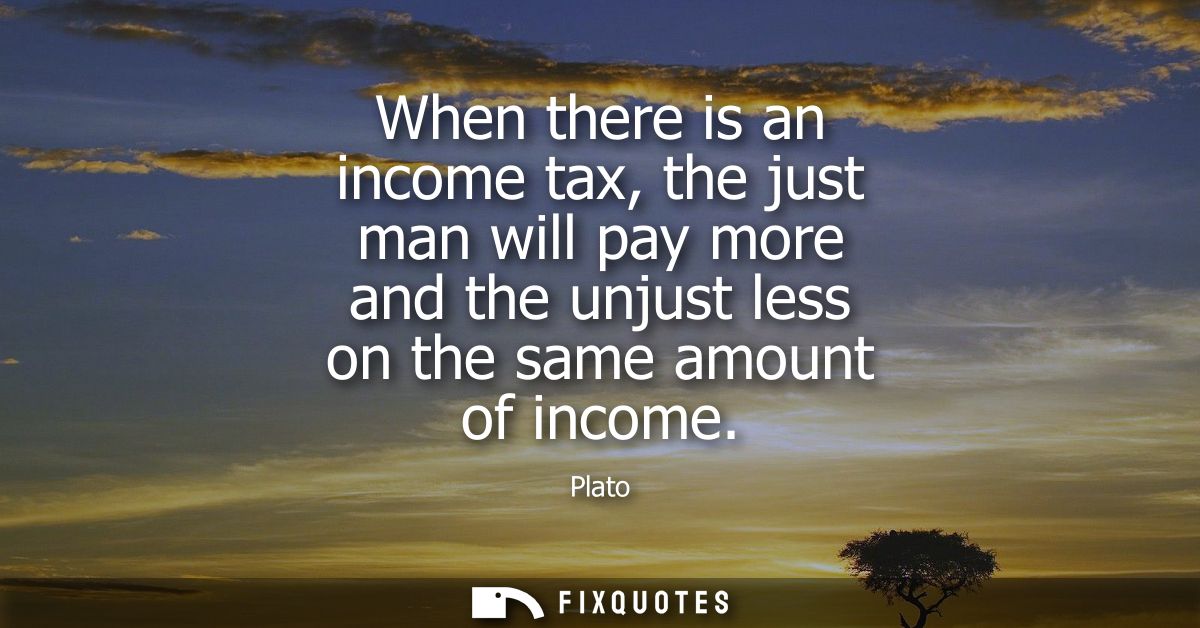
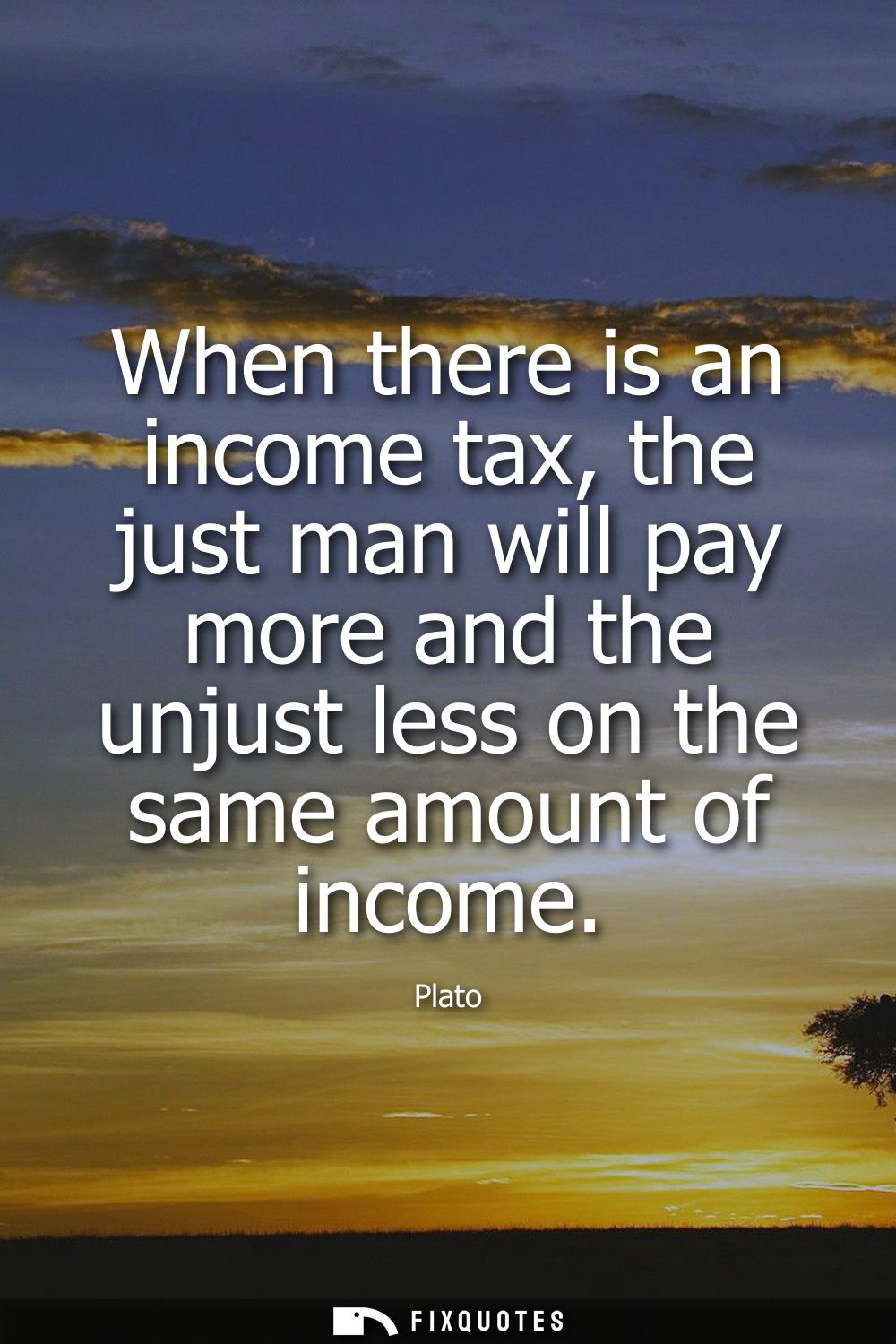
"When there is an income tax, the just man will pay more and the unjust less on the same amount of income"
About this Quote
The subtext is classic Platonic pessimism about systems that assume good faith. A society that needs revenue but relies on self-reporting effectively rewards the very vice it should be curbing: cleverness unmoored from responsibility. Plato’s broader project in The Republic is to contrast rule by appetite and advantage with rule by reason and virtue. Read through that lens, income tax becomes a miniature of democratic life: everyone is equal in principle, but the unscrupulous learn to game the machinery, and the conscientious subsidize both the state and the cheaters.
Context matters: Plato isn’t critiquing TurboTax; he’s critiquing a political order where law is too external to shape souls. The sting is that justice becomes a personal cost center. If the city can’t align incentives with virtue, it ends up selecting for injustice, not merely tolerating it. That’s why the quote still feels modern: it’s less about taxes than about how easily “fairness” collapses when enforcement depends on conscience.
Quote Details
| Topic | Justice |
|---|---|
| Source | Help us find the source |
| Cite | Cite this Quote |
Citation Formats
APA Style (7th ed.)
Plato. (n.d.). When there is an income tax, the just man will pay more and the unjust less on the same amount of income. FixQuotes. https://fixquotes.com/quotes/when-there-is-an-income-tax-the-just-man-will-pay-29335/
Chicago Style
Plato. "When there is an income tax, the just man will pay more and the unjust less on the same amount of income." FixQuotes. Accessed February 1, 2026. https://fixquotes.com/quotes/when-there-is-an-income-tax-the-just-man-will-pay-29335/.
MLA Style (9th ed.)
"When there is an income tax, the just man will pay more and the unjust less on the same amount of income." FixQuotes, https://fixquotes.com/quotes/when-there-is-an-income-tax-the-just-man-will-pay-29335/. Accessed 1 Feb. 2026.