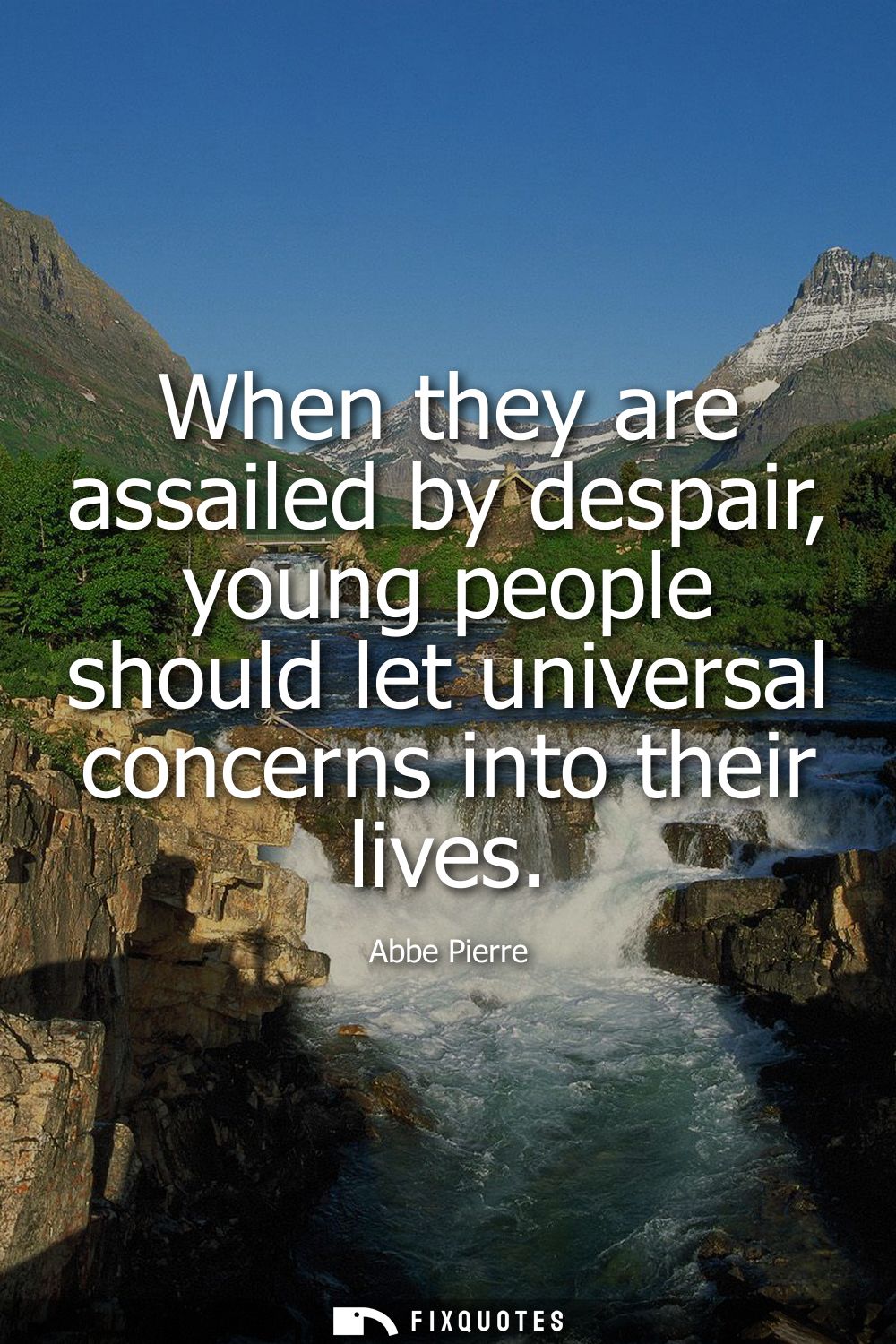
"When they are assailed by despair, young people should let universal concerns into their lives"
About this Quote
Despair, Abbe Pierre implies, is partly a problem of scale. Youth pain can feel total because it’s lived at close range: the breakup, the exam, the family fracture, the sense of being trapped inside a single, failing storyline. His prescription is not “cheer up” but “zoom out,” and it lands with the authority of a priest who spent his public life converting moral feeling into practical solidarity.
“Let universal concerns into their lives” is a deft reversal. We often treat big issues as an added burden on already stressed young people, another doomscrolling docket of catastrophe. Pierre frames the universal as an antidote: not distraction, but enlargement. The subtext is almost therapeutic, but also quietly political. Despair thrives in isolation and self-surveillance; universal concerns pull you into relationship, obligation, and action. They give suffering a direction other than inward collapse.
The line also carries the postwar Catholic social ethic Pierre embodied as a founder of the Emmaus movement: dignity is rebuilt through service, community, and a shared fight against poverty and exclusion. His word choice matters. “Let” suggests openness rather than commandment, an invitation into meaning rather than a scolding about privilege. At the same time, it’s a subtle critique of a culture that sells young people a private, optimized life as the whole horizon. Pierre offers a harder, sturdier consolation: your life becomes more bearable when it stops being only about you.
“Let universal concerns into their lives” is a deft reversal. We often treat big issues as an added burden on already stressed young people, another doomscrolling docket of catastrophe. Pierre frames the universal as an antidote: not distraction, but enlargement. The subtext is almost therapeutic, but also quietly political. Despair thrives in isolation and self-surveillance; universal concerns pull you into relationship, obligation, and action. They give suffering a direction other than inward collapse.
The line also carries the postwar Catholic social ethic Pierre embodied as a founder of the Emmaus movement: dignity is rebuilt through service, community, and a shared fight against poverty and exclusion. His word choice matters. “Let” suggests openness rather than commandment, an invitation into meaning rather than a scolding about privilege. At the same time, it’s a subtle critique of a culture that sells young people a private, optimized life as the whole horizon. Pierre offers a harder, sturdier consolation: your life becomes more bearable when it stops being only about you.
Quote Details
| Topic | Youth |
|---|
More Quotes by Abbe
Add to List