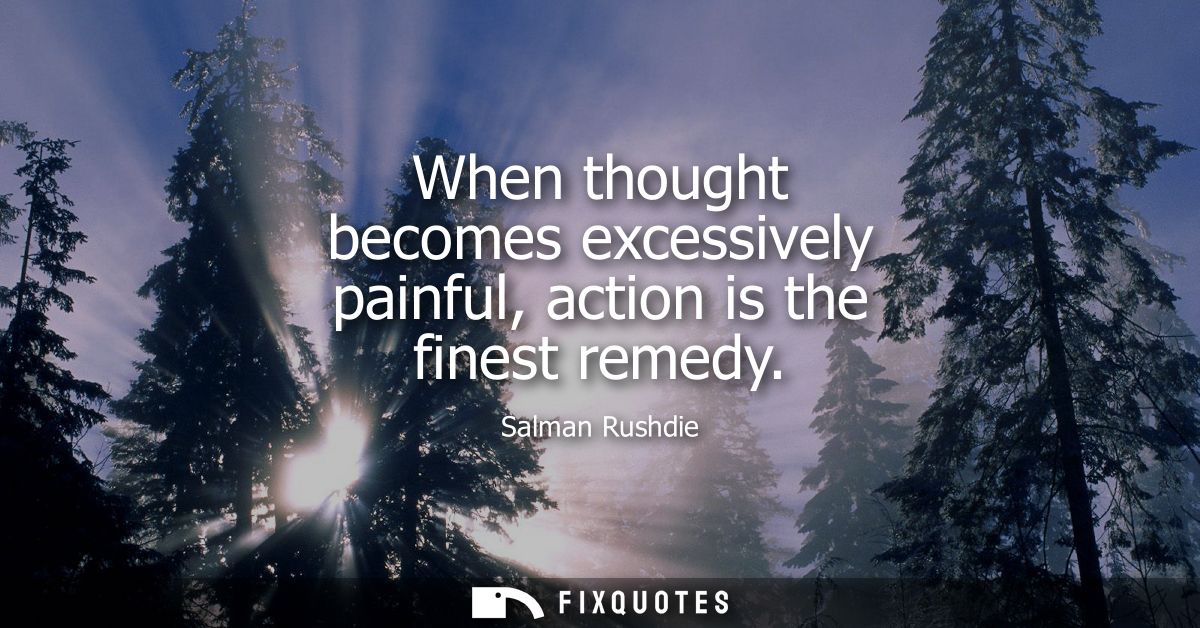
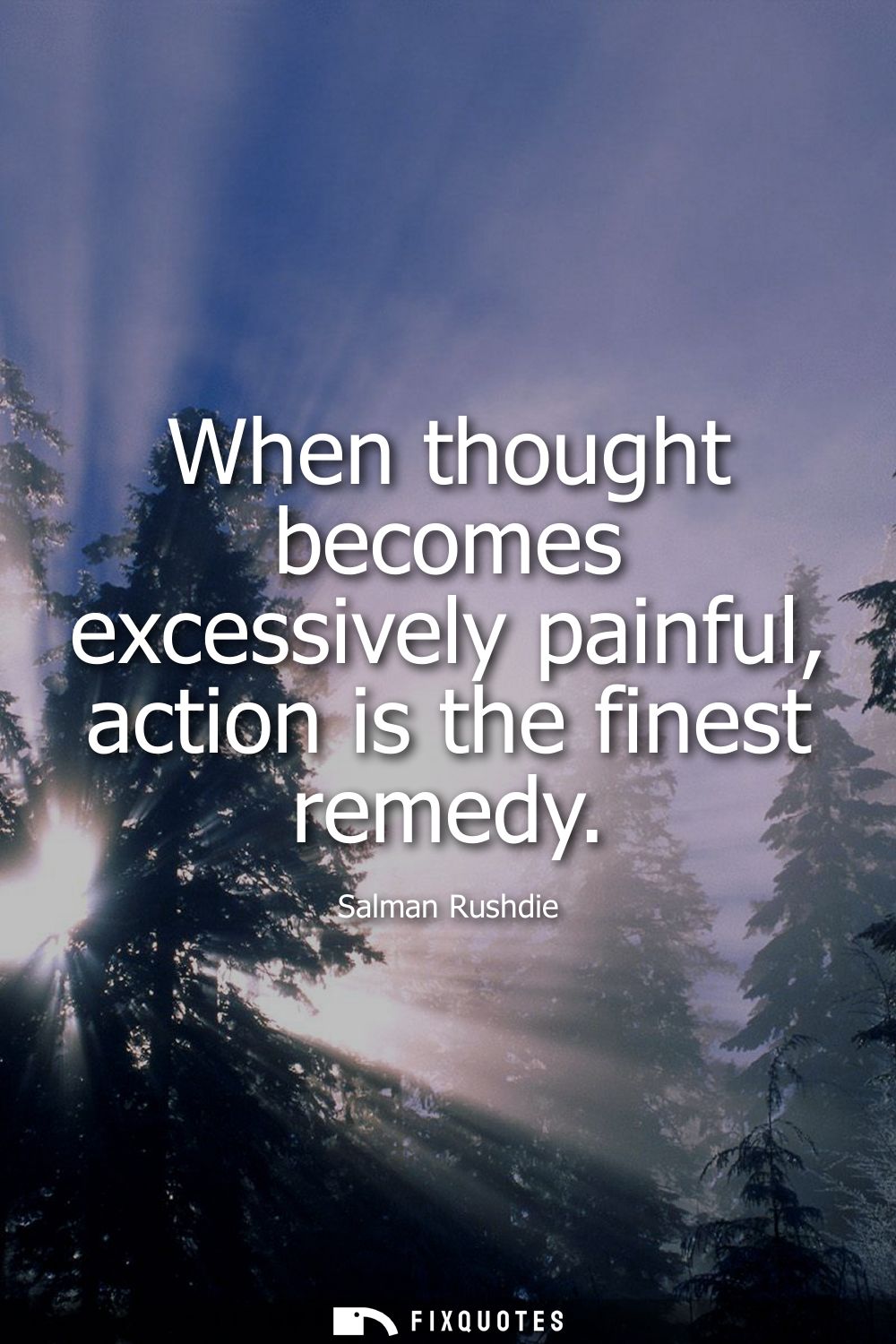
"When thought becomes excessively painful, action is the finest remedy"
About this Quote
The subtext carries Rushdie's lifelong argument that stories and ideas have consequences in the world. For a novelist who has lived under real, material threat for words on a page, the quote lands with a particular edge: contemplation can be a luxury; action can be survival. It also suggests a moral stance. When thinking hurts, we often treat pain as evidence that we're doing something important. Rushdie flips that temptation. Pain might be proof you're stuck inside the same loop, polishing dread into philosophy.
Stylistically, the sentence is clean and almost proverbial, which is part of its power: it offers permission to move. "Finest remedy" frames action as medicine, not performance. Not grand heroics, necessarily, but any purposeful motion that breaks the closed circuit of the mind. In a culture that fetishizes overanalysis and "processing" as an identity, Rushdie’s line is a bracing reminder that agency isn't the enemy of complexity. Sometimes it’s the only way to make complexity livable.
Quote Details
| Topic | Motivational |
|---|---|
| Source | Help us find the source |
| Cite |
Citation Formats
APA Style (7th ed.)
Rushdie, Salman. (2026, January 16). When thought becomes excessively painful, action is the finest remedy. FixQuotes. https://fixquotes.com/quotes/when-thought-becomes-excessively-painful-action-83825/
Chicago Style
Rushdie, Salman. "When thought becomes excessively painful, action is the finest remedy." FixQuotes. January 16, 2026. https://fixquotes.com/quotes/when-thought-becomes-excessively-painful-action-83825/.
MLA Style (9th ed.)
"When thought becomes excessively painful, action is the finest remedy." FixQuotes, 16 Jan. 2026, https://fixquotes.com/quotes/when-thought-becomes-excessively-painful-action-83825/. Accessed 1 Apr. 2026.