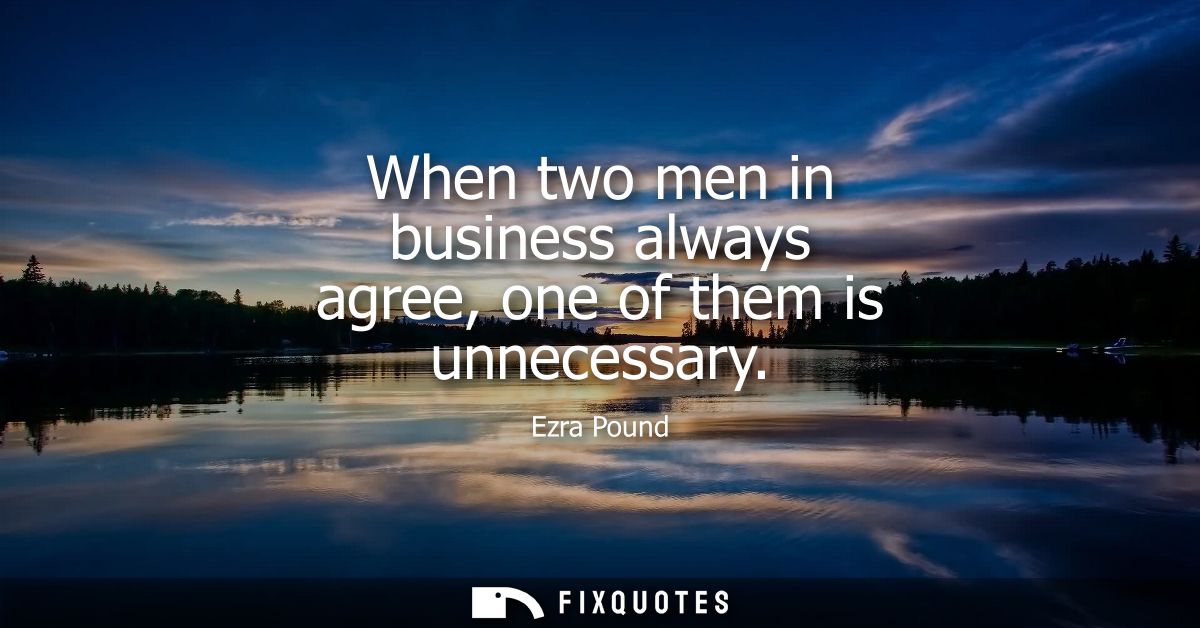
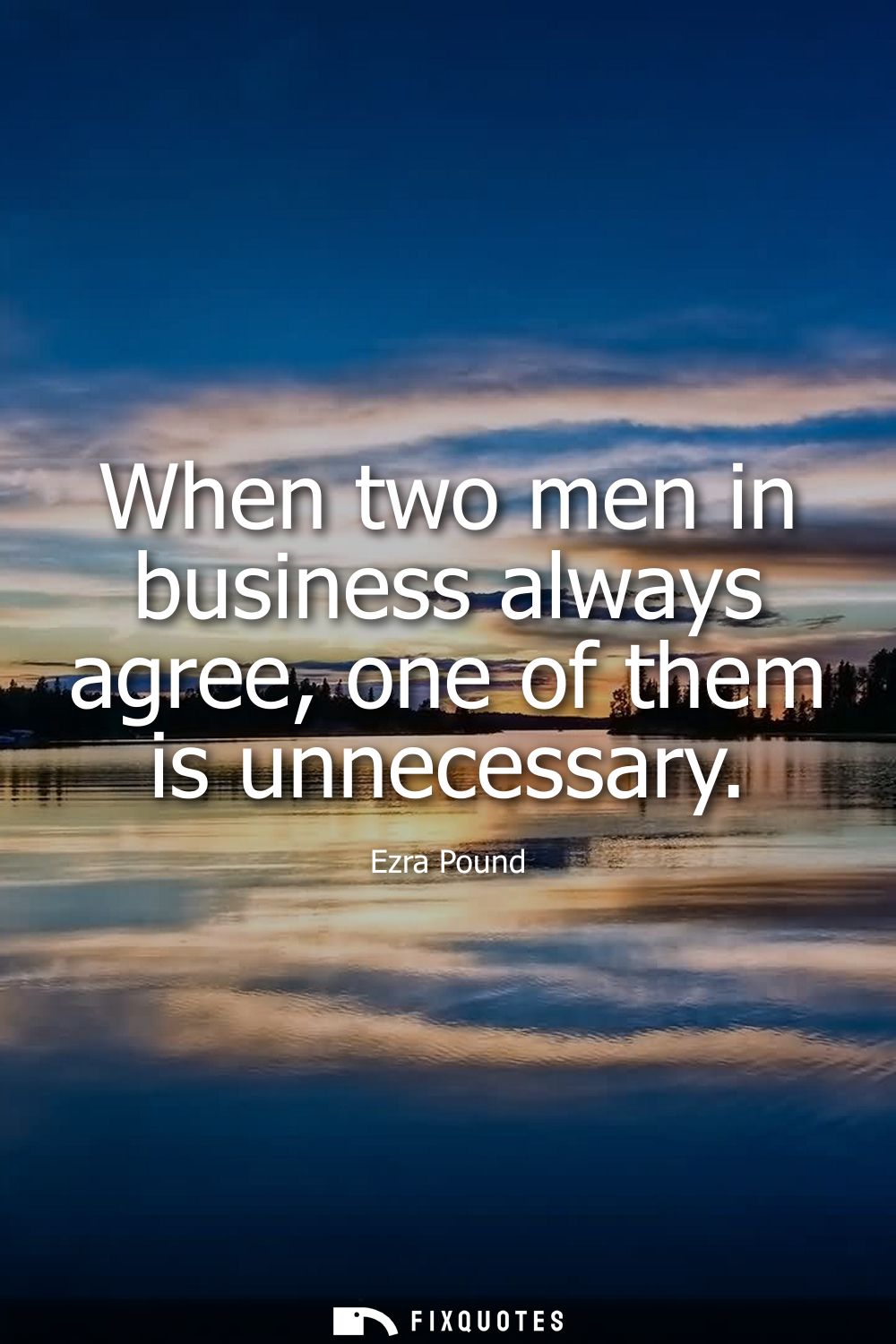
"When two men in business always agree, one of them is unnecessary"
About this Quote
Consensus is comforting in a boardroom, which is exactly why Pound treats it with suspicion. “When two men in business always agree, one of them is unnecessary” lands like a proverb with a knife in it: agreement isn’t framed as harmony but as redundancy, even quiet corruption. The line assumes that real commerce, like real thought, should involve friction. If there’s no clash of judgment, no competing model of risk, then someone isn’t thinking, or someone is paid not to.
Pound’s edge here is managerial but also aesthetic. As a poet who spent his career railing against softness, conformity, and secondhand thinking, he prized the hard, exacting cut. The sentence performs that ethic: blunt, economical, intolerant of wasted presence. Subtextually it’s an attack on the polite theater of “alignment” that so often masks hierarchy. Two executives “always” agreeing usually means one is the ventriloquist and the other the puppet, or both are captured by the same incentives. Either way, the partnership becomes less a dialogue than an echo.
There’s also a modern sting: businesses love to market dissent as a value while quietly punishing it. Pound reverses the usual feel-good moral. He’s not praising teamwork; he’s warning that sameness is inefficiency dressed up as unity. The quote works because it turns a social virtue into a diagnostic tool. If you never hear the no, you’re not hearing intelligence - you’re hearing choreography.
Pound’s edge here is managerial but also aesthetic. As a poet who spent his career railing against softness, conformity, and secondhand thinking, he prized the hard, exacting cut. The sentence performs that ethic: blunt, economical, intolerant of wasted presence. Subtextually it’s an attack on the polite theater of “alignment” that so often masks hierarchy. Two executives “always” agreeing usually means one is the ventriloquist and the other the puppet, or both are captured by the same incentives. Either way, the partnership becomes less a dialogue than an echo.
There’s also a modern sting: businesses love to market dissent as a value while quietly punishing it. Pound reverses the usual feel-good moral. He’s not praising teamwork; he’s warning that sameness is inefficiency dressed up as unity. The quote works because it turns a social virtue into a diagnostic tool. If you never hear the no, you’re not hearing intelligence - you’re hearing choreography.
Quote Details
| Topic | Decision-Making |
|---|---|
| Source | Help us find the source |
| Cite |
Citation Formats
APA Style (7th ed.)
Pound, Ezra. (2026, January 17). When two men in business always agree, one of them is unnecessary. FixQuotes. https://fixquotes.com/quotes/when-two-men-in-business-always-agree-one-of-them-52804/
Chicago Style
Pound, Ezra. "When two men in business always agree, one of them is unnecessary." FixQuotes. January 17, 2026. https://fixquotes.com/quotes/when-two-men-in-business-always-agree-one-of-them-52804/.
MLA Style (9th ed.)
"When two men in business always agree, one of them is unnecessary." FixQuotes, 17 Jan. 2026, https://fixquotes.com/quotes/when-two-men-in-business-always-agree-one-of-them-52804/. Accessed 6 Feb. 2026.
More Quotes by Ezra
Add to List