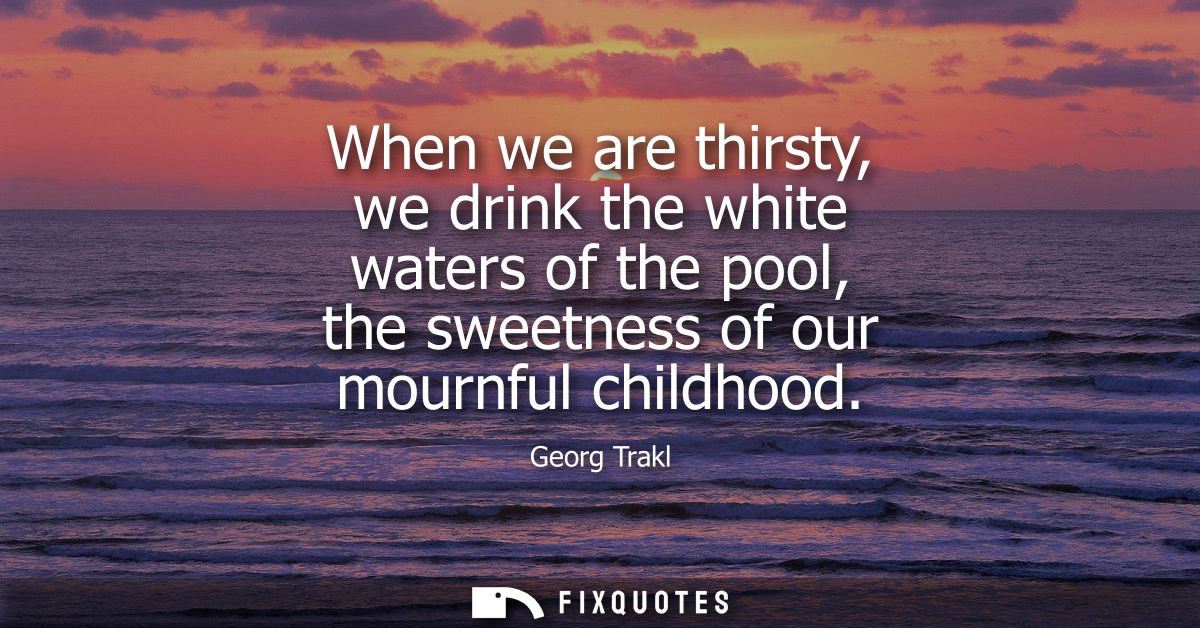
"When we are thirsty, we drink the white waters of the pool, the sweetness of our mournful childhood"
About this Quote
Then comes the turn that makes the line sting: “the sweetness of our mournful childhood.” Trakl fuses two registers that are usually kept apart in polite memoir - nostalgia’s sugar and grief’s metallic aftertaste. “Sweetness” doesn’t redeem the sadness; it’s complicit with it. Childhood becomes addictive precisely because it hurts in a familiar way, because it offers a grief you can name and therefore control, unlike adult despair, which arrives formless.
The subtext is that longing itself is the thirst, and memory is the only available liquid - not because it’s nourishing, but because it’s immediate. Trakl, writing from a late Austro-Hungarian world cracking into war and personal breakdown, often treats innocence as a poisoned relic. This line enacts that logic: the past isn’t a refuge; it’s an intoxicant. You drink it to feel something pure again, and what you get is a beautiful, anesthetic sorrow.
Quote Details
| Topic | Nostalgia |
|---|---|
| Source | Help us find the source |
| Cite |
Citation Formats
APA Style (7th ed.)
Trakl, Georg. (2026, January 17). When we are thirsty, we drink the white waters of the pool, the sweetness of our mournful childhood. FixQuotes. https://fixquotes.com/quotes/when-we-are-thirsty-we-drink-the-white-waters-of-53094/
Chicago Style
Trakl, Georg. "When we are thirsty, we drink the white waters of the pool, the sweetness of our mournful childhood." FixQuotes. January 17, 2026. https://fixquotes.com/quotes/when-we-are-thirsty-we-drink-the-white-waters-of-53094/.
MLA Style (9th ed.)
"When we are thirsty, we drink the white waters of the pool, the sweetness of our mournful childhood." FixQuotes, 17 Jan. 2026, https://fixquotes.com/quotes/when-we-are-thirsty-we-drink-the-white-waters-of-53094/. Accessed 14 Mar. 2026.