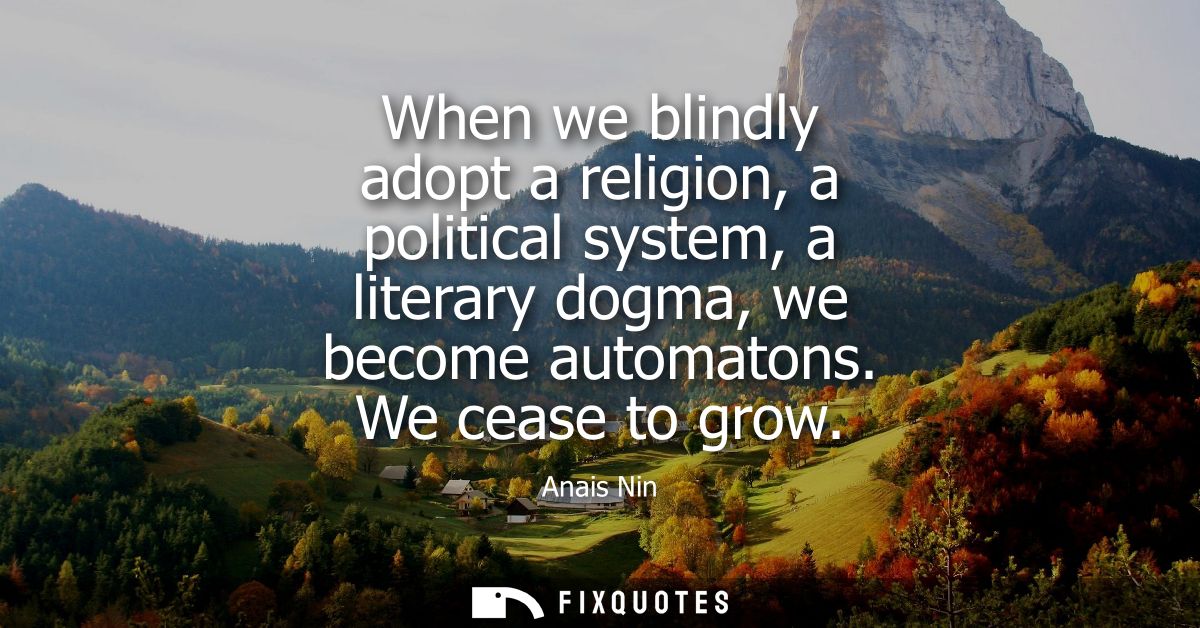
"When we blindly adopt a religion, a political system, a literary dogma, we become automatons. We cease to grow"
About this Quote
Nin takes a scalpel to the kind of belonging that asks you to stop thinking. The sting is in “blindly”: she isn’t indicting religion, politics, or aesthetics as such, but the moment they become prepackaged identities you can slip on like a uniform. “Adopt” sounds domestic, even tender, yet she pairs it with “automatons,” a hard mechanical word that turns comfort into captivity. That tonal whiplash is the point. Systems promise meaning; Nin warns they also offer anesthesia.
Her list is strategic. Putting “literary dogma” beside religion and politics collapses the hierarchy of seriousness. It’s a reminder that the same impulse drives the zealot, the partisan, and the art-world gatekeeper: the hunger to outsource uncertainty to a doctrine. Nin wrote from inside the modernist century’s ideological crossfire, when grand narratives (fascism, communism, psychoanalytic schools, even avant-garde movements) recruited total loyalty. As a diarist and novelist obsessed with interior life, she treats the self as a living instrument; any ideology that demands fixed conclusions is, to her, a form of spiritual taxidermy.
The subtext is a defense of experience over allegiance. “We cease to grow” reframes growth as an ethical obligation, not a self-help slogan. Growth requires friction: doubt, contradiction, revision. Blind adoption removes that friction by turning the mind into a machine that repeats approved phrases. Nin isn’t asking for cynicism; she’s asking for permeability. Keep your beliefs, she implies, but keep your nerve endings too.
Her list is strategic. Putting “literary dogma” beside religion and politics collapses the hierarchy of seriousness. It’s a reminder that the same impulse drives the zealot, the partisan, and the art-world gatekeeper: the hunger to outsource uncertainty to a doctrine. Nin wrote from inside the modernist century’s ideological crossfire, when grand narratives (fascism, communism, psychoanalytic schools, even avant-garde movements) recruited total loyalty. As a diarist and novelist obsessed with interior life, she treats the self as a living instrument; any ideology that demands fixed conclusions is, to her, a form of spiritual taxidermy.
The subtext is a defense of experience over allegiance. “We cease to grow” reframes growth as an ethical obligation, not a self-help slogan. Growth requires friction: doubt, contradiction, revision. Blind adoption removes that friction by turning the mind into a machine that repeats approved phrases. Nin isn’t asking for cynicism; she’s asking for permeability. Keep your beliefs, she implies, but keep your nerve endings too.
Quote Details
| Topic | Reason & Logic |
|---|
More Quotes by Anais
Add to List