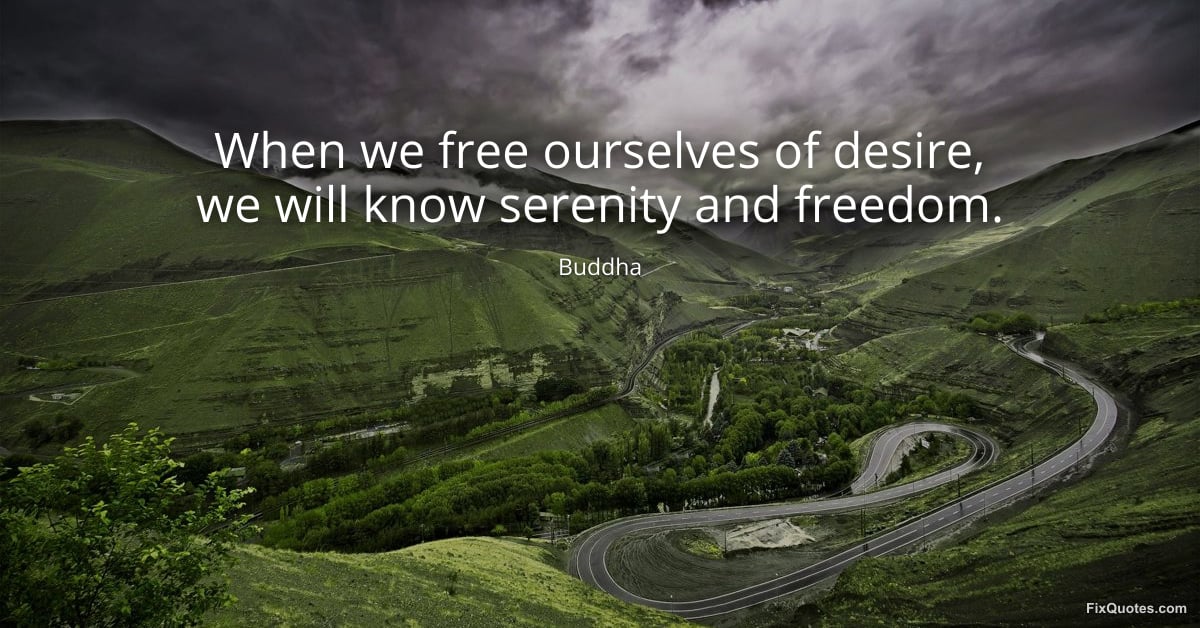
"When we free ourselves of desire, we will know serenity and freedom"
About this Quote
There is nothing soft or decorative about this line. It is a radical claim about the machinery of human suffering. Coming from the Buddha, it carries the force of a diagnosis, not a greeting-card platitude: desire is not merely wanting too much, but the restless attachment that keeps the mind in a permanent state of agitation. Serenity, in this framework, is not earned by acquiring the right objects, status, or even spiritual achievements. It appears only when the compulsion to cling loosens.
That is why the sentence still feels severe. It cuts against nearly every social script, ancient or modern. Whole political and economic orders depend on manufacturing desire, teaching people to confuse craving with identity and consumption with freedom. Buddha reverses that logic. What we call freedom, he suggests, is often servitude to appetite, fear, and fantasy. Real freedom begins when the self stops being yanked around by its own hungers.
The rhetoric works because of its clean, almost juridical certainty. "When" gives the statement the tone of law rather than hope; serenity is presented as a consequence, not a mood. The pairing of "serenity and freedom" is especially powerful because it joins inner and outer liberation. Peace is not just emotional calm. It is independence from the forces that colonize attention.
Historically, this sits at the center of early Buddhist thought: the Four Noble Truths identify craving as the engine of suffering. But the line endures because it names a permanent human trap. We do not simply desire things; we become organized by desire. Buddha's insight is that the jailer and the prisoner are often the same person.
That is why the sentence still feels severe. It cuts against nearly every social script, ancient or modern. Whole political and economic orders depend on manufacturing desire, teaching people to confuse craving with identity and consumption with freedom. Buddha reverses that logic. What we call freedom, he suggests, is often servitude to appetite, fear, and fantasy. Real freedom begins when the self stops being yanked around by its own hungers.
The rhetoric works because of its clean, almost juridical certainty. "When" gives the statement the tone of law rather than hope; serenity is presented as a consequence, not a mood. The pairing of "serenity and freedom" is especially powerful because it joins inner and outer liberation. Peace is not just emotional calm. It is independence from the forces that colonize attention.
Historically, this sits at the center of early Buddhist thought: the Four Noble Truths identify craving as the engine of suffering. But the line endures because it names a permanent human trap. We do not simply desire things; we become organized by desire. Buddha's insight is that the jailer and the prisoner are often the same person.
Quote Details
| Topic | Meditation |
|---|---|
| Source | Help us find the source |
| Cite |
Citation Formats
APA Style (7th ed.)
Buddha. (2026, March 10). When we free ourselves of desire, we will know serenity and freedom. FixQuotes. https://fixquotes.com/quotes/when-we-free-ourselves-of-desire-we-will-know-185945/
Chicago Style
Buddha. "When we free ourselves of desire, we will know serenity and freedom." FixQuotes. March 10, 2026. https://fixquotes.com/quotes/when-we-free-ourselves-of-desire-we-will-know-185945/.
MLA Style (9th ed.)
"When we free ourselves of desire, we will know serenity and freedom." FixQuotes, 10 Mar. 2026, https://fixquotes.com/quotes/when-we-free-ourselves-of-desire-we-will-know-185945/. Accessed 15 Mar. 2026.
More Quotes by Buddha
Add to List