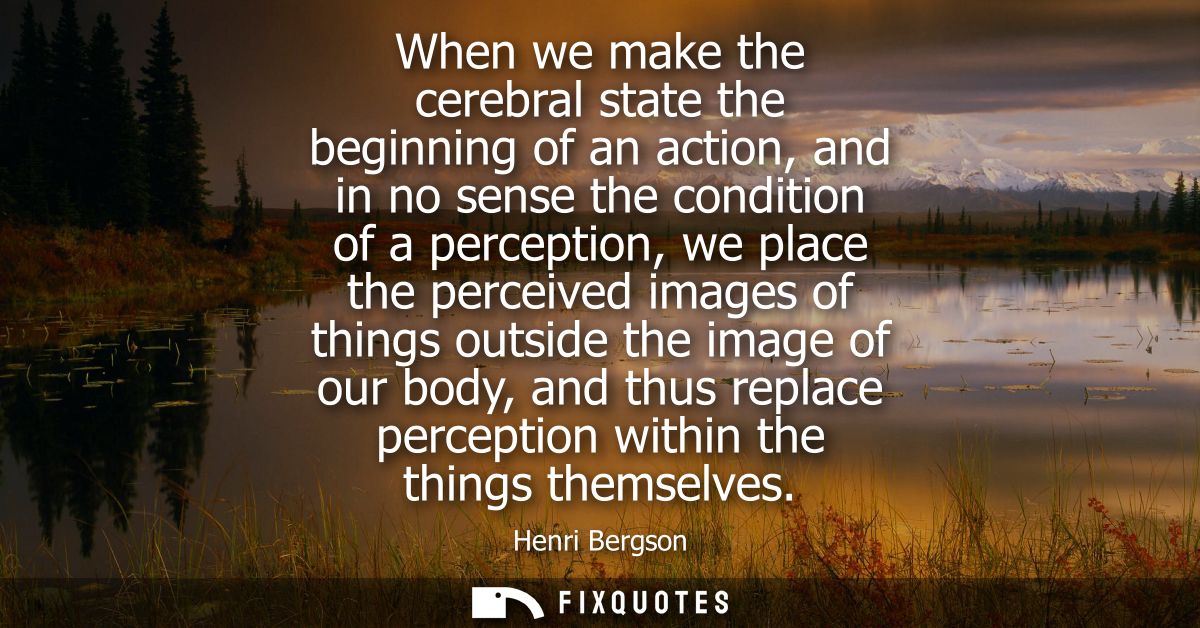
"When we make the cerebral state the beginning of an action, and in no sense the condition of a perception, we place the perceived images of things outside the image of our body, and thus replace perception within the things themselves"
About this Quote
The subtext is an attack on representationalism and the budding neuroscientific temptation (already strong in early psychology) to explain experience by stuffing it inside the skull. Bergson’s sly move is to make perception “within the things themselves” without lapsing into naive realism. He’s not denying consciousness; he’s relocating its work. Perception becomes an economy: what matters is what can be acted on. The “image of our body” is the hinge. The body is an image among images, but a privileged one because it is the point where the world can be altered.
Context matters: Bergson is writing against both mechanistic materialism and static intellectual abstraction, insisting on duration, flux, and lived time. In Matter and Memory, the stakes are ethical and existential as much as epistemic: if perception is action-oriented, then attention, habit, and freedom are not afterthoughts. They are the very grammar of how reality shows up for us.
Quote Details
| Topic | Deep |
|---|---|
| Source | Matter and Memory, Henri Bergson (1896). English translation by N. M. Paul & W. S. Palmer (1911), passage discussing cerebral states and perception. |
| Cite |
Citation Formats
APA Style (7th ed.)
Bergson, Henri. (2026, January 17). When we make the cerebral state the beginning of an action, and in no sense the condition of a perception, we place the perceived images of things outside the image of our body, and thus replace perception within the things themselves. FixQuotes. https://fixquotes.com/quotes/when-we-make-the-cerebral-state-the-beginning-of-32579/
Chicago Style
Bergson, Henri. "When we make the cerebral state the beginning of an action, and in no sense the condition of a perception, we place the perceived images of things outside the image of our body, and thus replace perception within the things themselves." FixQuotes. January 17, 2026. https://fixquotes.com/quotes/when-we-make-the-cerebral-state-the-beginning-of-32579/.
MLA Style (9th ed.)
"When we make the cerebral state the beginning of an action, and in no sense the condition of a perception, we place the perceived images of things outside the image of our body, and thus replace perception within the things themselves." FixQuotes, 17 Jan. 2026, https://fixquotes.com/quotes/when-we-make-the-cerebral-state-the-beginning-of-32579/. Accessed 30 Mar. 2026.