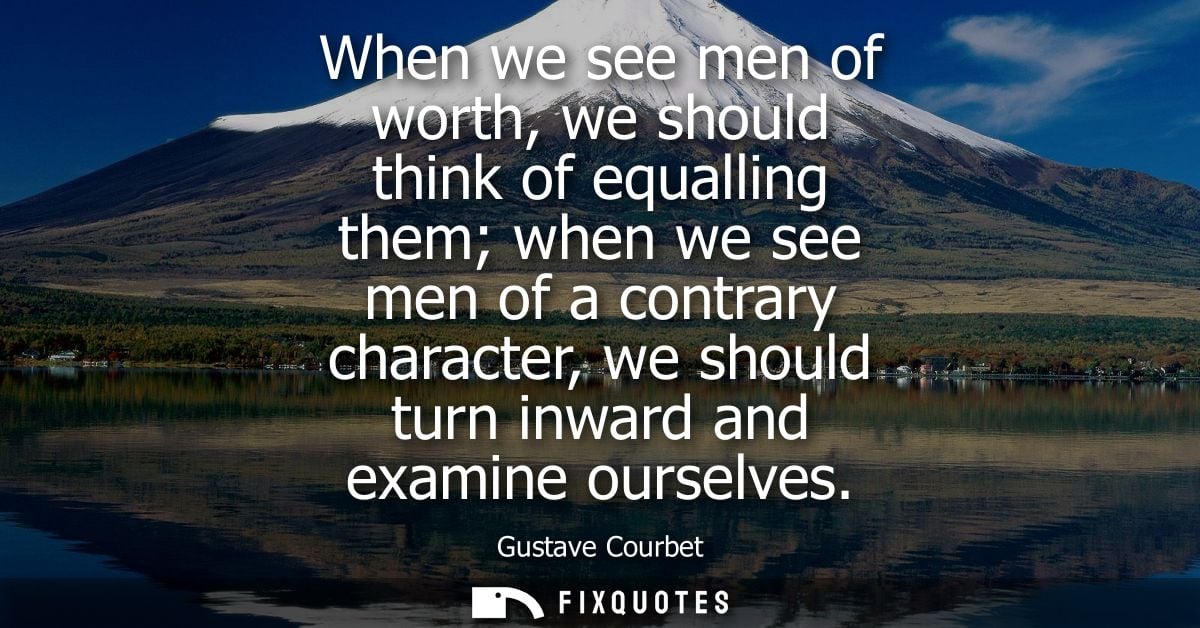
"When we see men of worth, we should think of equalling them; when we see men of a contrary character, we should turn inward and examine ourselves"
About this Quote
The phrasing is quietly combative. “Think of equalling them” doesn’t mean applauding from a safe distance; it’s an instruction to close the gap. That’s especially telling for Courbet, a painter who spent his career trying to drag art away from idealized heroes and mythic scenes and toward the rough, unglamorous reality of ordinary people. Realism, in his hands, wasn’t just a style; it was a moral posture: look directly, don’t romanticize, don’t outsource judgment to tradition.
The second clause is sharper. It denies the pleasurable simplicity of moral superiority. If someone is petty, cowardly, corrupt, the quote suggests your first move shouldn’t be outrage but introspection: Where do I carry a smaller version of that? Courbet smuggles accountability into everyday perception. The subtext is that character isn’t proven by what you praise or denounce, but by whether you can convert both reactions into discipline. In an age of public posturing, it reads like an antidote to performative virtue: less pointing, more reckoning.
Quote Details
| Topic | Self-Improvement |
|---|---|
| Source | Help us find the source |
| Cite |
Citation Formats
APA Style (7th ed.)
Courbet, Gustave. (2026, January 17). When we see men of worth, we should think of equalling them; when we see men of a contrary character, we should turn inward and examine ourselves. FixQuotes. https://fixquotes.com/quotes/when-we-see-men-of-worth-we-should-think-of-53133/
Chicago Style
Courbet, Gustave. "When we see men of worth, we should think of equalling them; when we see men of a contrary character, we should turn inward and examine ourselves." FixQuotes. January 17, 2026. https://fixquotes.com/quotes/when-we-see-men-of-worth-we-should-think-of-53133/.
MLA Style (9th ed.)
"When we see men of worth, we should think of equalling them; when we see men of a contrary character, we should turn inward and examine ourselves." FixQuotes, 17 Jan. 2026, https://fixquotes.com/quotes/when-we-see-men-of-worth-we-should-think-of-53133/. Accessed 5 Apr. 2026.