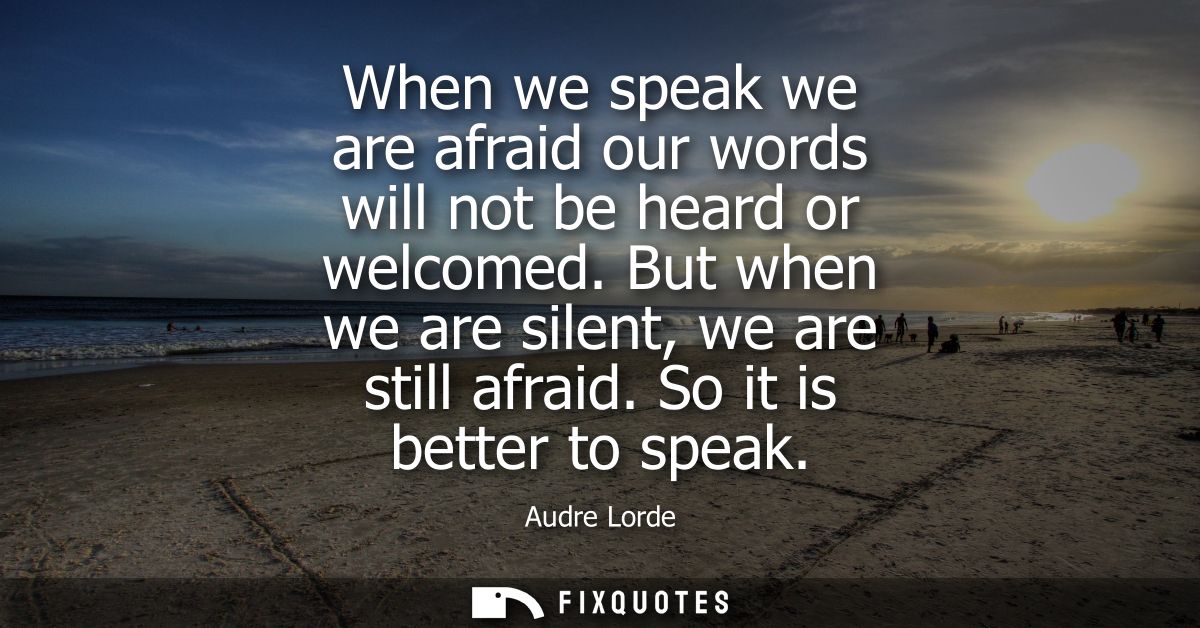
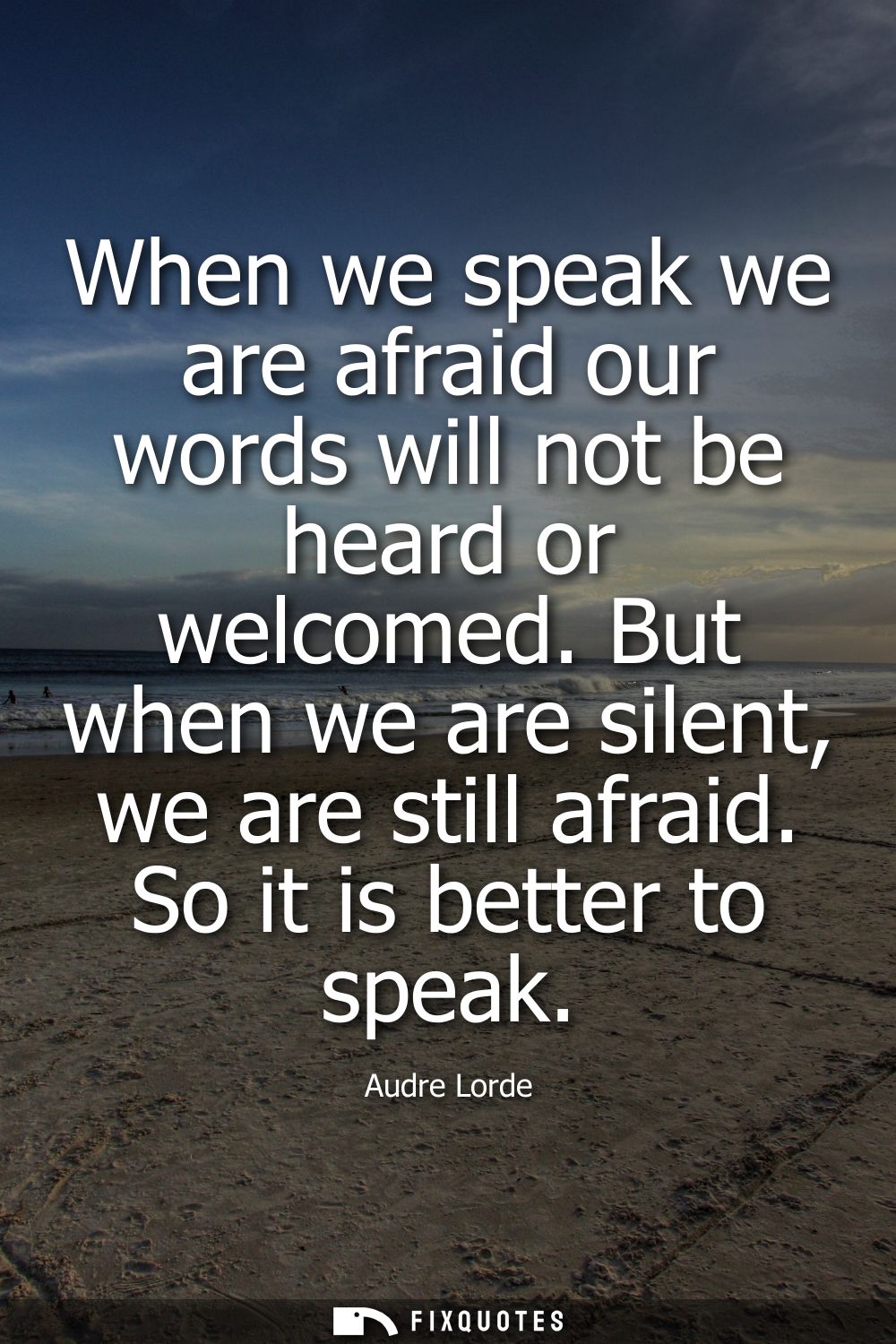
"When we speak, we are afraid our words will not be heard or welcomed. But when we are silent, we are still afraid. So it is better to speak"
About this Quote
The intent is political, but it’s also intimate. Lorde is writing out of the lived reality of being a Black lesbian feminist in a culture built to mishear, dismiss, or punish her. “Not be heard or welcomed” captures two separate threats: invisibility (no audience, no impact) and backlash (an audience that turns hostile). In that light, the sentence refuses the comforting myth that silence can keep you unmarked. Marginalized people already carry risk; quiet doesn’t erase it, it just relocates it inward.
The subtext is also a critique of respectability. “Welcomed” hints at the trap of calibrating your truth to fit the room, to earn permission to exist. Lorde argues you’ll be afraid anyway, so you might as well spend that fear producing something: testimony, dissent, a signal to others that they’re not alone. The rhetoric is deceptively simple, almost conversational, which is exactly why it works: it turns a moral dilemma into a clear-eyed cost-benefit analysis, then dares you to act.
Quote Details
| Topic | Confidence |
|---|---|
| Source | Evidence: and when we speak we are afraid our words will not be heard nor welcomed but when we are silent we are still afraid So it is better to speak remembering we were never meant to survive.. The wording in your query is a common paraphrase/modernized punctuation of lines from Audre Lorde’s poem “A Litany for Survival.” A primary-source publication for the poem is Lorde’s poetry collection The Black Unicorn (first edition published 1978 by W. W. Norton). The Poetry Foundation page reproduces the poem and includes a copyright credit indicating © 1978 and source as The Collected Poems of Audre Lorde (W. W. Norton), which supports the text of the quoted lines. A library catalog record also confirms The Black Unicorn as published in 1978 by Norton (print, 1st ed.). Other candidates (1) The Consent Guidebook (Erin Tillman, 2018) compilation97.1% ... Audre Lorde said, 'When we speak, we are afraid our words will not be heard or welcomed. But when we are silent, ... |
| Cite |
Citation Formats
APA Style (7th ed.)
Lorde, Audre. (2026, February 16). When we speak, we are afraid our words will not be heard or welcomed. But when we are silent, we are still afraid. So it is better to speak. FixQuotes. https://fixquotes.com/quotes/when-we-speak-we-are-afraid-our-words-will-not-be-37623/
Chicago Style
Lorde, Audre. "When we speak, we are afraid our words will not be heard or welcomed. But when we are silent, we are still afraid. So it is better to speak." FixQuotes. February 16, 2026. https://fixquotes.com/quotes/when-we-speak-we-are-afraid-our-words-will-not-be-37623/.
MLA Style (9th ed.)
"When we speak, we are afraid our words will not be heard or welcomed. But when we are silent, we are still afraid. So it is better to speak." FixQuotes, 16 Feb. 2026, https://fixquotes.com/quotes/when-we-speak-we-are-afraid-our-words-will-not-be-37623/. Accessed 27 Mar. 2026.