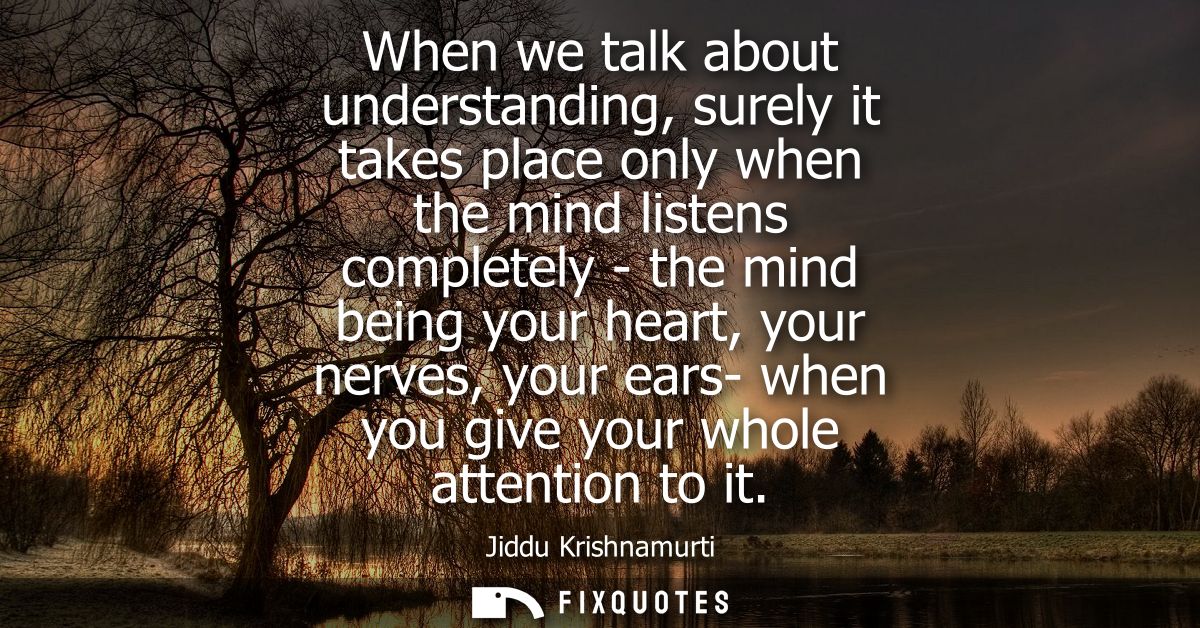
"When we talk about understanding, surely it takes place only when the mind listens completely - the mind being your heart, your nerves, your ears- when you give your whole attention to it"
About this Quote
The phrase “surely it takes place only when” is classic Krishnamurti: a soft-spoken absolute. He isn’t offering a technique so much as a diagnosis of why techniques fail. Most of what passes for understanding, he implies, is the mind talking to itself: sorting, labeling, rehearsing its own position while pretending to receive the world. By redefining “mind” as “your heart, your nerves, your ears,” he attacks the Western habit of treating cognition as a purely cerebral affair. This isn’t New Age ornamentation; it’s a strategic widening. If attention is whole-body, then distraction isn’t just scrolling - it’s the subtle tension of self-protection, the nervous system bracing to defend an identity.
Context matters: Krishnamurti spent decades rejecting organized authority, including the spiritual organization built around him. That anti-institutional stance lives in the sentence. “Give your whole attention” is an invitation to unmediated perception, bypassing gurus, doctrines, even comforting narratives about who you are. The subtext is ruthless: if you don’t understand, it’s not because reality is opaque; it’s because you’re not actually listening. And that lands as both liberation and indictment in a culture addicted to partial attention masquerading as insight.
Quote Details
| Topic | Wisdom |
|---|---|
| Source | Help us find the source |
| Cite |
Citation Formats
APA Style (7th ed.)
Krishnamurti, Jiddu. (2026, January 18). When we talk about understanding, surely it takes place only when the mind listens completely - the mind being your heart, your nerves, your ears- when you give your whole attention to it. FixQuotes. https://fixquotes.com/quotes/when-we-talk-about-understanding-surely-it-takes-7677/
Chicago Style
Krishnamurti, Jiddu. "When we talk about understanding, surely it takes place only when the mind listens completely - the mind being your heart, your nerves, your ears- when you give your whole attention to it." FixQuotes. January 18, 2026. https://fixquotes.com/quotes/when-we-talk-about-understanding-surely-it-takes-7677/.
MLA Style (9th ed.)
"When we talk about understanding, surely it takes place only when the mind listens completely - the mind being your heart, your nerves, your ears- when you give your whole attention to it." FixQuotes, 18 Jan. 2026, https://fixquotes.com/quotes/when-we-talk-about-understanding-surely-it-takes-7677/. Accessed 12 Feb. 2026.