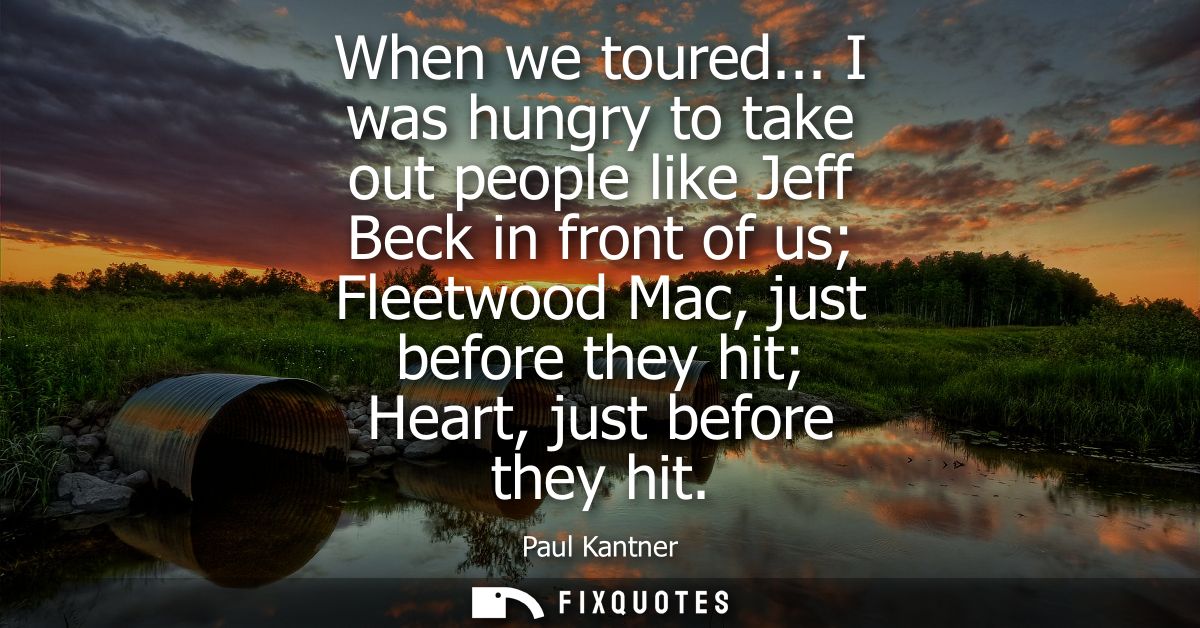
"When we toured... I was hungry to take out people like Jeff Beck in front of us; Fleetwood Mac, just before they hit; Heart, just before they hit"
About this Quote
Name-checking Jeff Beck, Fleetwood Mac, and Heart does double work. It flatters his own competitive edge (he had taste, he could spot killers early), and it reframes success as timing as much as talent: “just before they hit” is the crucial phrase. He’s not only measuring himself against greatness; he’s pointing to that razor-thin window when a group is still scrappy, still beatable, still trying to prove it. After the hit, the story becomes destiny. Before it, it’s a knife fight.
Kantner came out of a scene (Jefferson Airplane and its sprawling counterculture mythology) that’s often remembered as idealistic and communal. This quote punctures that nostalgia without being bitter. It’s a musician admitting the quiet truth behind the peace-and-love poster: the desire to win was always there, and it was often what made the music sharp enough to last.
Quote Details
| Topic | Music |
|---|---|
| Source | Help us find the source |
| Cite |
Citation Formats
APA Style (7th ed.)
Kantner, Paul. (2026, January 16). When we toured... I was hungry to take out people like Jeff Beck in front of us; Fleetwood Mac, just before they hit; Heart, just before they hit. FixQuotes. https://fixquotes.com/quotes/when-we-toured-i-was-hungry-to-take-out-people-109078/
Chicago Style
Kantner, Paul. "When we toured... I was hungry to take out people like Jeff Beck in front of us; Fleetwood Mac, just before they hit; Heart, just before they hit." FixQuotes. January 16, 2026. https://fixquotes.com/quotes/when-we-toured-i-was-hungry-to-take-out-people-109078/.
MLA Style (9th ed.)
"When we toured... I was hungry to take out people like Jeff Beck in front of us; Fleetwood Mac, just before they hit; Heart, just before they hit." FixQuotes, 16 Jan. 2026, https://fixquotes.com/quotes/when-we-toured-i-was-hungry-to-take-out-people-109078/. Accessed 30 Mar. 2026.