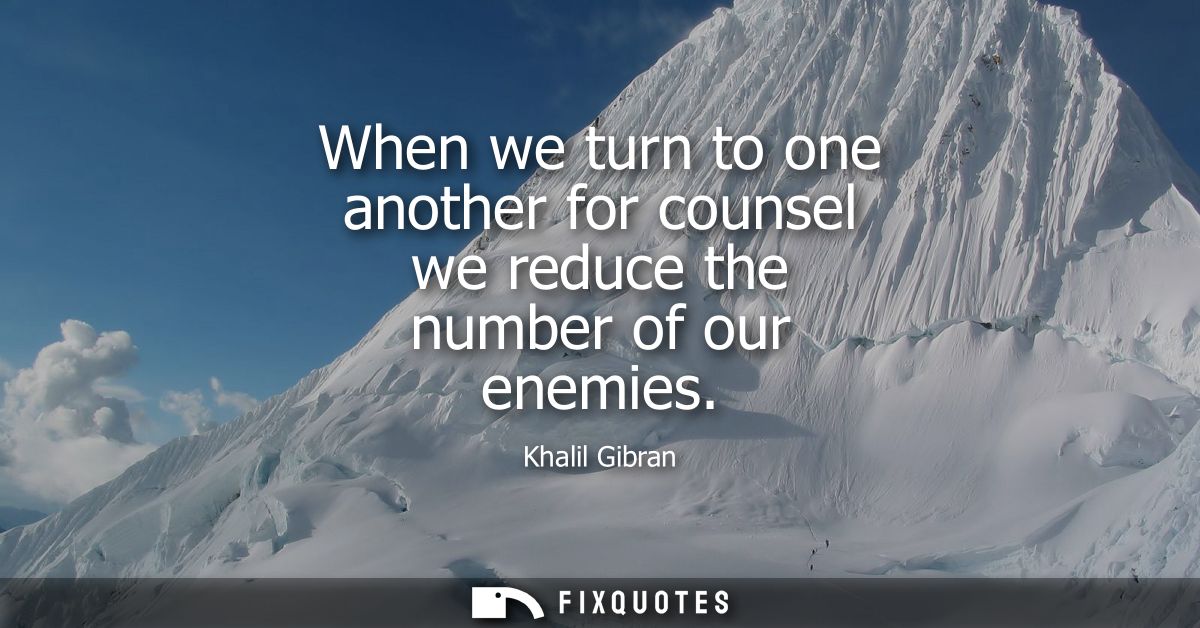
"When we turn to one another for counsel, we reduce the number of our enemies"
About this Quote
The phrasing does quiet work. "Turn to one another" suggests a physical reorientation, like bodies pivoting away from the horizon of conflict and toward the messier, more human face-to-face. And "reduce" is deliberately unsentimental. Gibran doesn’t promise harmony; he promises fewer enemies. It’s a minimalist, almost managerial claim: conflict may be inevitable, but its scope is negotiable.
Context matters. Gibran wrote as a Lebanese immigrant in the United States, shaped by exile, nationalism, and the early 20th century’s churn of empires and wars. His mystical tone often gets filed under inspirational poster, but this line has teeth in a diaspora context: community survival depends on conversation before fracture hardens into faction. The subtext is a rebuke to pride and self-sufficiency. If you insist on going it alone, you manufacture adversaries out of mere strangers. Counsel is the antidote to that reflex: a social technology that converts potential opponents into participants.
Quote Details
| Topic | Friendship |
|---|---|
| Source | Help us find the source |
| Cite |
Citation Formats
APA Style (7th ed.)
Gibran, Kahlil. (2026, February 20). When we turn to one another for counsel, we reduce the number of our enemies. FixQuotes. https://fixquotes.com/quotes/when-we-turn-to-one-another-for-counsel-we-reduce-17374/
Chicago Style
Gibran, Kahlil. "When we turn to one another for counsel, we reduce the number of our enemies." FixQuotes. February 20, 2026. https://fixquotes.com/quotes/when-we-turn-to-one-another-for-counsel-we-reduce-17374/.
MLA Style (9th ed.)
"When we turn to one another for counsel, we reduce the number of our enemies." FixQuotes, 20 Feb. 2026, https://fixquotes.com/quotes/when-we-turn-to-one-another-for-counsel-we-reduce-17374/. Accessed 24 Mar. 2026.