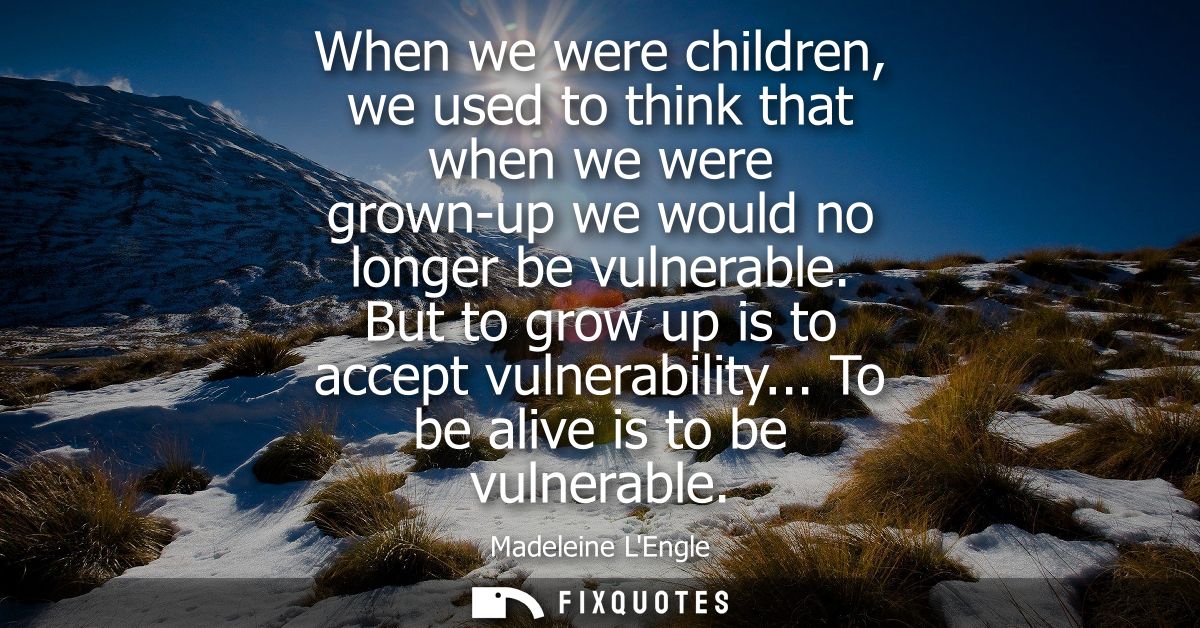
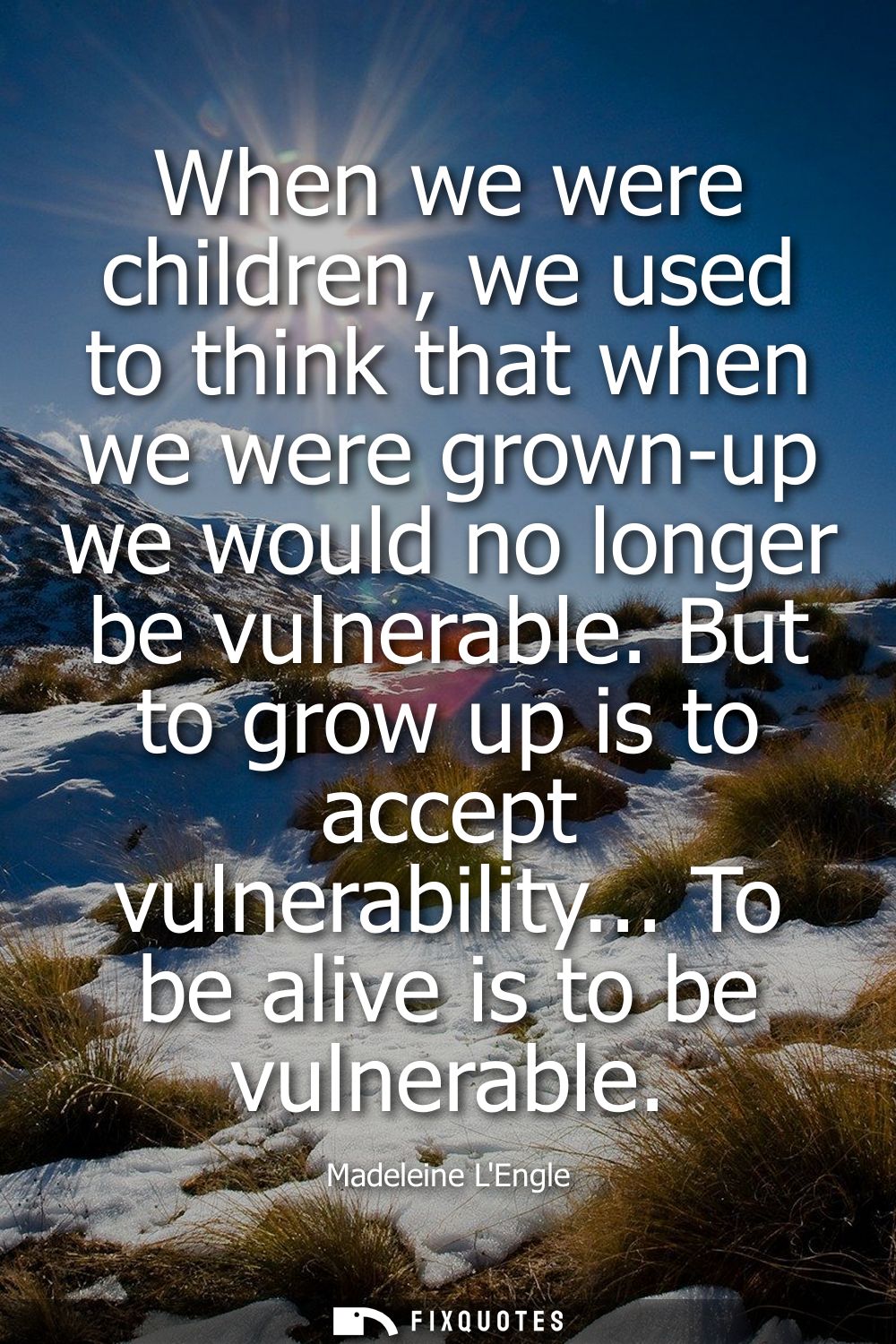
"When we were children, we used to think that when we were grown-up we would no longer be vulnerable. But to grow up is to accept vulnerability... To be alive is to be vulnerable"
About this Quote
The craft here is in the gentle bait-and-switch. She starts with a childlike assumption nearly everyone recognizes, then pivots on "But" and tightens the screw: "to grow up is to accept". Not to defeat vulnerability, not to outthink it, just to accept it as structural. The repetition of "vulnerable" works like a drumbeat, stripping the word of melodrama until it's as plain as breathing. By the time she lands on "To be alive is to be vulnerable", the statement feels less like advice and more like physics.
The subtext is quietly radical, especially in late-20th-century American culture where competence is often performed as self-sufficiency. L'Engle, a novelist steeped in spiritual and moral seriousness, is also arguing for intimacy: you cannot love, create, parent, or believe without risking loss, rejection, and change. Invulnerability isn't maturity; it's a kind of emotional quarantine. Her intent isn't to romanticize pain but to reframe it: the tenderness you resent is proof you're still in the world, still reachable, still human.
Quote Details
| Topic | Life |
|---|---|
| Source | Help us find the source |
| Cite |
Citation Formats
APA Style (7th ed.)
L'Engle, Madeleine. (2026, January 16). When we were children, we used to think that when we were grown-up we would no longer be vulnerable. But to grow up is to accept vulnerability... To be alive is to be vulnerable. FixQuotes. https://fixquotes.com/quotes/when-we-were-children-we-used-to-think-that-when-127543/
Chicago Style
L'Engle, Madeleine. "When we were children, we used to think that when we were grown-up we would no longer be vulnerable. But to grow up is to accept vulnerability... To be alive is to be vulnerable." FixQuotes. January 16, 2026. https://fixquotes.com/quotes/when-we-were-children-we-used-to-think-that-when-127543/.
MLA Style (9th ed.)
"When we were children, we used to think that when we were grown-up we would no longer be vulnerable. But to grow up is to accept vulnerability... To be alive is to be vulnerable." FixQuotes, 16 Jan. 2026, https://fixquotes.com/quotes/when-we-were-children-we-used-to-think-that-when-127543/. Accessed 21 Feb. 2026.