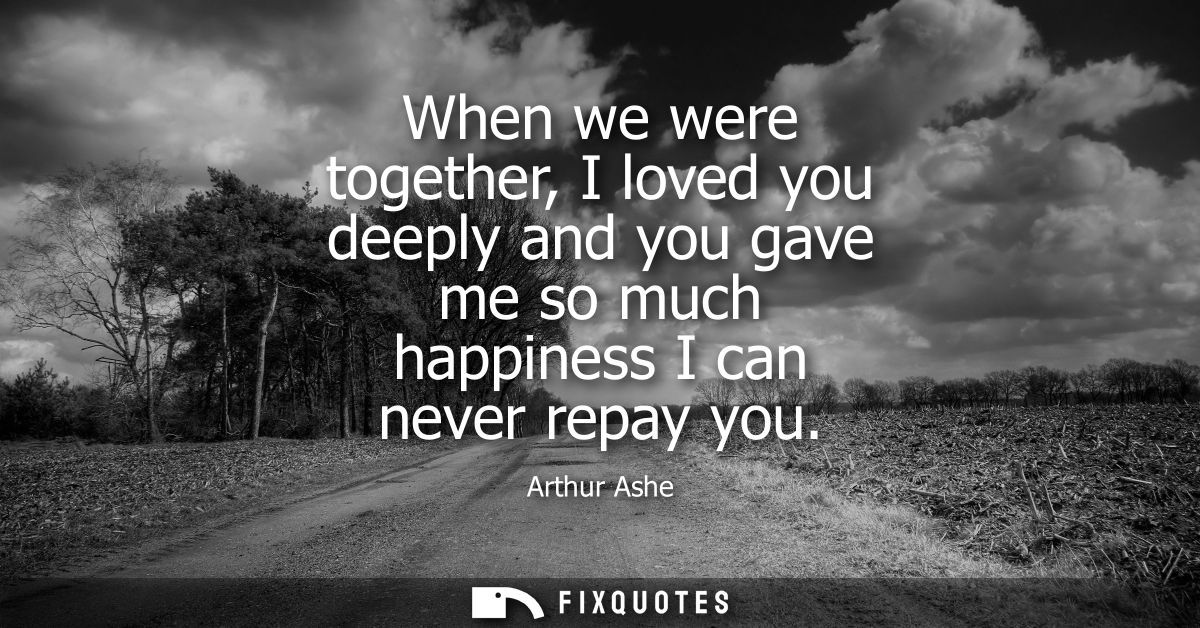
"When we were together, I loved you deeply and you gave me so much happiness, I can never repay you"
About this Quote
The emotional voltage comes from the pairing of depth and debt. "I loved you deeply" is intimate but controlled; "you gave me so much happiness I can never repay you" shifts the focus outward, turning romance into gratitude. That "never repay" is the subtextual pivot: it sounds generous, but it also hints at imbalance, at a relationship where one person feels permanently in arrears. Ashe isn’t begging for another chance; he’s acknowledging a ledger that can’t be balanced and choosing to leave it that way.
In context, Ashe’s cultural persona matters. He was a Black athlete navigating elite white institutions, often praised for restraint and dignity. This sentence carries that same ethic: no blame, no spectacle, no ownership. It’s a farewell that preserves the other person’s value while admitting a private kind of loss. The intent isn’t to reopen the door; it’s to close it without slamming.
Quote Details
| Topic | Heartbreak |
|---|---|
| Source | Help us find the source |
| Cite |
Citation Formats
APA Style (7th ed.)
Ashe, Arthur. (2026, February 20). When we were together, I loved you deeply and you gave me so much happiness, I can never repay you. FixQuotes. https://fixquotes.com/quotes/when-we-were-together-i-loved-you-deeply-and-you-4326/
Chicago Style
Ashe, Arthur. "When we were together, I loved you deeply and you gave me so much happiness, I can never repay you." FixQuotes. February 20, 2026. https://fixquotes.com/quotes/when-we-were-together-i-loved-you-deeply-and-you-4326/.
MLA Style (9th ed.)
"When we were together, I loved you deeply and you gave me so much happiness, I can never repay you." FixQuotes, 20 Feb. 2026, https://fixquotes.com/quotes/when-we-were-together-i-loved-you-deeply-and-you-4326/. Accessed 1 Apr. 2026.