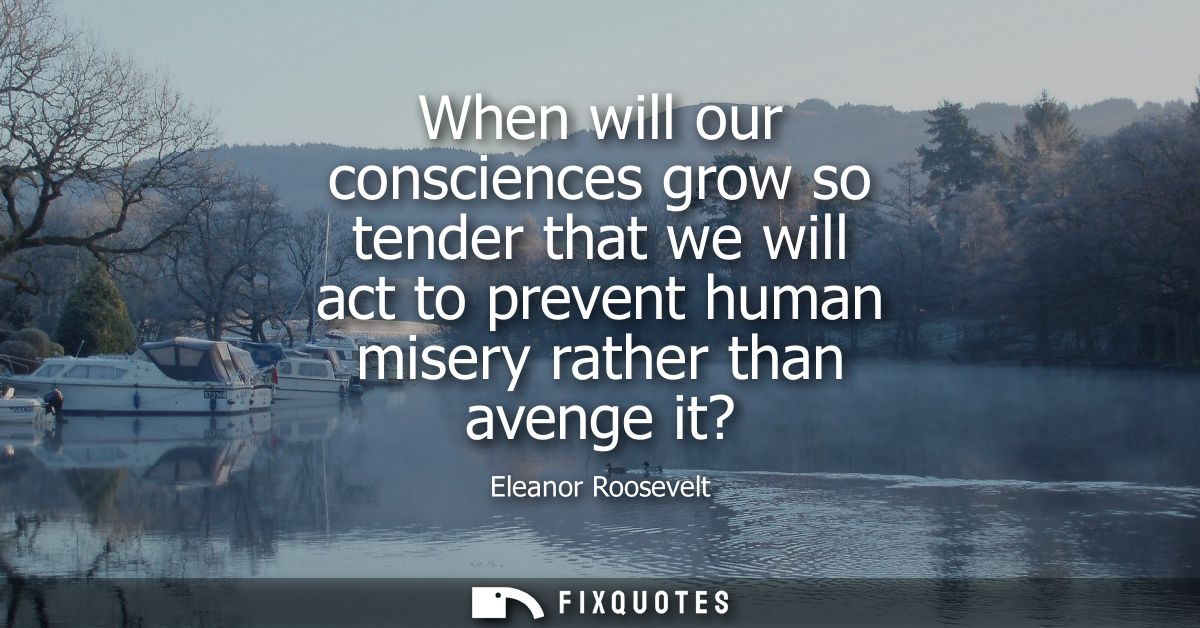
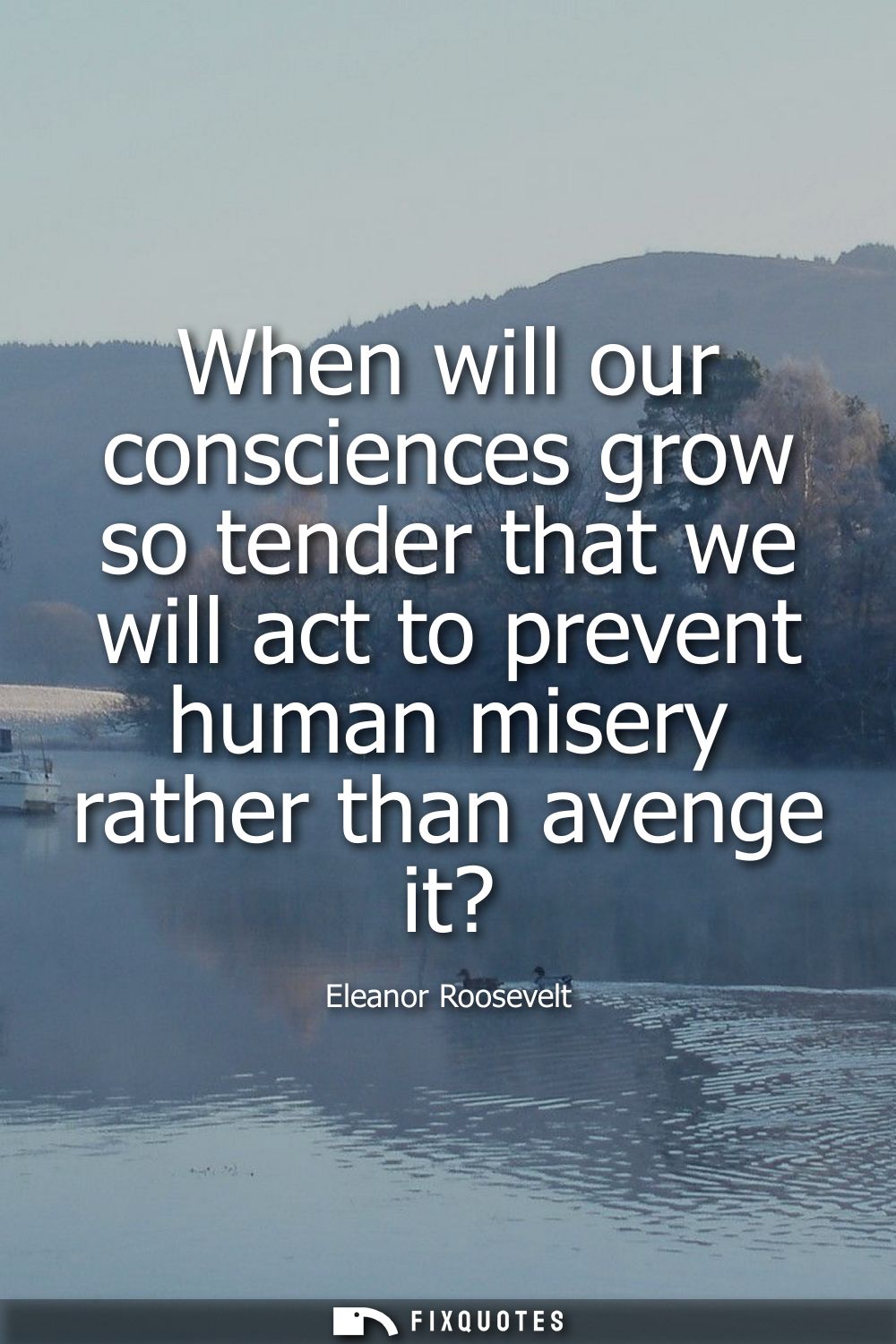
"When will our consciences grow so tender that we will act to prevent human misery rather than avenge it?"
About this Quote
The subtext is a critique of a politics that confuses justice with retaliation. “Avenge” carries a hint of nationalist pride and moral certainty: it’s what countries do after attacks, what institutions do after scandals, what communities do after harm has already hardened into a headline. Roosevelt’s moral imagination pushes upstream. She’s challenging the reflex to treat misery as inevitable until it becomes actionable as punishment.
Context sharpens the edge. Roosevelt’s public life ran through the Great Depression, World War II, the early Cold War, and the birth of the modern human-rights project; she helped steer the Universal Declaration of Human Rights. Read there, the quote is a rebuke to a world fluent in war-making and prison-building but stingy with social insurance, refugee protection, and international cooperation. The intent is not to plead for kindness. It’s to demand a different definition of strength: the courage to act before suffering can be weaponized into righteous revenge.
Quote Details
| Topic | Human Rights |
|---|---|
| Source | Help us find the source |
| Cite |
Citation Formats
APA Style (7th ed.)
Roosevelt, Eleanor. (2026, January 15). When will our consciences grow so tender that we will act to prevent human misery rather than avenge it? FixQuotes. https://fixquotes.com/quotes/when-will-our-consciences-grow-so-tender-that-we-19292/
Chicago Style
Roosevelt, Eleanor. "When will our consciences grow so tender that we will act to prevent human misery rather than avenge it?" FixQuotes. January 15, 2026. https://fixquotes.com/quotes/when-will-our-consciences-grow-so-tender-that-we-19292/.
MLA Style (9th ed.)
"When will our consciences grow so tender that we will act to prevent human misery rather than avenge it?" FixQuotes, 15 Jan. 2026, https://fixquotes.com/quotes/when-will-our-consciences-grow-so-tender-that-we-19292/. Accessed 12 Feb. 2026.