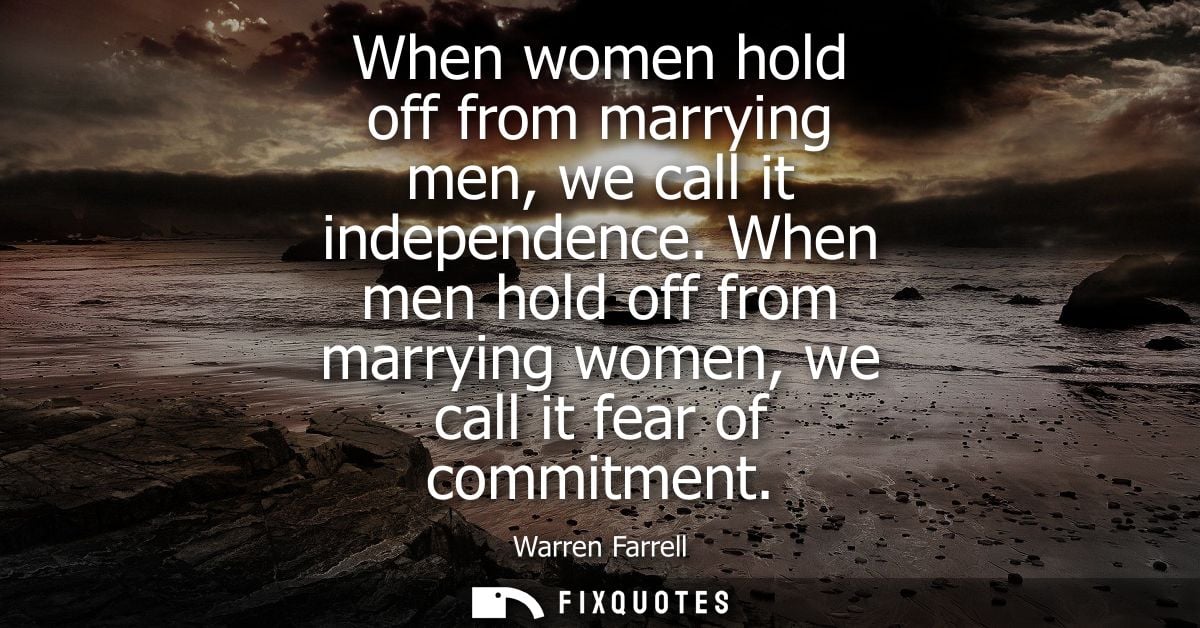
"When women hold off from marrying men, we call it independence. When men hold off from marrying women, we call it fear of commitment"
About this Quote
The subtext is less about marriage than about who gets to define the story around choice. Women’s delay reads as self-possession, men’s delay reads as avoidance: one side is narratively granted a future, the other is narratively stuck in a diagnosis. That framing fits Farrell’s broader project as a men’s-issues writer: arguing that cultural scripts routinely interpret male motives in the least generous light, especially in intimate life.
Context matters because the line compresses decades of shifting norms - later marriage, economic precarity, feminist gains, and the rise of relationship discourse that treats commitment as a moral milestone. It also quietly smuggles in a premise: that “holding off” is comparable across genders. It often isn’t. Different risks, power dynamics, and expectations can shape that delay. The quote works because it’s catchy and plausible, but its provocation depends on flattening those differences to make the linguistic bias pop.
Quote Details
| Topic | Relationship |
|---|---|
| Source | Help us find the source |
| Cite |
Citation Formats
APA Style (7th ed.)
Farrell, Warren. (2026, January 16). When women hold off from marrying men, we call it independence. When men hold off from marrying women, we call it fear of commitment. FixQuotes. https://fixquotes.com/quotes/when-women-hold-off-from-marrying-men-we-call-it-95890/
Chicago Style
Farrell, Warren. "When women hold off from marrying men, we call it independence. When men hold off from marrying women, we call it fear of commitment." FixQuotes. January 16, 2026. https://fixquotes.com/quotes/when-women-hold-off-from-marrying-men-we-call-it-95890/.
MLA Style (9th ed.)
"When women hold off from marrying men, we call it independence. When men hold off from marrying women, we call it fear of commitment." FixQuotes, 16 Jan. 2026, https://fixquotes.com/quotes/when-women-hold-off-from-marrying-men-we-call-it-95890/. Accessed 1 Apr. 2026.