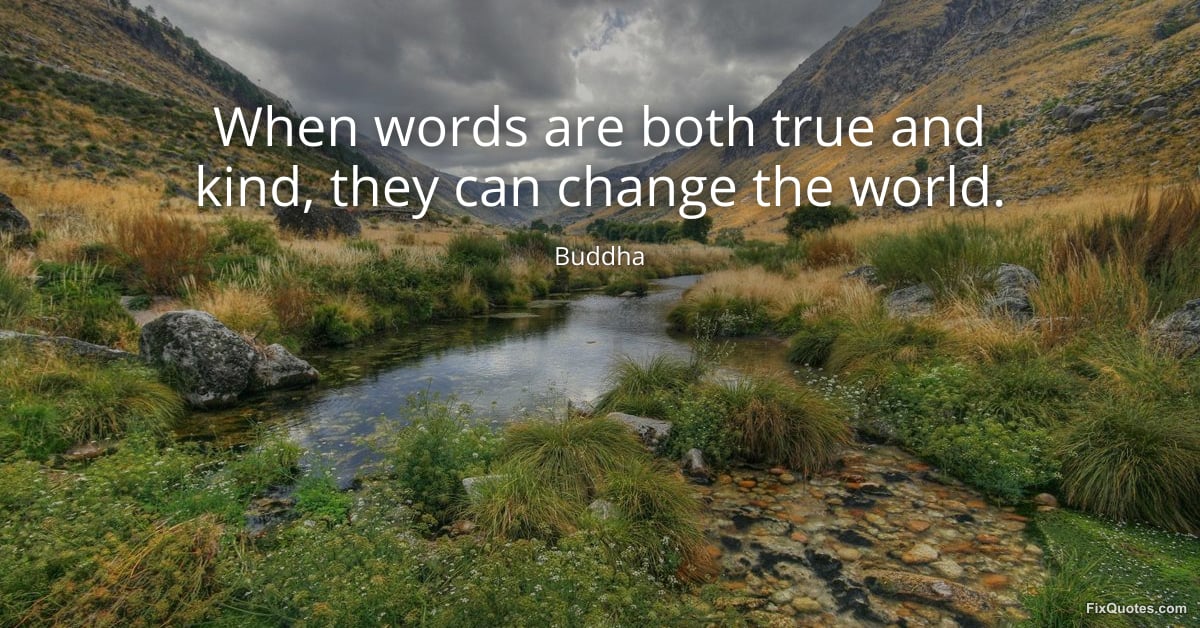
"When words are both true and kind, they can change the world"
About this Quote
Buddha’s line has the calm force of a moral standard that sounds gentle until you realize how demanding it is. Truth alone can wound. Kindness alone can drift into avoidance. The power of the statement lies in refusing that false choice. It proposes that speech is most transformative not when it is merely honest or merely pleasant, but when it binds ethical clarity to compassion.
That matters in the context of Buddhist teaching, where language is not a neutral tool. Speech is action. In the framework of right speech, one is called to avoid lies, cruelty, gossip, and pointless chatter. So the quote is not praising nice words in the abstract; it is setting a discipline. The intent is corrective. Human beings often use truth as a license for brutality, or kindness as an excuse for dishonesty. Buddha cuts across both habits. A world changed by language, in this view, is not changed by slogans or eloquence alone, but by speech that reduces suffering.
The subtext is political as much as personal. Words shape relationships, communities, and the moral atmosphere people live inside. To speak truthfully and kindly is to reject domination, vanity, and ego, all of which distort language. That gives the sentence its enduring weight. It does not flatter the speaker as a heroic truth-teller, and it does not celebrate civility for its own sake. It asks for something harder: self-mastery. The world changes because people do, and people often change through the words that make them feel seen without being deceived.
That matters in the context of Buddhist teaching, where language is not a neutral tool. Speech is action. In the framework of right speech, one is called to avoid lies, cruelty, gossip, and pointless chatter. So the quote is not praising nice words in the abstract; it is setting a discipline. The intent is corrective. Human beings often use truth as a license for brutality, or kindness as an excuse for dishonesty. Buddha cuts across both habits. A world changed by language, in this view, is not changed by slogans or eloquence alone, but by speech that reduces suffering.
The subtext is political as much as personal. Words shape relationships, communities, and the moral atmosphere people live inside. To speak truthfully and kindly is to reject domination, vanity, and ego, all of which distort language. That gives the sentence its enduring weight. It does not flatter the speaker as a heroic truth-teller, and it does not celebrate civility for its own sake. It asks for something harder: self-mastery. The world changes because people do, and people often change through the words that make them feel seen without being deceived.
Quote Details
| Topic | Kindness |
|---|---|
| Source | Help us find the source |
| Cite |
Citation Formats
APA Style (7th ed.)
Buddha. (2026, March 10). When words are both true and kind, they can change the world. FixQuotes. https://fixquotes.com/quotes/when-words-are-both-true-and-kind-they-can-change-185966/
Chicago Style
Buddha. "When words are both true and kind, they can change the world." FixQuotes. March 10, 2026. https://fixquotes.com/quotes/when-words-are-both-true-and-kind-they-can-change-185966/.
MLA Style (9th ed.)
"When words are both true and kind, they can change the world." FixQuotes, 10 Mar. 2026, https://fixquotes.com/quotes/when-words-are-both-true-and-kind-they-can-change-185966/. Accessed 4 Apr. 2026.
More Quotes by Buddha
Add to List