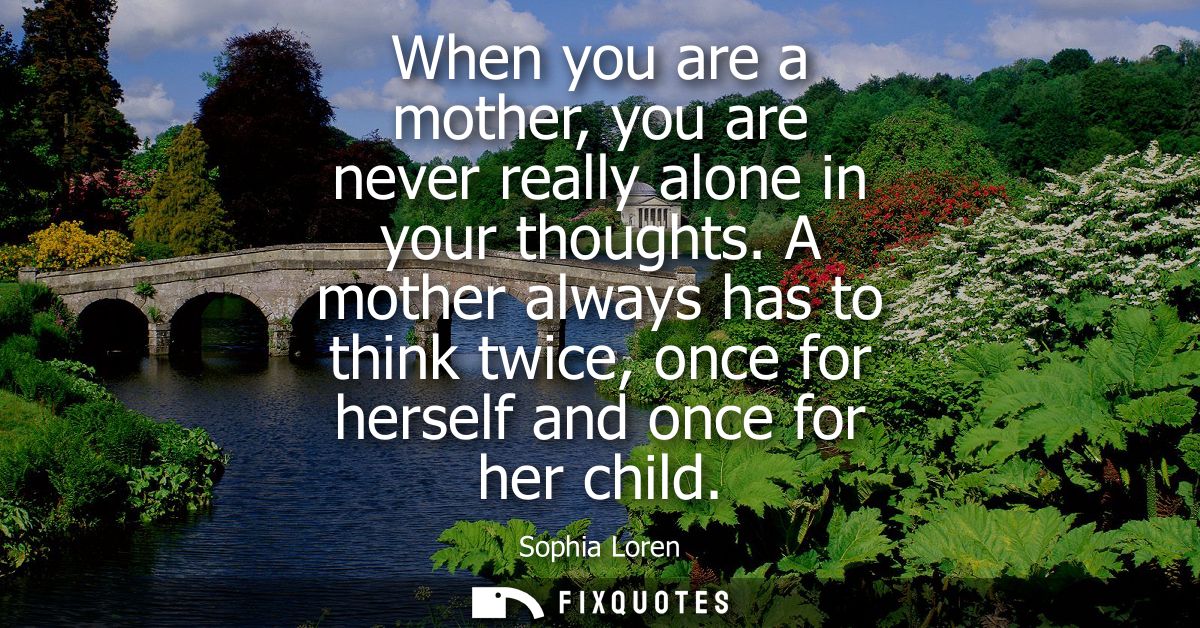
"When you are a mother, you are never really alone in your thoughts. A mother always has to think twice, once for herself and once for her child"
About this Quote
Motherhood, in Sophia Loren's telling, isn’t a halo or a highlight reel; it’s a permanent roommate in your own head. The line works because it smuggles a psychological truth into a simple piece of arithmetic: “think twice.” It’s not poetic abstraction, it’s a daily mechanism. Loren frames motherhood as an ongoing split-screen, where even private impulses get edited in real time by an internalized second audience: the child.
The subtext is quietly radical for a movie star whose public image was built on glamour and singular desirability. She’s redefining “never alone” away from romance and toward responsibility, replacing the fantasy of the self-contained woman with a self that’s relational by default. That’s why the quote lands: it refuses the tidy cultural script that motherhood is purely fulfilling, and instead depicts it as cognitive labor - constant contingency planning, emotional triage, risk assessment. The tenderness is there, but it’s tethered to vigilance.
Context matters, too. Loren came up in a postwar Italian culture that treated motherhood as both sacred duty and social identity, while her career demanded mobility, appetite, and self-possession. This line bridges those worlds without apology. It’s also a subtle rebuttal to the idea that a mother’s mind is somehow “less” because it’s occupied with someone else. Loren suggests the opposite: motherhood expands the perimeter of thought, forcing a double consciousness that reshapes desire, fear, and even spontaneity. The cost is privacy. The payoff is a new kind of presence.
The subtext is quietly radical for a movie star whose public image was built on glamour and singular desirability. She’s redefining “never alone” away from romance and toward responsibility, replacing the fantasy of the self-contained woman with a self that’s relational by default. That’s why the quote lands: it refuses the tidy cultural script that motherhood is purely fulfilling, and instead depicts it as cognitive labor - constant contingency planning, emotional triage, risk assessment. The tenderness is there, but it’s tethered to vigilance.
Context matters, too. Loren came up in a postwar Italian culture that treated motherhood as both sacred duty and social identity, while her career demanded mobility, appetite, and self-possession. This line bridges those worlds without apology. It’s also a subtle rebuttal to the idea that a mother’s mind is somehow “less” because it’s occupied with someone else. Loren suggests the opposite: motherhood expands the perimeter of thought, forcing a double consciousness that reshapes desire, fear, and even spontaneity. The cost is privacy. The payoff is a new kind of presence.
Quote Details
| Topic | Mother |
|---|---|
| Source | Help us find the source |
More Quotes by Sophia
Add to List