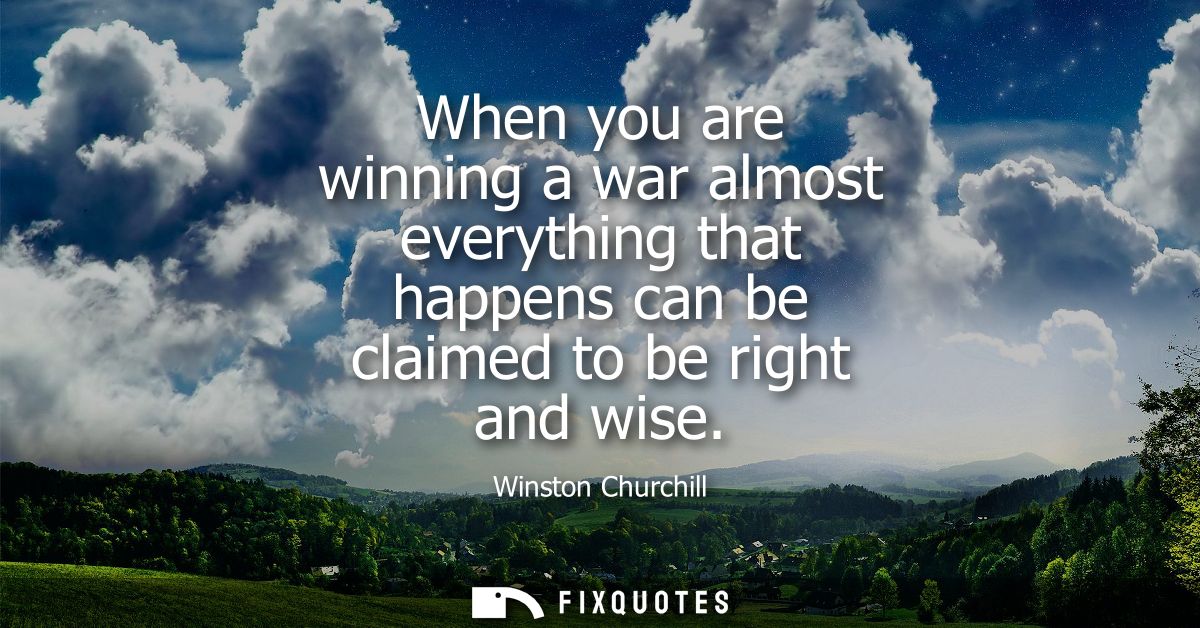
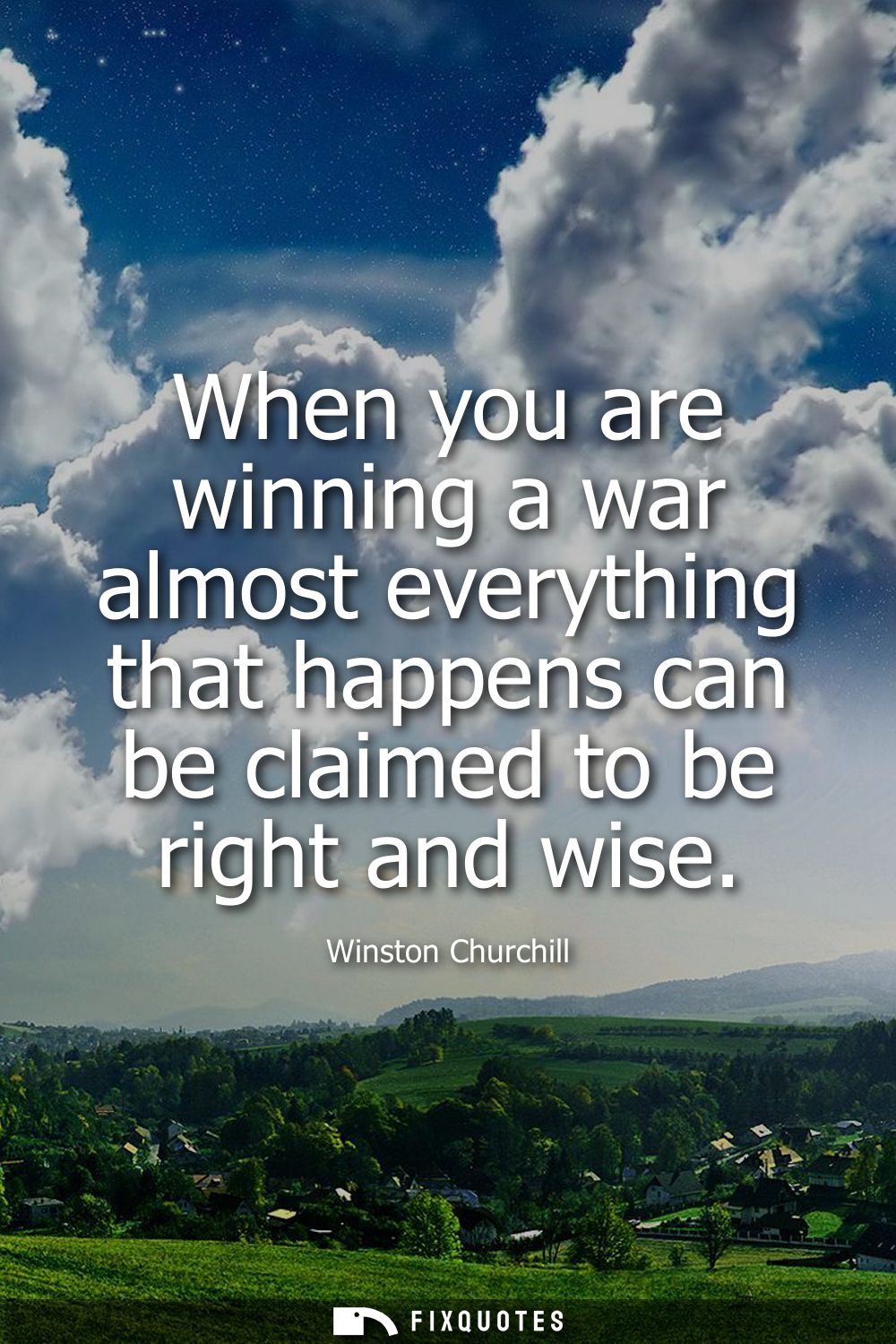
"When you are winning a war almost everything that happens can be claimed to be right and wise"
About this Quote
Victory is the great solvent: it dissolves moral doubt, strategic error, even sheer luck into a clean narrative of competence. Churchill’s line isn’t a pep talk about confidence; it’s a warning about how power edits the record. When you’re winning, the public, the press, and your own inner circle start reverse-engineering brilliance from outcomes. A risky maneuver becomes “bold.” A costly misjudgment becomes “necessary.” Atrocities get filed under “hard choices.” The scoreboard doesn’t just validate policy; it manufactures wisdom.
The intent carries Churchill’s characteristic realism about politics and war. He knew that wartime leadership is judged less like a court case and more like a referendum. The subtext is almost prosecutorial: don’t mistake applause for proof, and don’t let success anesthetize scrutiny. Winning provides cover not only for leaders but for institutions that would rather celebrate coherence than confront contingency. It also hints at a darker mechanism: victors get to define what “right” means, and they do it while the guns are still warm.
Context matters. Churchill led a nation that needed stories strong enough to endure rationing, bombing, and mass death; legitimacy was a strategic asset. Yet he also understood how history is written in real time, by press briefings and speeches as much as by archives. The line anticipates the most uncomfortable lesson of war: outcomes don’t just end conflicts, they launder decisions.
The intent carries Churchill’s characteristic realism about politics and war. He knew that wartime leadership is judged less like a court case and more like a referendum. The subtext is almost prosecutorial: don’t mistake applause for proof, and don’t let success anesthetize scrutiny. Winning provides cover not only for leaders but for institutions that would rather celebrate coherence than confront contingency. It also hints at a darker mechanism: victors get to define what “right” means, and they do it while the guns are still warm.
Context matters. Churchill led a nation that needed stories strong enough to endure rationing, bombing, and mass death; legitimacy was a strategic asset. Yet he also understood how history is written in real time, by press briefings and speeches as much as by archives. The line anticipates the most uncomfortable lesson of war: outcomes don’t just end conflicts, they launder decisions.
Quote Details
| Topic | War |
|---|
More Quotes by Winston
Add to List