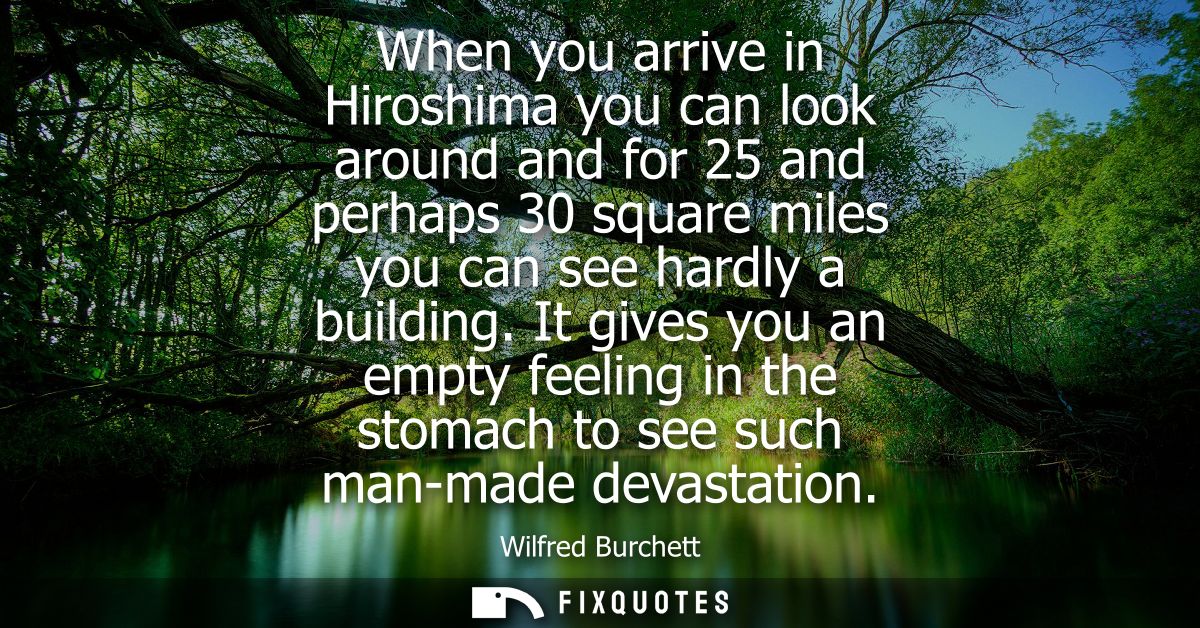
"When you arrive in Hiroshima, you can look around and for 25 and perhaps 30 square miles you can see hardly a building. It gives you an empty feeling in the stomach to see such man-made devastation"
About this Quote
The pivot to the body (“an empty feeling in the stomach”) is the line’s real intent. Burchett doesn’t ask for political agreement; he recruits a physical response. That nausea is a refusal of distance, the opposite of wartime language designed to keep consequences clean and far away. Calling it “man-made devastation” tightens the screw: this isn’t an earthquake, not fate, not “the fog of war.” It’s authored. The phrasing quietly indicts not only the bomb but the industrial competence that made such erasure possible.
Context matters: Burchett was among the first Western journalists to report from Hiroshima after the bombing, and his work collided with official narratives eager to treat the atomic strike as decisive, regrettable, and contained. This quote functions as counter-propaganda without sounding ideological. It’s reportage as moral leverage: a landscape so blank it produces a gut-level verdict before the reader can retreat into arguments about necessity.
Quote Details
| Topic | War |
|---|---|
| Source | Help us find the source |
| Cite |
Citation Formats
APA Style (7th ed.)
Burchett, Wilfred. (2026, February 16). When you arrive in Hiroshima, you can look around and for 25 and perhaps 30 square miles you can see hardly a building. It gives you an empty feeling in the stomach to see such man-made devastation. FixQuotes. https://fixquotes.com/quotes/when-you-arrive-in-hiroshima-you-can-look-around-108120/
Chicago Style
Burchett, Wilfred. "When you arrive in Hiroshima, you can look around and for 25 and perhaps 30 square miles you can see hardly a building. It gives you an empty feeling in the stomach to see such man-made devastation." FixQuotes. February 16, 2026. https://fixquotes.com/quotes/when-you-arrive-in-hiroshima-you-can-look-around-108120/.
MLA Style (9th ed.)
"When you arrive in Hiroshima, you can look around and for 25 and perhaps 30 square miles you can see hardly a building. It gives you an empty feeling in the stomach to see such man-made devastation." FixQuotes, 16 Feb. 2026, https://fixquotes.com/quotes/when-you-arrive-in-hiroshima-you-can-look-around-108120/. Accessed 7 Mar. 2026.