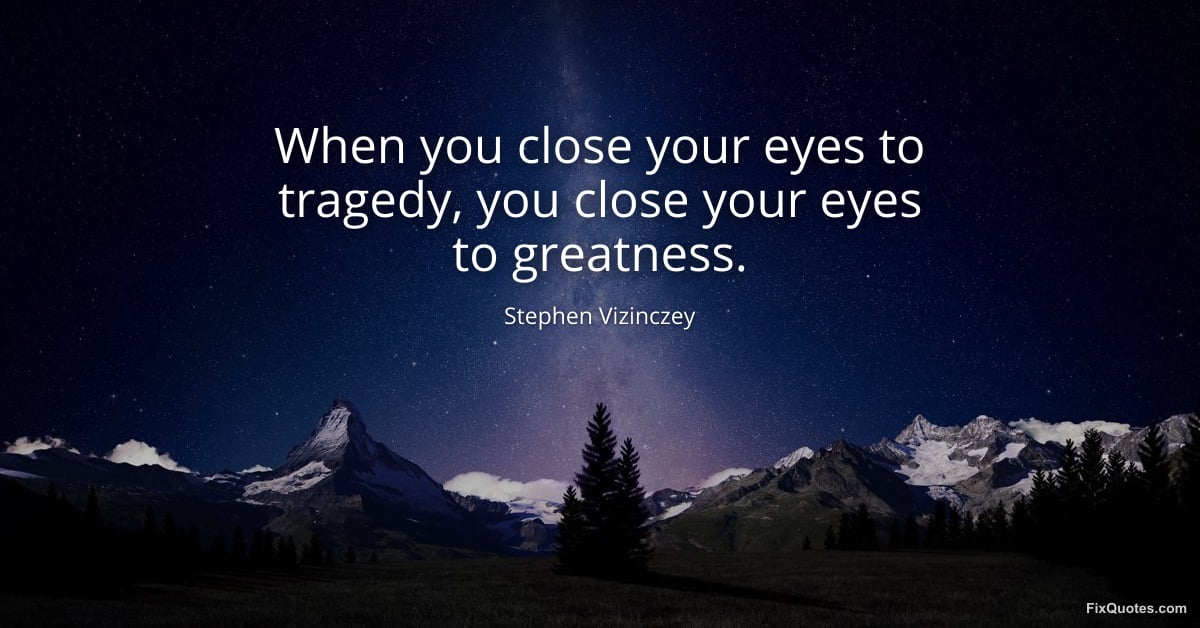
"When you close your eyes to tragedy, you close your eyes to greatness"
About this Quote
The intent is partly literary, partly civic. As a novelist and critic with a long view of European catastrophe and the 20th century’s ideological wreckage, he’s arguing for the necessity of dark knowledge: the stuff that makes art sharper and human beings less gullible. Tragedy isn’t just sorrow; it’s the revelation of limits - of character, of institutions, of fate. Greatness, in this framing, isn’t motivational-poster heroism. It’s the hard-earned scale of mind that comes from staring down what breaks people and still choosing to understand it.
The subtext is a rebuke to cultures of denial: the glossy optimism that treats suffering as a “downer,” the politics that asks citizens to look away from inconvenient deaths, the personal habit of curating a life free of discomfort. Vizinczey suggests that greatness has a cost: attention. Not voyeurism, not despair, but the disciplined willingness to witness. That’s why the line works - it makes avoidance feel like self-amputation, a closing of the eyes not only to pain, but to the full range of what human beings can be.
Quote Details
| Topic | Wisdom |
|---|---|
| Source | Help us find the source |
| Cite |
Citation Formats
APA Style (7th ed.)
Vizinczey, Stephen. (2026, January 16). When you close your eyes to tragedy, you close your eyes to greatness. FixQuotes. https://fixquotes.com/quotes/when-you-close-your-eyes-to-tragedy-you-close-124614/
Chicago Style
Vizinczey, Stephen. "When you close your eyes to tragedy, you close your eyes to greatness." FixQuotes. January 16, 2026. https://fixquotes.com/quotes/when-you-close-your-eyes-to-tragedy-you-close-124614/.
MLA Style (9th ed.)
"When you close your eyes to tragedy, you close your eyes to greatness." FixQuotes, 16 Jan. 2026, https://fixquotes.com/quotes/when-you-close-your-eyes-to-tragedy-you-close-124614/. Accessed 5 Apr. 2026.