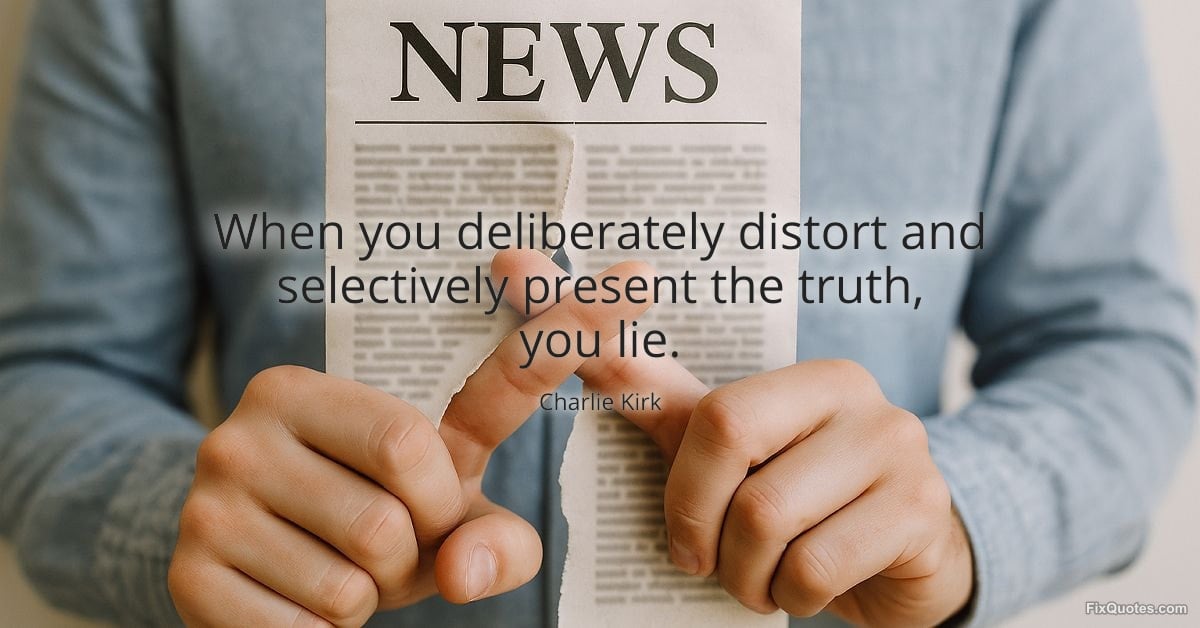
"When you deliberately distort and selectively present the truth, you lie"
About this Quote
The subtext is less about epistemology than about legitimacy. In an environment where everyone accuses everyone else of bad faith, this quote attempts to seize the ethical high ground by defining the offense in terms broad enough to indict a rival’s media ecosystem, but also slippery enough to weaponize. “Selectively present” describes nearly every political communication tactic, from campaign ads to cable-news chyrons to curated viral clips. That ambiguity is the point: it allows the speaker to brand opponents as liars while keeping one’s own selective storytelling safely inside the tent of “truth-telling.”
Context matters because this is the age of montage politics: chopped footage, screenshot “receipts,” and algorithmic outrage where omission can be more potent than fabrication. Kirk’s sentence functions as a preemptive rebuttal to fact-check culture too; it implies that being technically accurate can still be morally fraudulent. The rhetorical play is clean: it converts a debate over interpretation into a binary of honesty versus deceit, which is exactly how political language wins fights without resolving them.
Quote Details
| Topic | Honesty & Integrity |
|---|---|
| Source | Help us find the source |
| Cite |
Citation Formats
APA Style (7th ed.)
Kirk, Charlie. (2026, January 13). When you deliberately distort and selectively present the truth, you lie. FixQuotes. https://fixquotes.com/quotes/when-you-deliberately-distort-and-selectively-173182/
Chicago Style
Kirk, Charlie. "When you deliberately distort and selectively present the truth, you lie." FixQuotes. January 13, 2026. https://fixquotes.com/quotes/when-you-deliberately-distort-and-selectively-173182/.
MLA Style (9th ed.)
"When you deliberately distort and selectively present the truth, you lie." FixQuotes, 13 Jan. 2026, https://fixquotes.com/quotes/when-you-deliberately-distort-and-selectively-173182/. Accessed 6 Mar. 2026.