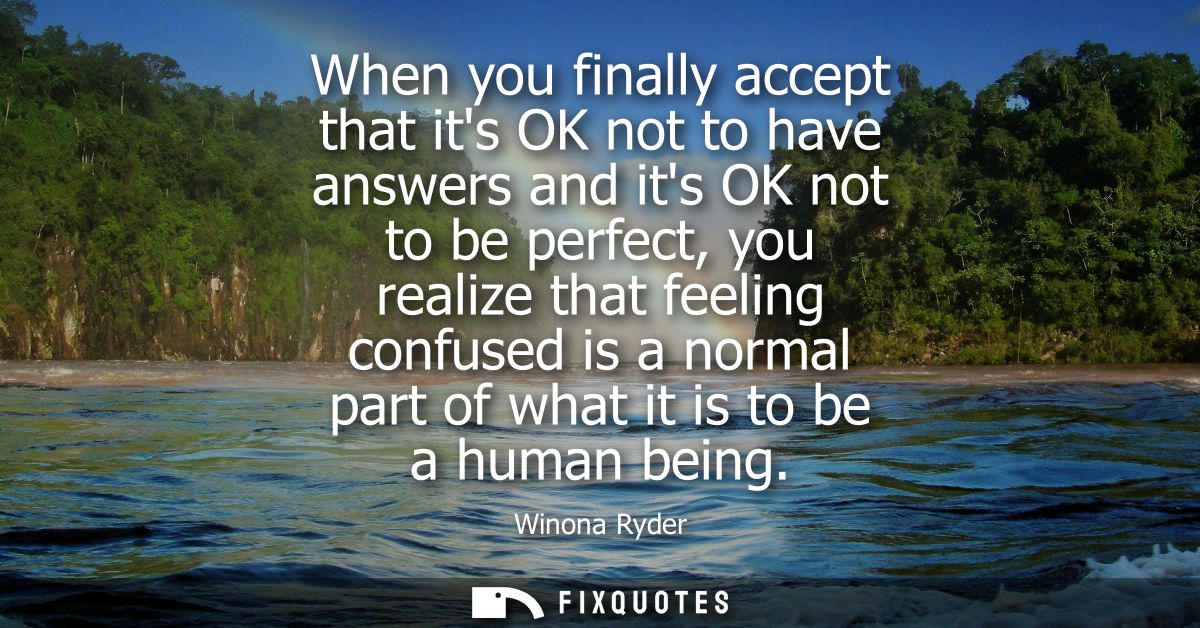
"When you finally accept that it's OK not to have answers and it's OK not to be perfect, you realize that feeling confused is a normal part of what it is to be a human being"
About this Quote
The subtext is especially potent coming from Ryder, whose public narrative has long been shaped by scrutiny: the early stardom, the tabloid microscope, the career dip, the high-profile comeback. When you’ve been turned into a symbol - of cool, of fragility, of scandal, of redemption - the insistence that confusion is normal reads like self-defense and cultural critique at once. It pushes back against the idea that adulthood should look like competence uninterrupted.
Structurally, the sentence mimics the emotional logic it describes. It meanders a little, repeats itself, circles toward clarity - performing the very confusion it’s trying to normalize. And the ending reframes confusion not as a temporary glitch but as a stable feature of being human. That’s why it works: it doesn’t promise a solution. It promises relief from the requirement to pretend you already have one.
Quote Details
| Topic | Self-Improvement |
|---|---|
| Source | Help us find the source |
| Cite |
Citation Formats
APA Style (7th ed.)
Ryder, Winona. (2026, January 16). When you finally accept that it's OK not to have answers and it's OK not to be perfect, you realize that feeling confused is a normal part of what it is to be a human being. FixQuotes. https://fixquotes.com/quotes/when-you-finally-accept-that-its-ok-not-to-have-84376/
Chicago Style
Ryder, Winona. "When you finally accept that it's OK not to have answers and it's OK not to be perfect, you realize that feeling confused is a normal part of what it is to be a human being." FixQuotes. January 16, 2026. https://fixquotes.com/quotes/when-you-finally-accept-that-its-ok-not-to-have-84376/.
MLA Style (9th ed.)
"When you finally accept that it's OK not to have answers and it's OK not to be perfect, you realize that feeling confused is a normal part of what it is to be a human being." FixQuotes, 16 Jan. 2026, https://fixquotes.com/quotes/when-you-finally-accept-that-its-ok-not-to-have-84376/. Accessed 9 Mar. 2026.