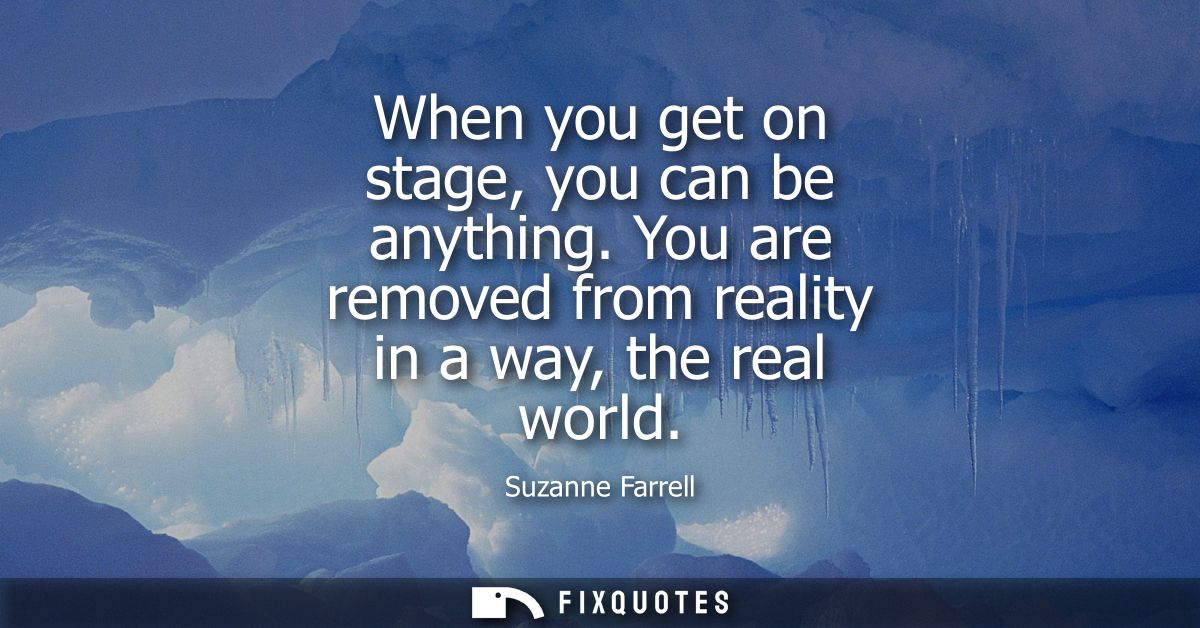
"When you get on stage, you can be anything. You are removed from reality in a way, the real world"
About this Quote
The wording is tellingly plain: "anything" is an audacious promise, then immediately qualified by "removed from reality", as if she knows the romantic myth can curdle into escapism. Farrell is pointing at a paradox dancers live with. Ballet is brutally material - soreness, repetition, gravity, aging - yet its cultural function is to look like transcendence. The stage is where the audience gets the illusion; the dancer gets the permission. Permission to inhabit roles, emotions, even archetypes that would feel theatrical or unsafe in ordinary life.
Context matters: Farrells career unfolded in an era when ballet demanded near-total devotion, often under charismatic (and controlling) male power. In that landscape, "removed from reality" reads as both refuge and strategy. Art becomes a kind of counter-sovereignty: the place where a dancer can author herself, even if the offstage world insists on hierarchy, decorum, and limits. The quote works because it captures that split-second alchemy - the body in full constraint, the self in brief expansion.
Quote Details
| Topic | Art |
|---|---|
| Source | Help us find the source |
| Cite |
Citation Formats
APA Style (7th ed.)
Farrell, Suzanne. (2026, January 17). When you get on stage, you can be anything. You are removed from reality in a way, the real world. FixQuotes. https://fixquotes.com/quotes/when-you-get-on-stage-you-can-be-anything-you-are-74012/
Chicago Style
Farrell, Suzanne. "When you get on stage, you can be anything. You are removed from reality in a way, the real world." FixQuotes. January 17, 2026. https://fixquotes.com/quotes/when-you-get-on-stage-you-can-be-anything-you-are-74012/.
MLA Style (9th ed.)
"When you get on stage, you can be anything. You are removed from reality in a way, the real world." FixQuotes, 17 Jan. 2026, https://fixquotes.com/quotes/when-you-get-on-stage-you-can-be-anything-you-are-74012/. Accessed 14 Mar. 2026.