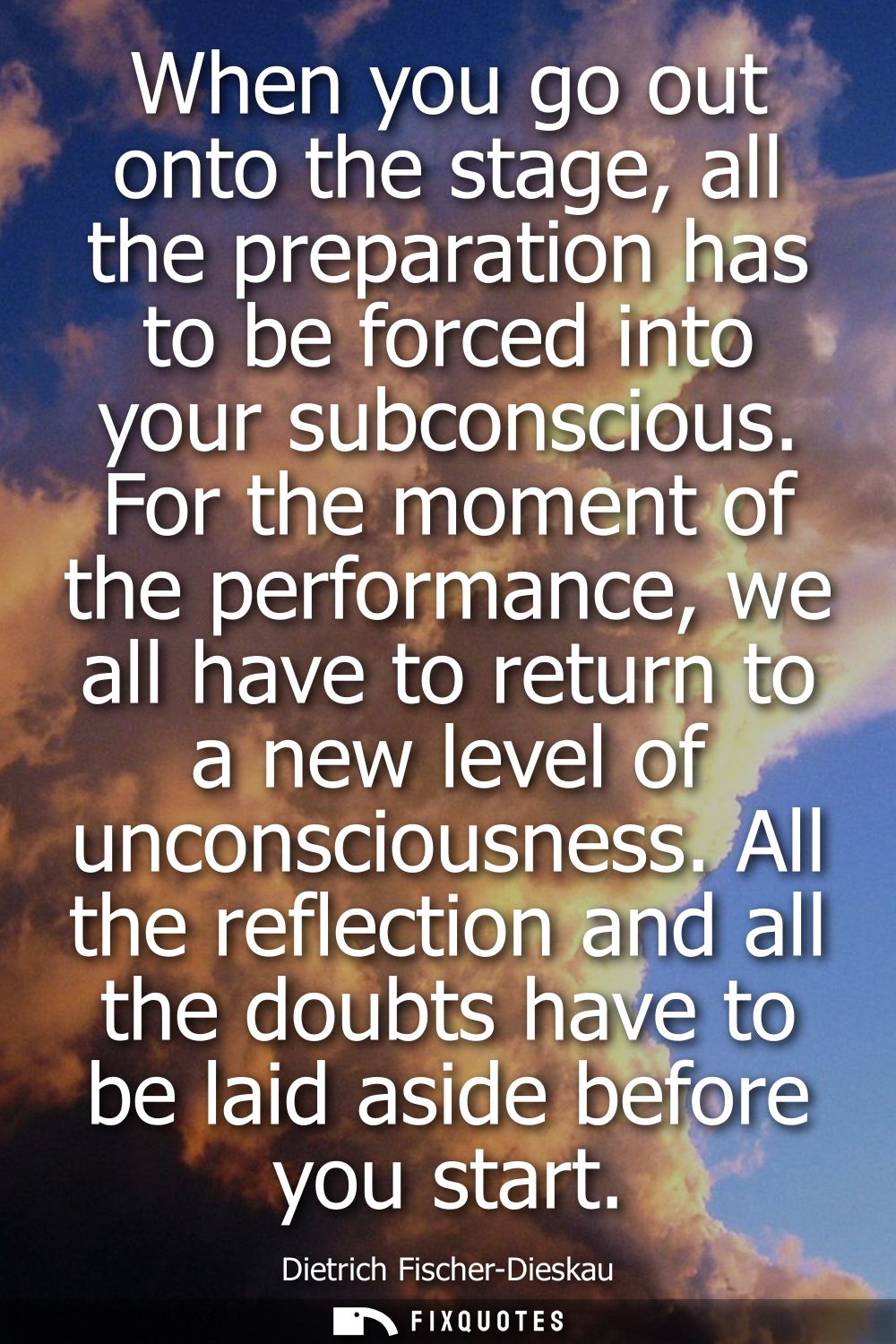
"When you go out onto the stage, all the preparation has to be forced into your subconscious. For the moment of the performance, we all have to return to a new level of unconsciousness. All the reflection and all the doubts have to be laid aside before you start"
About this Quote
Calling it “a new level of unconsciousness” is a sly rebuke to the romantic myth of inspiration arriving out of nowhere. This isn’t mystical trance; it’s engineered instinct. Fischer-Dieskau, famously meticulous about text, phrasing, and psychological detail in Lieder, is admitting that analysis has an expiration date. You interrogate Schubert in the practice room; you stop interrogating when the hall goes quiet. The singer who keeps checking their own work in real time turns art into a self-audit.
The subtext is about trust: trust in craft, in muscle memory, in the collaboration with pianist and composer, in the audience’s attention. It’s also about vulnerability. “Lay aside” reads like a ritual instruction, a way to step past self-consciousness and into presence. Coming from a musician shaped by postwar German culture, it carries a moral edge: seriousness matters, but the point of seriousness is freedom, not paralysis. The ultimate discipline is knowing when to stop controlling and start listening.
Quote Details
| Topic | Music |
|---|---|
| Source | Help us find the source |
| Cite |
Citation Formats
APA Style (7th ed.)
Fischer-Dieskau, Dietrich. (2026, January 17). When you go out onto the stage, all the preparation has to be forced into your subconscious. For the moment of the performance, we all have to return to a new level of unconsciousness. All the reflection and all the doubts have to be laid aside before you start. FixQuotes. https://fixquotes.com/quotes/when-you-go-out-onto-the-stage-all-the-72915/
Chicago Style
Fischer-Dieskau, Dietrich. "When you go out onto the stage, all the preparation has to be forced into your subconscious. For the moment of the performance, we all have to return to a new level of unconsciousness. All the reflection and all the doubts have to be laid aside before you start." FixQuotes. January 17, 2026. https://fixquotes.com/quotes/when-you-go-out-onto-the-stage-all-the-72915/.
MLA Style (9th ed.)
"When you go out onto the stage, all the preparation has to be forced into your subconscious. For the moment of the performance, we all have to return to a new level of unconsciousness. All the reflection and all the doubts have to be laid aside before you start." FixQuotes, 17 Jan. 2026, https://fixquotes.com/quotes/when-you-go-out-onto-the-stage-all-the-72915/. Accessed 31 Mar. 2026.