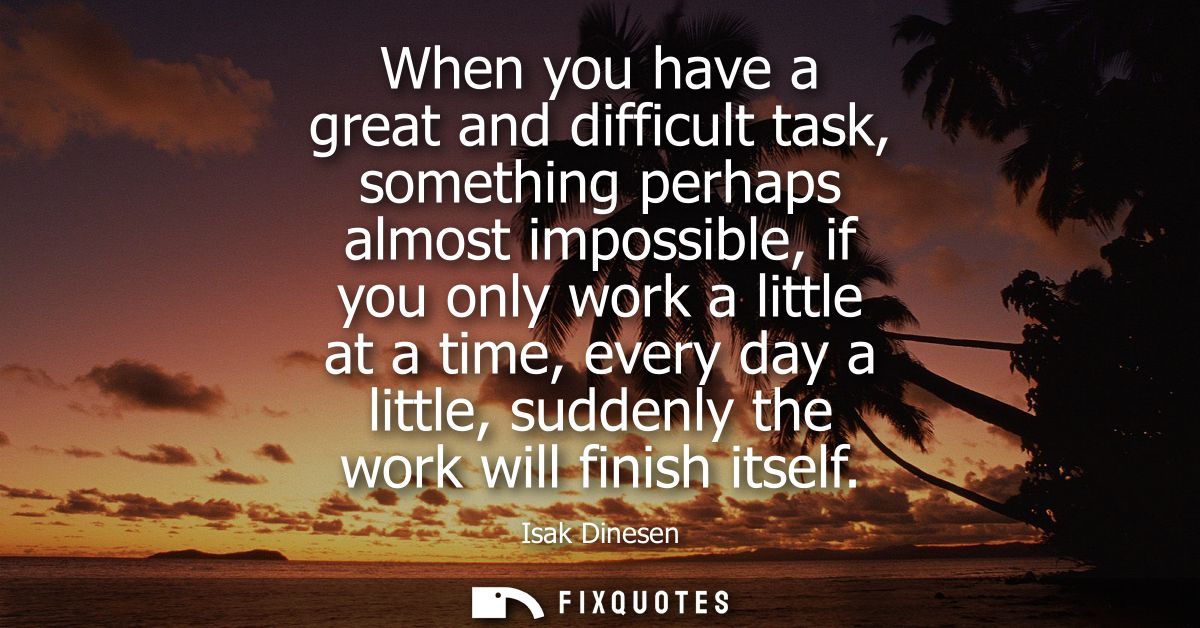
"When you have a great and difficult task, something perhaps almost impossible, if you only work a little at a time, every day a little, suddenly the work will finish itself"
About this Quote
The slyest move is the last clause, “suddenly the work will finish itself.” Of course it won’t. Work doesn’t self-complete; people complete it. The phrasing shifts credit away from the self and toward the process, as if daily effort becomes a kind of enchantment. Coming from a writer who built ornate narratives out of patience and revision, it reads less like productivity advice and more like a philosophy of artistry: the muse is not lightning, it’s accumulation. “Suddenly” captures the psychological trick of long projects: the end often arrives not as a triumphal march but as a surprise, because the real labor happened offstage in small, forgettable sessions.
Context matters, too. Dinesen’s life included illness, displacement, and the long afterlife of experience turned into literature. The quote carries that hard-earned pragmatism: when circumstances make the “impossible” feel constant, you don’t conquer it in one blow. You outlast it by routine.
Quote Details
| Topic | Perseverance |
|---|---|
| Source | Help us find the source |
| Cite |
Citation Formats
APA Style (7th ed.)
Dinesen, Isak. (2026, January 17). When you have a great and difficult task, something perhaps almost impossible, if you only work a little at a time, every day a little, suddenly the work will finish itself. FixQuotes. https://fixquotes.com/quotes/when-you-have-a-great-and-difficult-task-54806/
Chicago Style
Dinesen, Isak. "When you have a great and difficult task, something perhaps almost impossible, if you only work a little at a time, every day a little, suddenly the work will finish itself." FixQuotes. January 17, 2026. https://fixquotes.com/quotes/when-you-have-a-great-and-difficult-task-54806/.
MLA Style (9th ed.)
"When you have a great and difficult task, something perhaps almost impossible, if you only work a little at a time, every day a little, suddenly the work will finish itself." FixQuotes, 17 Jan. 2026, https://fixquotes.com/quotes/when-you-have-a-great-and-difficult-task-54806/. Accessed 25 Mar. 2026.