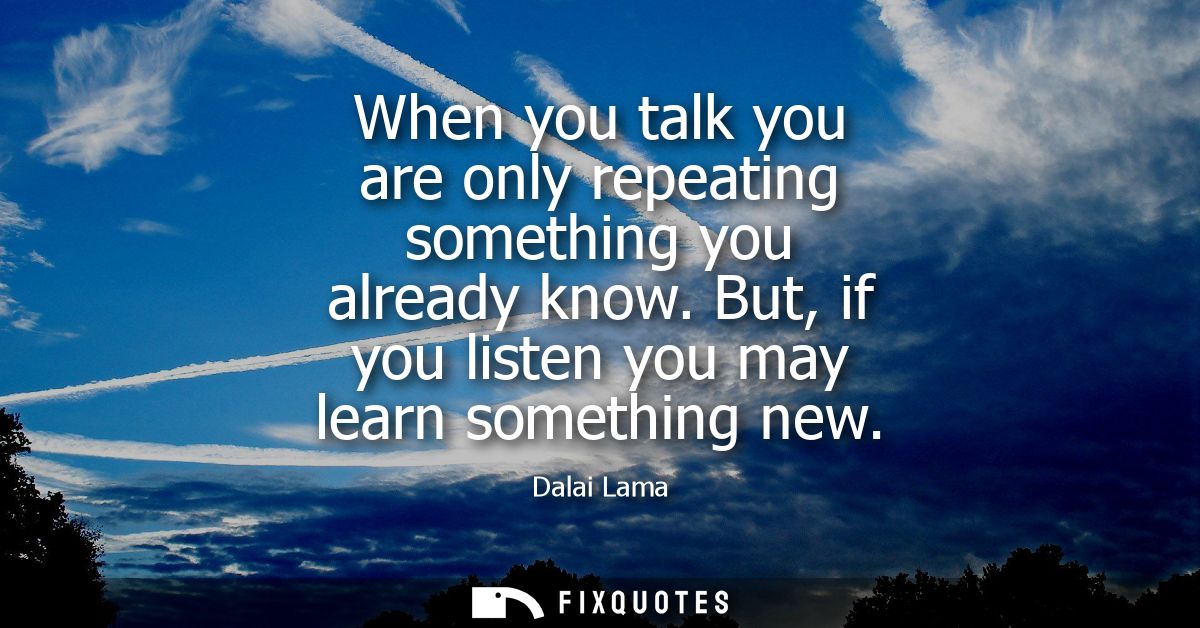
"When you talk you are only repeating something you already know. But, if you listen you may learn something new"
About this Quote
There is a gentle trap hidden in the Dalai Lama's calm phrasing: it flatters you into thinking this is simple etiquette, then pivots into an argument about power. Talking, he suggests, is mostly self-confirmation - a way to rehearse your existing story, polish your identity, keep the room orbiting around you. Listening, by contrast, is pitched not as politeness but as risk: you cede control of the narrative long enough for reality, or another person, to change you.
The line works because it reframes silence as agency. In a culture that treats speaking up as moral proof and personal branding as a survival skill, the Dalai Lama reverses the hierarchy. The subtext is Buddhist practice made portable: the ego is loud, and it is rarely curious. Listening becomes a form of humility with teeth, a disciplined refusal to let the self be the loudest authority in the room.
Context matters. As a spiritual and political leader shaped by exile, diplomacy, and asymmetrical power, the Dalai Lama has lived in situations where speech can harden positions while listening can keep channels open. Read that way, the quote isn't anti-speech; it's anti-reflex. It asks you to notice how often conversation is performance, not inquiry - and how learning requires the uncomfortable admission that you might be wrong, or at least incomplete.
The line works because it reframes silence as agency. In a culture that treats speaking up as moral proof and personal branding as a survival skill, the Dalai Lama reverses the hierarchy. The subtext is Buddhist practice made portable: the ego is loud, and it is rarely curious. Listening becomes a form of humility with teeth, a disciplined refusal to let the self be the loudest authority in the room.
Context matters. As a spiritual and political leader shaped by exile, diplomacy, and asymmetrical power, the Dalai Lama has lived in situations where speech can harden positions while listening can keep channels open. Read that way, the quote isn't anti-speech; it's anti-reflex. It asks you to notice how often conversation is performance, not inquiry - and how learning requires the uncomfortable admission that you might be wrong, or at least incomplete.
Quote Details
| Topic | Wisdom |
|---|---|
| Source | Attributed to the 14th Dalai Lama; commonly cited on Dalai Lama quote compilations (see Wikiquote entry). |
More Quotes by Dalai
Add to List