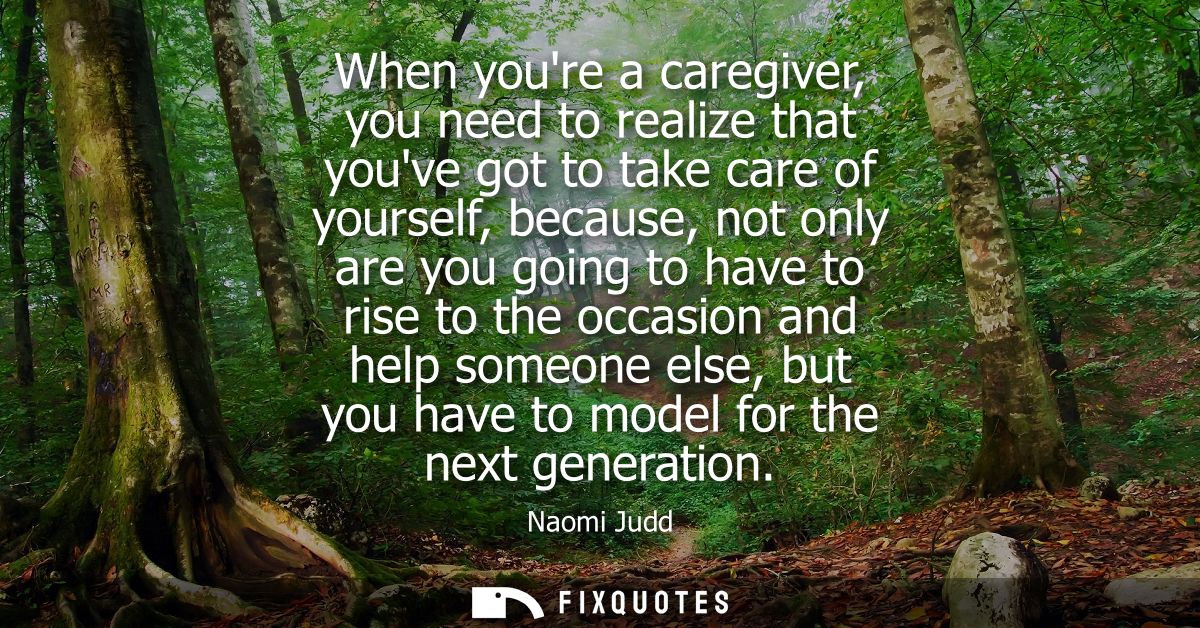
"When you're a caregiver, you need to realize that you've got to take care of yourself because not only are you going to have to rise to the occasion and help someone else, but you have to model for the next generation"
About this Quote
That last clause is the real engine. “Model for the next generation” reframes self-care from an individual luxury into an ethical practice with consequences. It’s a quiet indictment of families (and especially women) taught to disappear into service. If the next generation sees caregiving as self-erasure, they inherit a cycle where devotion is measured by depletion.
Coming from Judd, a musician whose public life was braided with family, fame, and widely reported struggles with health and depression, the quote carries lived texture. She’s speaking from a culture that applauds caretakers only when they’re breaking. The intent isn’t to sell “me time,” but to legitimize boundaries as part of the job. The subtext: care that costs you your body, mind, or identity doesn’t stay noble for long; it becomes unstable, resentful, and ultimately unsustainable.
Quote Details
| Topic | Self-Care |
|---|---|
| Source | Help us find the source |
| Cite |
Citation Formats
APA Style (7th ed.)
Judd, Naomi. (2026, February 16). When you're a caregiver, you need to realize that you've got to take care of yourself because not only are you going to have to rise to the occasion and help someone else, but you have to model for the next generation. FixQuotes. https://fixquotes.com/quotes/when-youre-a-caregiver-you-need-to-realize-that-114796/
Chicago Style
Judd, Naomi. "When you're a caregiver, you need to realize that you've got to take care of yourself because not only are you going to have to rise to the occasion and help someone else, but you have to model for the next generation." FixQuotes. February 16, 2026. https://fixquotes.com/quotes/when-youre-a-caregiver-you-need-to-realize-that-114796/.
MLA Style (9th ed.)
"When you're a caregiver, you need to realize that you've got to take care of yourself because not only are you going to have to rise to the occasion and help someone else, but you have to model for the next generation." FixQuotes, 16 Feb. 2026, https://fixquotes.com/quotes/when-youre-a-caregiver-you-need-to-realize-that-114796/. Accessed 6 Apr. 2026.