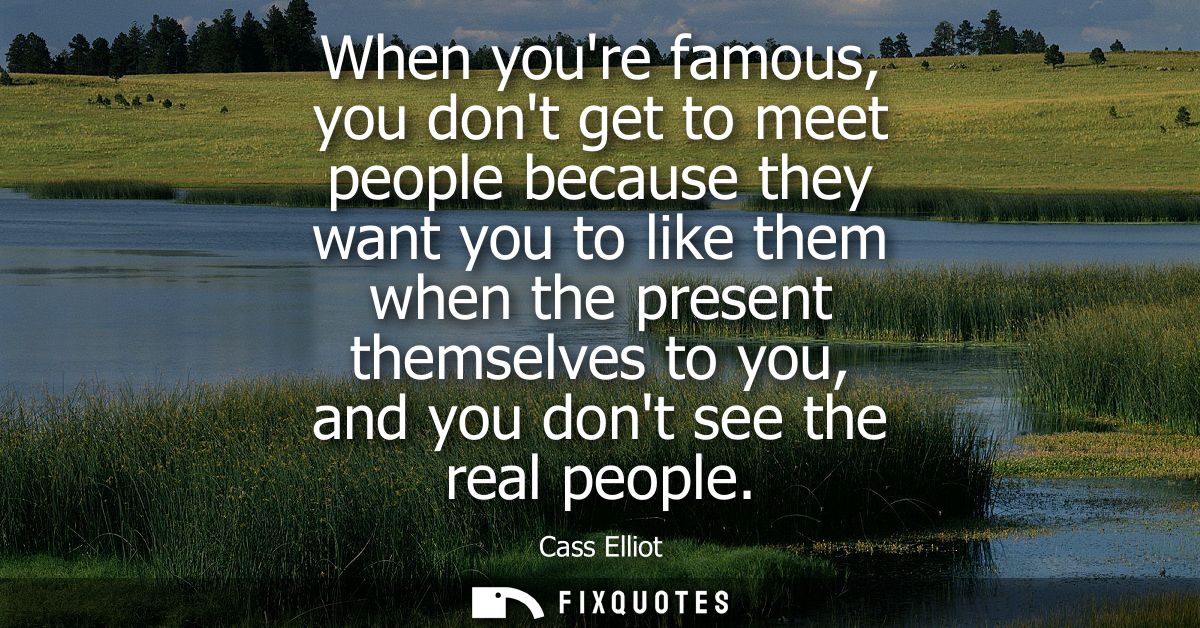
"When you're famous, you don't get to meet people because they want you to like them when the present themselves to you, and you don't see the real people"
About this Quote
The subtext is lonelier than it first sounds. Elliot isn’t bragging about access or complaining about fans; she’s describing how celebrity warps trust. If everyone arrives with a carefully arranged version of themselves, the famous person can’t calibrate reality. Flattery becomes suspicious, friendliness becomes strategy, even kindness can feel like a means to an end. The “real people” disappear not because they’re fake, but because the situation incentivizes self-editing.
Context matters: Elliot was a major voice in the 1960s pop machine, a woman navigating relentless public commentary about image, body, and persona. That era’s fame was newly mass-mediated - TV, glossy magazines, constant branding - but without today’s language for boundaries or parasocial dynamics. Her line reads like an early diagnosis of what we now call authenticity fatigue: the sense that celebrity turns every room into a mirror, and every stranger into someone trying to control what the mirror reflects.
Quote Details
| Topic | Fake Friends |
|---|---|
| Source | Help us find the source |
| Cite |
Citation Formats
APA Style (7th ed.)
Elliot, Cass. (2026, January 17). When you're famous, you don't get to meet people because they want you to like them when the present themselves to you, and you don't see the real people. FixQuotes. https://fixquotes.com/quotes/when-youre-famous-you-dont-get-to-meet-people-45859/
Chicago Style
Elliot, Cass. "When you're famous, you don't get to meet people because they want you to like them when the present themselves to you, and you don't see the real people." FixQuotes. January 17, 2026. https://fixquotes.com/quotes/when-youre-famous-you-dont-get-to-meet-people-45859/.
MLA Style (9th ed.)
"When you're famous, you don't get to meet people because they want you to like them when the present themselves to you, and you don't see the real people." FixQuotes, 17 Jan. 2026, https://fixquotes.com/quotes/when-youre-famous-you-dont-get-to-meet-people-45859/. Accessed 10 Mar. 2026.