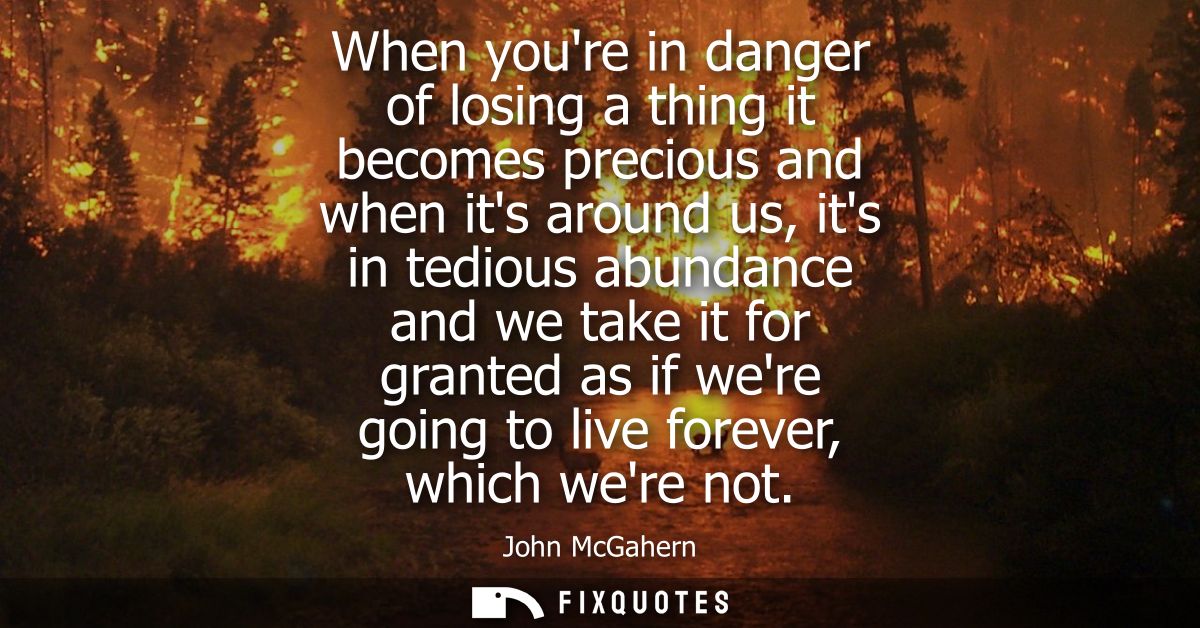
"When you're in danger of losing a thing it becomes precious and when it's around us, it's in tedious abundance and we take it for granted as if we're going to live forever, which we're not"
About this Quote
The subtext is less “appreciate what you have” than “your sense of reality is crooked.” When life feels stable, we don’t simply relax; we misread stability as permanence. “Tedious abundance” is especially telling: abundance isn’t framed as generosity but as deadening noise, the everyday piled so high it becomes invisible. McGahern is attentive to the way repetition corrodes attention, how the familiar turns into a kind of background hum we stop hearing until the power cuts out.
Context matters with McGahern. As a writer steeped in Irish rural life, family authority, and the slow pressures of time, he often shows how ordinary routines carry existential stakes. The sentence’s long, breathless structure mimics that drift into assumption - one clause sliding into the next the way days do, until the final corrective lands: “which we’re not.” No fireworks, just a blunt memento mori. The intent isn’t to scare; it’s to snap the reader out of the delusion that tomorrow is guaranteed, and to expose how our neglect is less moral failure than a built-in feature of being human.
Quote Details
| Topic | Mortality |
|---|---|
| Source | Help us find the source |
| Cite |
Citation Formats
APA Style (7th ed.)
McGahern, John. (2026, January 16). When you're in danger of losing a thing it becomes precious and when it's around us, it's in tedious abundance and we take it for granted as if we're going to live forever, which we're not. FixQuotes. https://fixquotes.com/quotes/when-youre-in-danger-of-losing-a-thing-it-becomes-114176/
Chicago Style
McGahern, John. "When you're in danger of losing a thing it becomes precious and when it's around us, it's in tedious abundance and we take it for granted as if we're going to live forever, which we're not." FixQuotes. January 16, 2026. https://fixquotes.com/quotes/when-youre-in-danger-of-losing-a-thing-it-becomes-114176/.
MLA Style (9th ed.)
"When you're in danger of losing a thing it becomes precious and when it's around us, it's in tedious abundance and we take it for granted as if we're going to live forever, which we're not." FixQuotes, 16 Jan. 2026, https://fixquotes.com/quotes/when-youre-in-danger-of-losing-a-thing-it-becomes-114176/. Accessed 12 Feb. 2026.