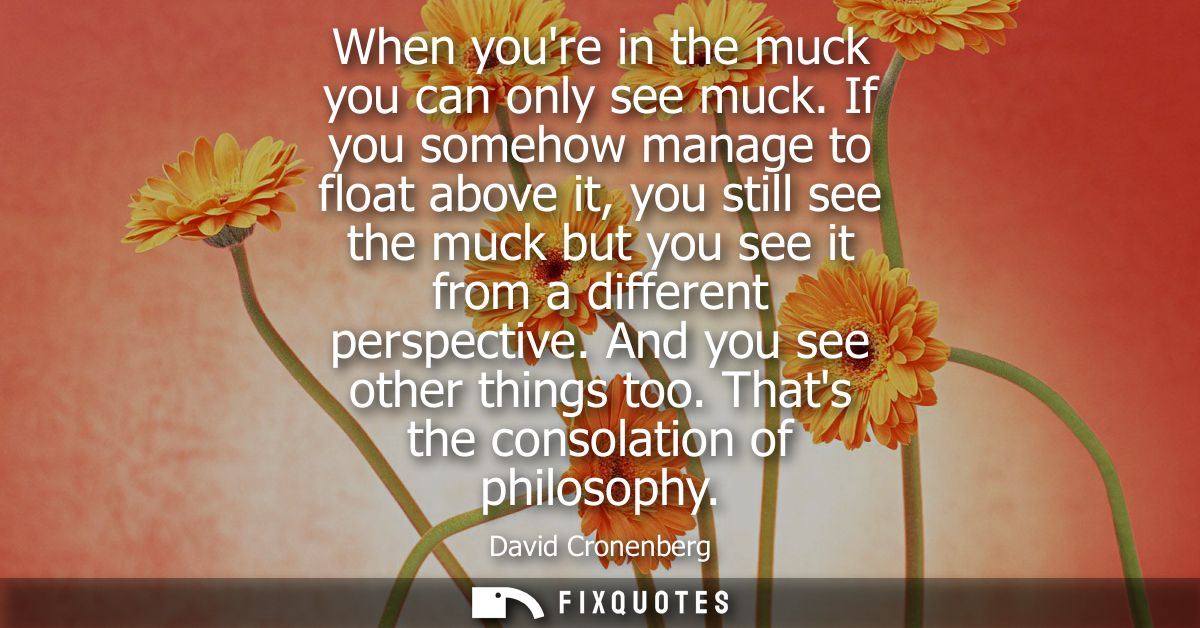
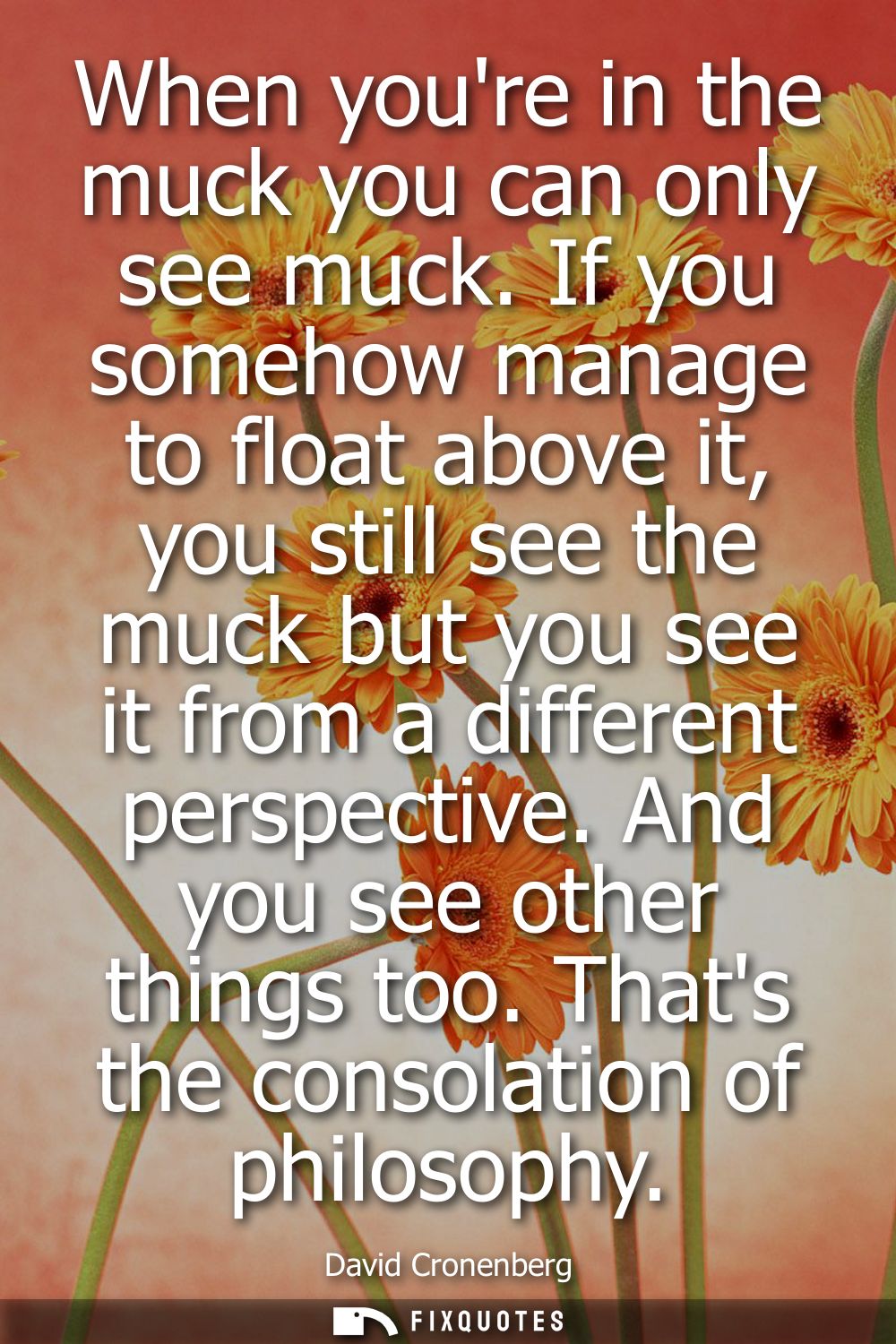
"When you're in the muck you can only see muck. If you somehow manage to float above it, you still see the muck but you see it from a different perspective. And you see other things too. That's the consolation of philosophy"
About this Quote
The sly move is that “floating above it” doesn’t clean anything up. You still see the muck. Philosophy doesn’t disinfect; it reframes. That’s the line between denial and distance. His perspective shift is less about escape than about regaining range: the ability to register more than the problem, more than the body, more than the crisis. The consolation isn’t optimism; it’s expanded bandwidth.
Coming from a director whose films anatomize the anxiety of flesh, technology, sex, and contagion, the quote reads like a manifesto for making art out of nausea. Cronenberg’s characters rarely transcend their conditions; they mutate with them. So “philosophy” here feels less like academic system-building than a practiced, almost clinical detachment - the camera’s eye. It’s the tool that lets you look at horror without being fully swallowed by it, to see structure in the mess: motives, patterns, consequences, absurdity.
Subtext: wisdom doesn’t redeem suffering, but it can prevent suffering from becoming the only story you’re capable of telling. That’s a bleak comfort, and a real one.
Quote Details
| Topic | Wisdom |
|---|---|
| Source | Help us find the source |
| Cite |
Citation Formats
APA Style (7th ed.)
Cronenberg, David. (2026, January 17). When you're in the muck you can only see muck. If you somehow manage to float above it, you still see the muck but you see it from a different perspective. And you see other things too. That's the consolation of philosophy. FixQuotes. https://fixquotes.com/quotes/when-youre-in-the-muck-you-can-only-see-muck-if-48326/
Chicago Style
Cronenberg, David. "When you're in the muck you can only see muck. If you somehow manage to float above it, you still see the muck but you see it from a different perspective. And you see other things too. That's the consolation of philosophy." FixQuotes. January 17, 2026. https://fixquotes.com/quotes/when-youre-in-the-muck-you-can-only-see-muck-if-48326/.
MLA Style (9th ed.)
"When you're in the muck you can only see muck. If you somehow manage to float above it, you still see the muck but you see it from a different perspective. And you see other things too. That's the consolation of philosophy." FixQuotes, 17 Jan. 2026, https://fixquotes.com/quotes/when-youre-in-the-muck-you-can-only-see-muck-if-48326/. Accessed 30 Mar. 2026.