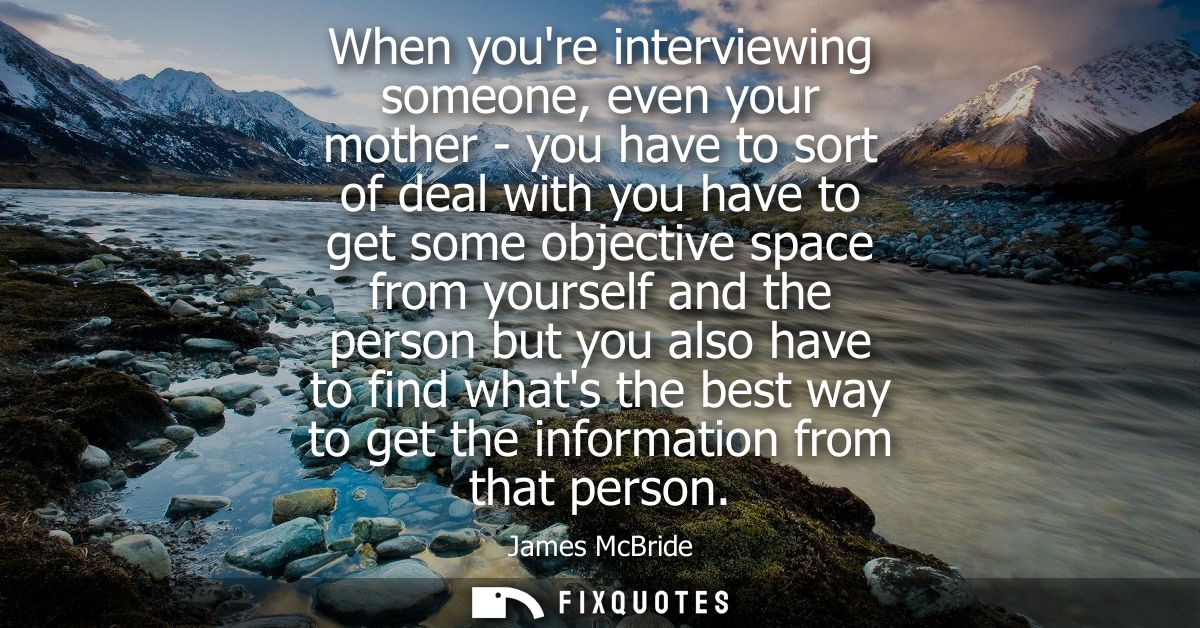
"When you're interviewing someone, even your mother - you have to sort of deal with: you have to get some objective space from yourself and the person, but you also have to find what's the best way to get the information from that person"
About this Quote
The subtext is that interviews are negotiations, not confessions. “Objective space” sounds clinical, but McBride immediately undercuts any fantasy of detachment by pivoting to strategy: “the best way to get the information.” That phrasing admits an uncomfortable truth about reporting and storytelling: information is often coaxed out, not simply offered up, and the interviewer’s job includes reading temperament, fear, pride, and silence. There’s an ethical tension humming underneath: seeking truth without turning the conversation into extraction.
Contextually, this fits McBride’s larger project as a writer who moves between memoir, biography, and fiction with a reporter’s ear. His work often depends on people whose lives have been misheard or flattened. The quote reads like field advice, but it’s also a credo: respect the person enough to step back from your own needs, then respect the truth enough to ask in the way it can actually be spoken.
Quote Details
| Topic | Learning |
|---|---|
| Source | Help us find the source |
| Cite |
Citation Formats
APA Style (7th ed.)
McBride, James. (2026, February 16). When you're interviewing someone, even your mother - you have to sort of deal with: you have to get some objective space from yourself and the person, but you also have to find what's the best way to get the information from that person. FixQuotes. https://fixquotes.com/quotes/when-youre-interviewing-someone-even-your-mother-161374/
Chicago Style
McBride, James. "When you're interviewing someone, even your mother - you have to sort of deal with: you have to get some objective space from yourself and the person, but you also have to find what's the best way to get the information from that person." FixQuotes. February 16, 2026. https://fixquotes.com/quotes/when-youre-interviewing-someone-even-your-mother-161374/.
MLA Style (9th ed.)
"When you're interviewing someone, even your mother - you have to sort of deal with: you have to get some objective space from yourself and the person, but you also have to find what's the best way to get the information from that person." FixQuotes, 16 Feb. 2026, https://fixquotes.com/quotes/when-youre-interviewing-someone-even-your-mother-161374/. Accessed 26 Mar. 2026.