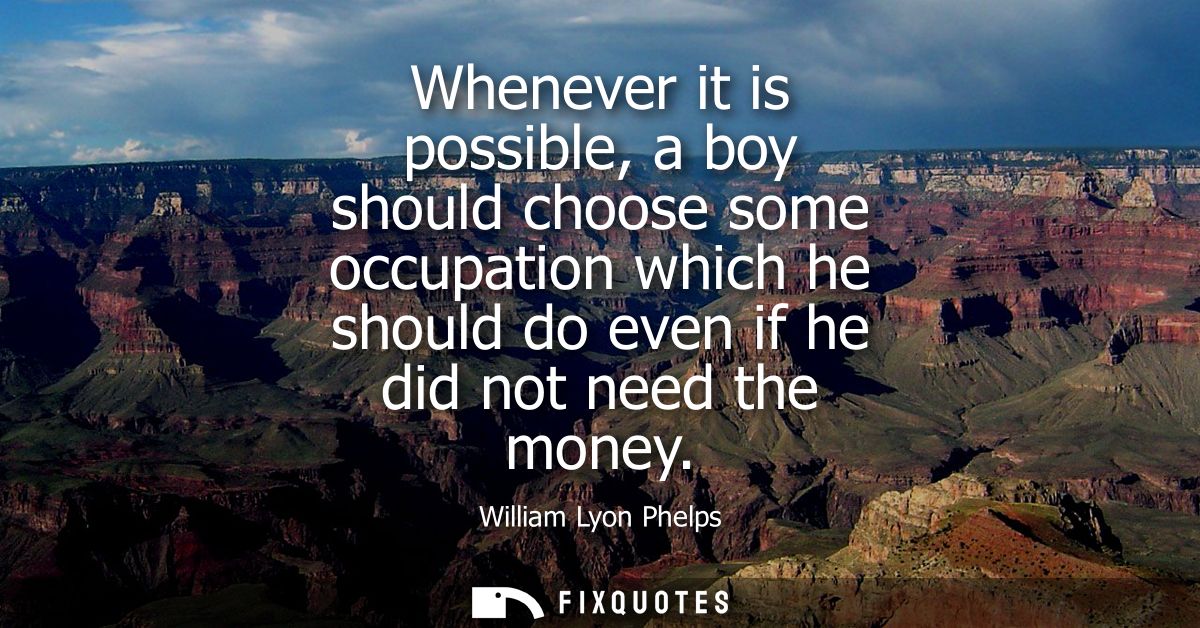
"Whenever it is possible, a boy should choose some occupation which he should do even if he did not need the money"
About this Quote
The key phrase is “whenever it is possible,” a quiet admission of class reality. Phelps isn’t speaking to boys hauling coal or stitching garments; he’s addressing those with at least a little margin. The subtext is both compassionate and exclusionary: if you have options, you’re morally obligated to use them wisely, not just profitably. Choosing work you’d do without the paycheck becomes a test of character, not merely taste.
There’s also a rhetorical sleight of hand in “occupation.” It suggests more than a job title; it’s what occupies the mind. Phelps wants labor to be inwardly organized around interest and purpose, because that kind of engagement produces not only happier workers but better citizens - people less easily bought, less easily bored, less easily bent by trends.
Read today, the line lands as a rebuke to hustle culture and a reminder of its blind spot. Meaningful work is a privilege when rent is due; Phelps knows it, then brackets it. That bracket is the whole debate.
Quote Details
| Topic | Work Ethic |
|---|---|
| Source | Help us find the source |
| Cite |
Citation Formats
APA Style (7th ed.)
Phelps, William Lyon. (2026, January 17). Whenever it is possible, a boy should choose some occupation which he should do even if he did not need the money. FixQuotes. https://fixquotes.com/quotes/whenever-it-is-possible-a-boy-should-choose-some-76974/
Chicago Style
Phelps, William Lyon. "Whenever it is possible, a boy should choose some occupation which he should do even if he did not need the money." FixQuotes. January 17, 2026. https://fixquotes.com/quotes/whenever-it-is-possible-a-boy-should-choose-some-76974/.
MLA Style (9th ed.)
"Whenever it is possible, a boy should choose some occupation which he should do even if he did not need the money." FixQuotes, 17 Jan. 2026, https://fixquotes.com/quotes/whenever-it-is-possible-a-boy-should-choose-some-76974/. Accessed 29 Mar. 2026.